
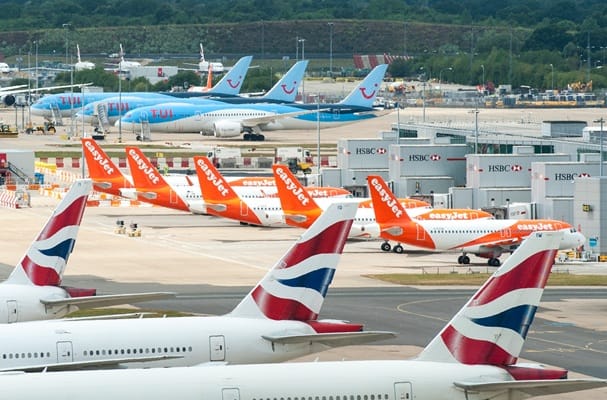
Thousands of British travellers remained stranded at airports across Europe on Wednesday as airlines struggled to restore normal operations following a technical failure in the UK’s air traffic control system.
More than 1,000 flights were cancelled on Tuesday after what National Air Traffic Services (Nats) described as a “system error”, grounding aircraft and triggering disruption across Britain’s aviation network.
A further estimated 300 flights were cancelled on Wednesday morning as airlines attempted to reposition aircraft and crews, with the disruption expected to continue into Thursday.
Passengers were forced to spend the night in airport terminals across Britain and Europe, with footage showing travellers sleeping on floors and camp beds. Some airports provided stranded passengers with towels, food and drinks as they waited for replacement flights.
The disruption is estimated to have cost the aviation industry about £100mn, intensifying pressure on Nats and its chief executive Martin Rolfe.
Mr Rolfe is due to speak with the Transport Secretary on Wednesday as ministers seek an explanation for the latest failure at the operator of one of Britain’s most critical pieces of national infrastructure.
Airlines demand accountability
The incident has revived questions over the resilience of the UK’s air traffic control network, particularly after a major systems failure in August 2023 disrupted more than 700,000 passengers.
Ryanair and other airlines have called for Mr Rolfe to resign, arguing that Nats has failed to invest sufficiently in preventing a repeat of previous failures.
Neal McMahon, Ryanair’s chief operating officer, told LBC: “Martin Rolfe should go meet the Transport Secretary this afternoon and resign. He has presided over a pattern of failures.”
🚨🇬🇧 Meanwhile at the UK’s Largest Airports
“We’ve waited 5 hours – can we at least not get a drink of Water?”
Absolute Chaos at ALL of Britains Major Airports as hundreds of Flights are cancelled due to technical disruptions.
This is Heathrow & Gatwick – Britains 2 biggest… pic.twitter.com/Wbk171DpOh
— Concerned Citizen (@BGatesIsaPyscho) September 9, 2026
He said the latest incident demonstrated that Nats had failed to improve the resilience of its systems despite assurances following the 2023 disruption.
McMahon said the failure would cost Ryanair “millions and millions” of pounds.
“This is a UK problem. We see nothing similar across Europe at the scale of the NATS failures we’ve seen.”
More than 200 Ryanair flights had been cancelled, according to McMahon, leaving thousands of passengers disrupted and airlines facing additional costs for accommodation, rebooking and compensation.
He argued that Nats should reimburse carriers for the financial damage caused by the outage, accusing the organisation of escaping meaningful financial consequences under the existing regulatory regime.
The airline said separately that more than 65,000 of its passengers had been affected and that it had cancelled more than 50 scheduled flights.
British Airways said it had cancelled or diverted more than 100 flights on Tuesday, affecting “tens of thousands of customers”.
Passengers face days of disruption
The operational consequences of the outage have extended well beyond the period in which Nats’ systems were affected.
One British traveller stranded at Frankfurt Airport told LBC that airport staff had distributed camp beds, towels and chocolate to passengers, while lights were dimmed in areas where travellers were attempting to sleep.
Another passenger attempting to return from Ibiza said her Tuesday flight had been cancelled and that British Airways initially offered her the next available flight on Friday.
She eventually changed airlines and secured an alternative service to Bournemouth, due to depart on Wednesday.
Heathrow said flights were operating on Wednesday but warned that disruption would continue as airlines repositioned aircraft and crews.
@British_Airways Heathrow is a complete mess. Hordes of angry people in a mob. We need help! pic.twitter.com/n2NEhewCQO
— Evan Dalton (@daltone1) September 8, 2026
“Following yesterday’s NATS technical issue, flights are operating today, but some disruption may continue as airlines reposition aircraft and crew,” Heathrow Airport said.
The airport urged passengers to check their flight status before travelling.
“Please check your flight status with your airline before travelling to the airport and only travel if your flight is confirmed to be operating.
“We apologise to those affected and have extra colleagues across our terminals to support passengers while we work with NATS and airline partners to restore normal operations as quickly as possible.”
According to FlightRadar data, 246 flights had been cancelled at Heathrow by 6am on Wednesday, while Gatwick recorded 33 cancellations.
Heathrow had cancelled all inbound flights on Tuesday evening, while other major UK airports only began to resume more normal operations later that night.
Government demands explanation
The political pressure on Nats increased after Foreign Secretary Ed Miliband said the Transport Secretary would demand answers from the organisation’s management.
Mr Miliband told LBC’s Nick Ferrari: “Well, first of all, I want to apologise to your listeners and others who have faced this terrible disruption, Nick. This should not be happening. It should not happen again.”
He said: “Heidi Alexander will be calling in the head of NATS this morning to demand an explanation of what happened and what steps NATS are taking to prevent this kind of thing happening.”
Adding: “We need our airports running. We need our aeroplanes running normally. We can’t have this happening.”
Mayhem at Heathrow staff overwhelmed passengers confused and bewildered. I was held on a plane for 8 hours on the tarmac I wake this morning totally stunned by the experience #heathrow pic.twitter.com/KTiiIn2nKW
— Nick Marr | Real Estate Pioneer (@NickCMarr) September 9, 2026
Nats said its technical problem had been resolved by 7.30pm on Tuesday, although it acknowledged that recovery across the aviation network had taken longer than expected.
The organisation, which provides air traffic control services to 15 UK airports, said the effects of the outage would continue after the underlying systems issue had been fixed.
Nats chief resists calls to resign
Mr Rolfe has so far resisted calls to resign, saying his immediate priority was restoring normal operations.
Asked whether he was considering his position, the Nats chief executive said he “always accept(s) full responsibility”.
He said: “I am the CEO of a piece of critical infrastructure, so it is my job to take responsibility for that.
“What I absolutely take responsibility for is keeping people safe and delivering the best service we possibly can on a day like today.
“You will understand my focus is entirely about how we actually resolve this issue, get things back to normal, help our airlines, our airport customers and the travelling public.”
His position has nevertheless come under increasing pressure from airlines.
#Heathrow airport News:
UK's Major airports including Heathrow, Gatwick, remain distributed due to a technical failure.
More than 1,000 flights were cancelled during Tuesday's disruption, according to flight-tracking data.#flight #britain pic.twitter.com/58rnqlyAhU
— Ravinder Singh (@ravindraJourno) September 9, 2026
Ryanair’s McMahon said: “How many more failures do passengers have to suffer before overpaid failure Nats CEO Martin Rolfe accepts responsibility for his repeated mismanagement and resigns?
“Over three years after Nats’ catastrophic 2023 system meltdown, it’s clear that nothing has changed, with UK passengers once again suffering avoidable ATC (air traffic control) delays of up to eight hours today due to a critical Nats ATC system failing.”
The latest outage has raised broader concerns about the resilience of Britain’s aviation infrastructure at a time when airlines are operating close to capacity.
While the immediate technical fault has been resolved, the disruption illustrates how quickly problems at a centralised air traffic control system can cascade through the wider European aviation network.
For ministers, airlines and passengers, the central question is now whether the latest failure represents an isolated technical incident or evidence of deeper weaknesses in a system that has suffered several major disruptions in recent years.


Leave a Comment