
Donald Trump has dismissed concerns that Vladimir Putin could launch an attack on NATO, saying he is “not concerned… at all” about the prospect despite growing warnings in Washington and European capitals over Russia’s intentions.
The US president said he did not believe Moscow would attack NATO territory, playing down fears that Russia could seek to test the alliance’s collective defence commitments through a limited military operation or hybrid assault.
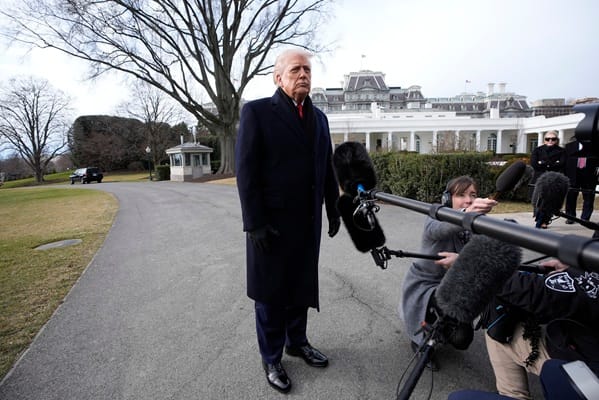
Speaking to reporters at the White House, Mr Trump said he had held “good talks” with Mr Putin and was confident the Russian president would not attack a NATO member.
“He’s not going to be attacking a NATO territory.”
Asked directly whether he was worried about the possibility of Russia attacking a NATO country, Mr Trump replied: “I am not concerned… at all. There is no problem.”
His comments come amid heightened scrutiny of Russia’s intentions and following a rare visit to Moscow by CIA Director John Ratcliffe earlier this week.
US media reports have suggested Mr Ratcliffe’s discussions with Russian intelligence officials included concerns about the possibility of Moscow conducting military operations or other provocations against NATO territory.
Mr Trump, however, rejected suggestions that the CIA director had travelled to Moscow specifically to deliver a warning to Mr Putin.
In an interview with Axios, he said: “Ratcliffe meets with his Russian counterpart once every six months or once a year. They have a very good relationship.”
People familiar with the discussions have said Mr Ratcliffe did raise concerns about potential Russian operations against NATO, although this was not necessarily the central purpose of the meetings.
The talks reportedly covered a range of security issues, including Russia’s support for Iran, as Washington seeks to preserve direct channels of communication with Moscow.
The Kremlin has likewise dismissed warnings of an imminent Russian attack on NATO as “scare stories”.
European governments have nevertheless become increasingly concerned about the possibility of Moscow testing the alliance without launching an outright war.
One scenario under discussion is a limited military or hybrid operation intended to probe whether NATO would respond collectively under Article 5, the alliance’s mutual defence provision.
An armed attack against one NATO member can trigger Article 5, under which allies commit to treating the attack as an assault on the alliance as a whole.
The central concern is therefore not necessarily that Russia would immediately attempt a full-scale war against NATO, but that it could seek to exploit ambiguity through a smaller military incursion, sabotage operation or other action designed to fall short of an unmistakable act of war.
European capitals have also expressed concerns about cyberattacks, infrastructure sabotage and other forms of hybrid warfare, particularly along NATO’s eastern flank and in the Baltic region.
The warnings come as Russia’s war in Ukraine continues and tensions between Moscow and Western governments remain elevated over military support for Kyiv.
Russia has accused Britain and France of “playing with fire” over their assistance to Ukraine and has threatened retaliation against Western military interests.
Against that backdrop, Mr Trump’s unusually categorical assessment that there is “no problem” with Russia attacking NATO marks a sharp contrast with increasingly urgent warnings from some European officials and security analysts.
For now, however, the US president has made clear that he sees no immediate reason to believe Mr Putin intends to widen the confrontation into NATO territory.


Leave a Comment