
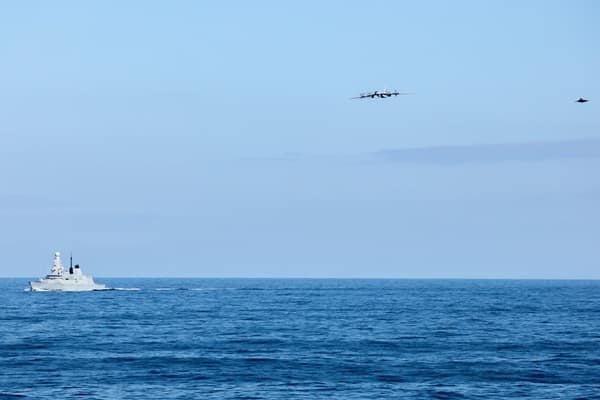
Britain’s newest aircraft carrier has found itself at the centre of an increasingly tense confrontation with Russia after RAF fighter jets were scrambled to intercept two Russian military aircraft that repeatedly approached a NATO carrier strike group in the Norwegian Sea.
The incident, confirmed by the Ministry of Defence, underscores how the High North is rapidly becoming one of the most volatile theatres in Europe’s new era of great-power competition.
According to the MoD, two Russian Tu-142 “Bear F” maritime patrol aircraft repeatedly flew close to the UK-led carrier strike group last week in what officials described as an “unsafe and unprofessional” encounter.
The Russian aircraft reportedly dropped numerous sonobuoys—underwater listening devices used to detect submarines—near HMS Prince of Wales, the Royal Navy’s £3 billion flagship and the first European aircraft carrier to conduct NATO air defence operations using F-35 Lightning II stealth fighters.
The response was swift.
On July 2, British F-35 jets launched from the carrier intercepted and escorted the Russian aircraft away from the task group, preventing them from operating unchecked around one of NATO’s most valuable naval assets.
While no shots were fired, the encounter illustrates how the confrontation between NATO and Russia increasingly plays out through aggressive military signalling rather than direct conflict.
Russia has long used long-range patrol aircraft to monitor NATO naval deployments, particularly in strategically sensitive waters stretching from the North Atlantic to the Arctic Ocean.
For Britain, however, the stakes are rising.
The deployment of HMS Prince of Wales is designed to demonstrate that NATO can project power deep into northern Europe, protect vital sea lanes and reinforce allies bordering Russia.
Moscow, meanwhile, appears determined to show that no NATO deployment will go unchallenged.
The repeated approaches by the Russian aircraft—and their deployment of sonobuoys—suggest an attempt to gather intelligence on NATO submarine activity and carrier operations.
The incident comes as the Arctic is assuming unprecedented strategic importance.
With Finland and Sweden now strengthening NATO’s northern flank, Russia faces a dramatically altered security landscape across its north-western border.
The Norwegian Sea has become a vital corridor for alliance naval operations, while the Arctic itself is increasingly viewed as critical for missile defence, submarine patrols and the protection of undersea infrastructure.
Britain’s carrier strike group is intended to send a clear signal that NATO remains capable of operating freely in these contested waters.
Russia’s response suggests it intends to contest that freedom whenever possible.
The latest confrontation also comes after reports that HMS Prince of Wales required repairs during its deployment to Norway, temporarily delaying parts of its mission.
Although technical issues are not uncommon during lengthy deployments, the timing has inevitably attracted scrutiny given the carrier’s central role in Britain’s defence strategy.
Despite those setbacks, the vessel remains one of the Royal Navy’s most capable assets, carrying advanced F-35 fighters, helicopters and a multinational escort force.
Its deployment demonstrates Britain’s continued commitment to NATO deterrence at a time when tensions with Russia remain exceptionally high.
Encounters like this rarely dominate headlines for long.
Yet they illustrate a broader reality: Europe is entering an era where military brinkmanship has become routine.
Russian aircraft probing NATO defences.
British and allied fighters scrambling to intercept.
Naval task groups operating under constant surveillance.
None of these incidents alone amount to war.
But collectively they reveal a pattern of persistent pressure that carries inherent risks of miscalculation.
The interception over the Norwegian Sea serves as another reminder that while the fighting remains centred on Ukraine, the strategic contest between Russia and NATO now stretches from the Baltic to the Arctic—and shows little sign of easing.


Leave a Comment