
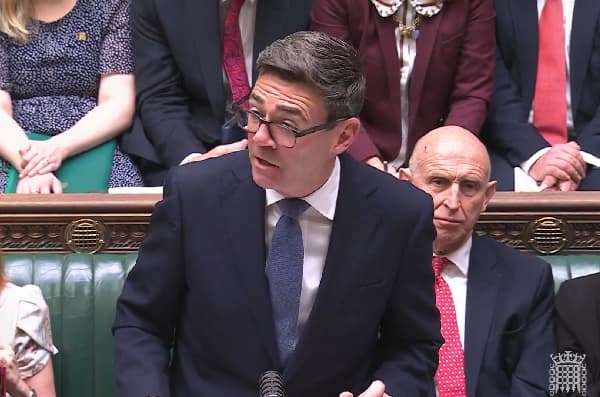
Prime Minister Andy Burnham faced his first major parliamentary test on Wednesday as Conservative leader Kemi Badenoch challenged him over soaring government borrowing costs, the prospect of tax rises and his spending commitments.
The exchange came a day after UK borrowing costs rose to their highest level in 18 years, adding pressure on the new government as it prepares its first Budget.
Badenoch opened her attack by citing Jim O’Neill, a long-term supporter of Burnham and former government minister and Goldman Sachs economist, who had criticised the prime minister’s parliamentary statement on Tuesday.
“Lord O’Neill, a close friend of the Prime Minister, said yesterday’s statement in the Commons was the last thing investors wanted to hear.
“Lord O’Neill is a serious economist, he knows what he’s talking about and sure enough, yesterday, the cost of government borrowing rose to its highest in 18 years. How does he tackle to tackle the Government’s rising debt costs?”
Burnham defended his relationship with O’Neill while arguing that the Conservatives had left Britain with weak growth and a deteriorating debt position.
“Can I say to the Right Honourable lady, I’ve worked with Jim O’Neill for 10 years. Jim O’Neill always gives me candid advice, we don’t always agree. But he and I worked together to turn Greater Manchester from a former industrial heartland to the fastest-growing city region in the country.
“They complain, but where are their ideas about growth? When they were in government we saw 14 years of stagnant growth, we saw 14 years of debt rising as a percentage of GDP. I would say to her that the turbulence on global markets are because of that exposure that we left behind. We are turning that corner.”
Burnham said Britain had the fastest growth rate in the G7 and that government borrowing had fallen to its lowest level in six years during the first half of 2026.
“I say to the party opposite… that is problem-solving rather than pointscoring.”
His response came after O’Neill told LBC: “If your country is under the focus of ‘can they come up with a sensible fiscal strategy’ on a day when the markets think ‘well no, you’re not showing any sign of it’ you’re going to have a tough day… if it stays like this your mortgage rate is going up.
The prime minister was also pressed over whether his government would raise taxes to shore up the public finances.
Burnham again declined to give a detailed answer, arguing that the Budget should not be written in the Commons.
“I’ve already indicated my first moves were to cut tax, but I’m not going to do what any prime minister has done and write the Budget here,” he told MPs.
He added: “I can also say to her that he and I took a deliberate decision to set an early date for the Budget so that we reduce the period for prolonged speculation of the kind that she is wanting us to indulge in today.”
The exchange then turned to spending, with Badenoch accusing Burnham of prioritising popularity over difficult fiscal decisions.
She had challenged the prime minister during his three-hour, 23-minute statement to the Commons on Tuesday over whether he had rejected a spending request. Burnham said his government was committed to reducing the welfare bill.
“I do not want to be a Prime Minister that sees a situation where we have so many people in their 20s not in education, employment or training.
“I can’t defend that, and I want to change that by giving more support to young people so that we start investing in their success rather than paying for failure, as we have done for many years under successive governments.”
Badenoch responded: “He did not say no to a single spending request, and personally I think it’s delightful that he wants to make everyone happy but a Prime Minister needs to be a leader not a people-pleaser.”
She then returned to the question of how Burnham’s spending pledges would be financed.
“Yesterday the Prime Minister told the House that his summer of promises would be paid for by reprioritising within Government. So what exactly has he cut?”
Burnham pointed to measures he said would lower costs for households and businesses.
“In terms of ‘what has he cut?’, tax is the simple answer to that question. Within days of office I indicated that we would remove VAT off electricity bills, that will help people with the cost of living and then days later with the support of the Chancellor we said that there would be a cut in business rates for pubs, social clubs, live music venues. So this Government (is) lowering the cost of living, lowering the cost of business.”
The confrontation highlighted the central economic dilemma confronting Burnham and Chancellor John Healey: the government is under pressure to deliver on spending commitments while financial markets are demanding greater evidence that the public finances remain under control.
The rise in gilt yields has narrowed the room for manoeuvre ahead of the Budget, while uncertainty over future taxation and spending threatens to keep investors focused on the government’s fiscal credibility.
For Burnham, his first PMQs therefore offered an early indication of the political battle likely to dominate the months ahead: whether his government can combine higher public spending and tax relief with a credible strategy for bringing down borrowing and sustaining investor confidence.


Leave a Comment