
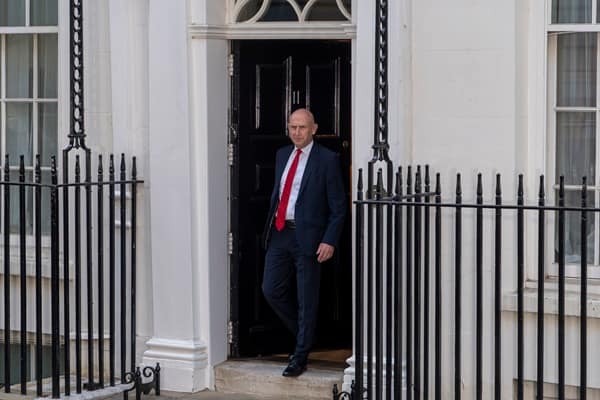
Chancellor John Healey has insisted he is “100 per cent” committed to increasing defence spending, despite the government delaying a target that he previously argued was essential to Britain’s national security.
Healey, a former defence secretary, defended the decision during a visit to the US for talks with foreign counterparts, after facing accusations of hypocrisy over his changed position on the pledge to spend 3 per cent of gross domestic product on defence by 2030.
The chancellor dramatically resigned from Sir Keir Starmer’s cabinet after the then-prime minister declined to commit to the target. Since then, however, the government led by Andy Burnham has indicated that the 2030 deadline will not be met.
Healey’s first Budget is scheduled for October 28, but the government will not set out its detailed defence spending commitments until next year’s spending review.
The chancellor has warned that closing a £5bn funding gap would require the government to make “difficult decisions” in next month’s Budget.
Healey acknowledged that his new role on Burnham’s frontbench was a “bigger job”, but argued that defence remained central to the spending review.
“For the first time at the spending review, we will set out a clear path about how we will meet that Nato commitment in 2035: 3.5 per cent of GDP,” he told The Times.
“As Burnham has said on his first day as prime minister, we will fully meet our commitments to our allies.
“And as part of setting out that clear path, we will set that target date for 3 per cent.”
Current spending plans are expected to reach only 2.7 per cent of GDP by 2030, leaving a significant gap between the government’s existing trajectory and the target Healey previously demanded.
The dispute comes as Washington increases pressure on European allies and Canada to assume greater responsibility for the defence of the continent.
The US has promoted a broader Nato spending strategy dubbed “Nato 3.0”, with President Donald Trump repeatedly calling on allies to increase defence budgets as security threats multiply.
Trump is also reviewing the US position on the Falkland Islands as a means of “encouraging the sort of burden-sharing that we seek”, according to reports.
Healey acknowledged the deterioration in Britain’s strategic environment, pointing to recent reports of Iranian cyberattacks and Russian threats against drone production facilities.
“The world has become more dangerous,” he said. “The threats are increasing and we’re stepping up further.”
“There’s always difficult decisions as Chancellor. The most difficult decisions come to the Chancellor and the Prime Minister in Government.”
The political pressure on London has been reinforced by criticism from senior US officials.
Asked whether Britain should spend 3 per cent of GDP on defence, Trump told reporters in the Oval Office: “The UK’s got some problems, but they’ll get solved.”
In June, US Secretary of War Pete Hegseth told Healey’s brief successor, Dan Jarvis, that Britain needed to “step up” and “spend even more”, while criticising the UK’s initial response to the Iran war.
Hegseth also mocked Britain’s maritime capabilities by referring to the “big, bad Royal Navy” after the UK failed to rapidly deploy a warship to the Middle East.
The issue carries particular political significance for Healey. In his resignation letter from the previous government, he argued that Britain “must” reach 3 per cent of GDP in defence spending by 2030.
The subsequent decision to defer the target has prompted accusations that he has abandoned the position that helped bring down the previous government and contributed to Burnham’s arrival in Downing Street.
James Cartlidge, the shadow defence secretary, accused Healey of “backtracking on the very pledge which sealed the fate of the last prime minister and opened the door of No 10 to Andy Burnham”.
The prime minister is due to face his first scrutiny from opposition parties today, adding a further political test as the government attempts to reconcile ambitious defence commitments with pressure on the public finances.
Meanwhile, Conservative leader Kemi Badenoch has promoted Andrew Griffith, who has more than 25 years of private-sector experience, to shadow chancellor as she prepares her opposition team for the possibility of an early general election.
For Healey, the immediate challenge is to demonstrate that the government’s revised timetable represents a credible route towards higher defence spending rather than a retreat from the commitment he once made a condition of political leadership.


Leave a Comment