
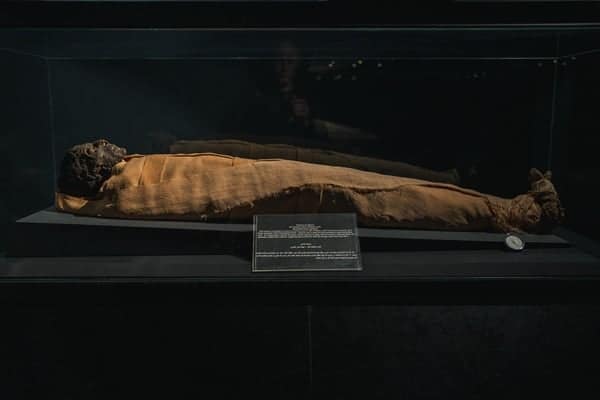
Kelvingrove Art Gallery and Museum has withdrawn ancient human remains from public display as curators confront growing ethical questions over whether the dead ever agreed to become exhibits.
Ancient Egyptian mummies have been removed from display at one of Glasgow’s best-known museums, in a move that brings a modern question of consent into direct confrontation with centuries-old burial practices.
Kelvingrove Art Gallery and Museum has withdrawn the remains amid proposals to restrict the display of human remains to cases where the deceased gave documented, informed consent before death — or, in appropriate circumstances, where consent has been obtained from descendants.
A notice now marks the space where the mummies once stood: “We have removed human remains from this display as a mark of respect.”
The decision reflects a wider reassessment of how museums present the remains of the dead, particularly those taken from ancient societies whose burial traditions and wishes cannot readily be established. It also raises difficult questions for institutions whose collections were assembled long before contemporary standards of consent and dignity became central to debates about cultural heritage.
Glasgow Life, the charity that operates the city’s museums and cultural venues, is understood to be considering a similar removal of a coffin and mummified human remains from the St Mungo Museum, near Glasgow Cathedral.
The changes follow the publication in June 2026 of a revised Code of Ethics by the International Council of Museums. The code says museums should uphold the inherent dignity of human remains and promote respect for their significance.
For Glasgow Life, the question is no longer simply whether ancient remains can be displayed, but whether the absence of consent should itself be sufficient reason to remove them from public view.
A spokesperson for Glasgow Life said the decision reflected contemporary museum practice and the ethical principles set out in the revised international code.
The spokesperson also cited the 2025 report Laying Ancestors to Rest, produced by the All-Party Parliamentary Group on Afrikan Reparations, which raises concerns about displaying ancient Egyptian human remains without knowing the wishes of the individuals or the intentions of the communities that buried them.
Glasgow Life Museums’ draft Human Remains Policy proposes that remains should be displayed only where documented and informed consent exists from the deceased or, where appropriate, their descendants.
“In the absence of such consent, we believe removing ancient Egyptian human remains from display is more respectful to the deceased individuals,” the spokesperson said.
The policy marks a significant shift in the principles governing museum collections. Human remains have long occupied an uneasy position between historical evidence, scientific material and the physical traces of individual lives. Their exhibition can offer insight into ancient societies, but it can also turn the dead into objects of public curiosity without any clear indication that they would have agreed to such treatment.
The difficulty is particularly acute for ancient Egyptian remains, whose preparation for burial was often bound up with beliefs about the afterlife and the preservation of the body. Thousands of years later, museums must decide how to balance the educational value of these collections against the dignity of the individuals whose remains they contain.
Obtaining consent from people who died millennia ago is, in most cases, impossible. Glasgow Life’s proposed approach places the burden on museums to establish a basis for display, rather than assuming that the passage of time removes the ethical obligation to consider the wishes of the dead.
The removals also reflect growing scrutiny of the ways museums acquired, interpreted and exhibited human remains, as cultural institutions reconsider their responsibilities to the communities from which collections originated.
For visitors to Kelvingrove, the immediate result is an empty display space accompanied by a short notice. Behind it lies a broader debate over who has the authority to decide how the dead should be remembered — and whether the absence of an objection can ever be treated as permission.
In Glasgow, the museum’s answer is increasingly clear: where informed consent cannot be established, the remains may be better left out of sight.


Leave a Comment