
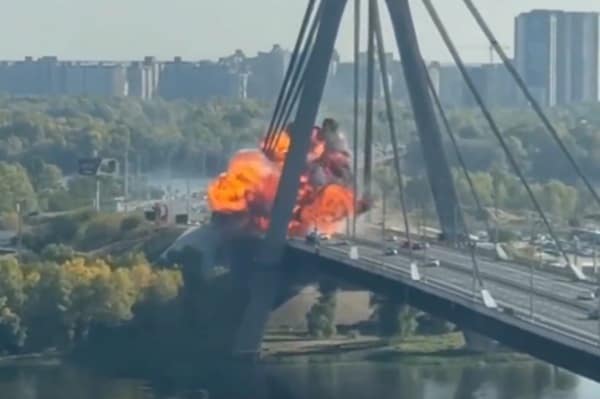
Two Russian men who say they secretly assisted Ukraine’s intelligence services have described covert operations against military targets inside Russia, offering a rare glimpse into the murky world of sabotage and espionage behind the war.
The accounts appear in Shadowmen, a BBC Eye documentary for the BBC World Service, produced after Polish journalist Marcin Mamoń spent two years cultivating contacts within a network of Russians who claim to work clandestinely against the Kremlin.
Among them is a man the film identifies as Ivan, who describes himself as a patriot determined to remove Vladimir Putin’s government from power. He believes helping Ukraine’s war effort could bring about that outcome.
Read more related news:
Brits told ‘our nation is going to need you’ as Britain prepares for war and the ‘unthinkable’
‘We’ll be under someone else’s rule’: Former officer delivers terrifying warning over the lack of UK’s defences
Exclusive: ‘We are already limited’: Ukrainian drone operators describe Starlink restrictions on the battlefield
NATO issues chilling alert of ‘threat of an air attack’ near Ukraine border
Another figure, known as Foma, is living in exile in Poland, where he runs a network of volunteers inside Russia. The group conducts surveillance on senior military officers being tracked by Ukraine’s military intelligence service, the GUR, according to the documentary.
Their accounts expose the shadowy dimension of a conflict increasingly fought beyond the front lines, where information, clandestine networks and attacks on military infrastructure have become part of the wider struggle.
But the claims come with significant caveats. The BBC documentary also raises the possibility that some people presenting themselves as Ukrainian operatives could instead be working for Russian intelligence, highlighting the difficulty of distinguishing genuine resistance from deception in an environment shaped by secrecy and suspicion.
The BBC said the film examines the motivations of Russians who claim to oppose the Kremlin, the risks they say they have taken and the challenges of independently verifying their accounts. Many people involved were unwilling to provide further details, citing security concerns.
Monica Garnsey, the BBC’s executive producer, said the documentary was not a straightforward account of heroes and villains.
“Marcin Mamoń has used the incredible access he gained to tell a story that is not about heroes or villains, but about men who have crossed a line many will never face, and who are living with the consequences,” she said.
“Shadowmen asks difficult questions about acts of war, patriotism, and loyalty, and there are no simple answers.”
Sabotage inside Russia has accompanied the invasion almost from its beginning. Railway lines serving the front have been disrupted, recruitment offices set alight, fuel depots attacked and military figures killed. Responsibility for individual incidents has often proved difficult to establish independently.
Ukraine’s GUR and Security Service have claimed involvement in some operations, while Russian partisan groups have taken credit for others. Moscow has frequently portrayed suspects as individuals recruited online in exchange for money.
The competing accounts illustrate the challenges of establishing what happens behind enemy lines, where intelligence operations are designed to conceal their sponsors and where claims of allegiance can themselves become instruments of war.
For the men featured in Shadowmen, the documentary presents a personal reckoning with the choices they say they have made. For observers, it offers a glimpse into a covert conflict in which the truth may be as difficult to establish as the targets are to reach.


Leave a Comment