
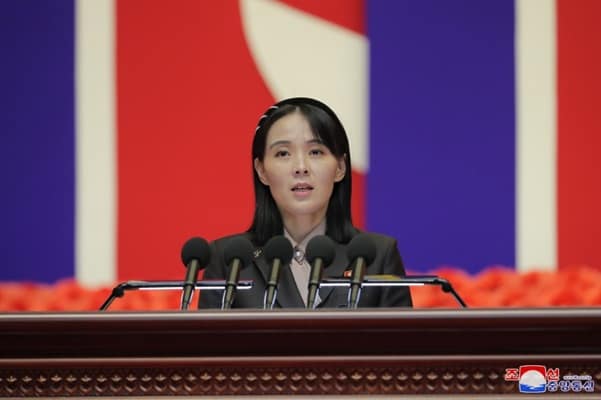
North Korea has threatened to launch immediate military counterattacks against South Korean forces and announced plans to resume propaganda loudspeaker broadcasts along the border, escalating tensions between the two countries after weeks of mutual accusations over military provocations.
Kim Yo Jong, the influential sister of North Korean leader Kim Jong Un, and senior military officials visited the inter-Korean frontier on Wednesday, where they warned South Korean troops against crossing what Pyongyang considers its territory.
Marshal Pak Jong Chon, a senior North Korean military commander, told frontline soldiers they must respond with force if South Korean troops threaten their safety.
“When the enemy, following warning broadcasts and warning shots, commits provocations that actually threaten the safety of our soldiers in the future, you must absolutely not tolerate it and must counterattack immediately,” he said, according to state news agency KCNA.
“Now is not the time to sit engaged in a war of words.”
Read more related news:
South Korea warns ‘we will punish’ the North resolutely as tensions explode amid Kim Yo Jong’s threats
Kim Jong-un death claims escalate online potentially plunging North Korea into civil war’
The unusually direct warning suggests Pyongyang is seeking to reinforce its military posture along the border while signalling that future confrontations could escalate rapidly from verbal threats to exchanges of fire.
Hong Min, a senior research fellow at the Korea Institute for National Unification, told NK News that the visit marked a shift from rhetorical pressure towards a more concrete threat of military retaliation.
“The photo [of the visit], alongside the statement, is a big part of the warning,” he said.
Wednesday’s speeches suggested North Korean forces had been instructed to respond without waiting for further orders from senior commanders, Hong added.
In a statement released on Wednesday evening, Kim Yo Jong announced that North Korea would restart its loudspeaker broadcasts against South Korea along the entire border within October, although she did not specify an exact date.
The broadcasts, a longstanding instrument of psychological warfare between the two countries, were halted in June 2025 after South Korean President Lee Jae Myung ordered Seoul to suspend its own anti-Pyongyang transmissions. North Korea subsequently stopped its broadcasts, and South Korea began removing its border loudspeakers two months later.
Kim described the planned resumption as “the most just measure and appropriate response”, warning that North Korean border guards would show “no mercy” if South Korean troops continued what Pyongyang regards as provocative actions.
She also said her brother had ordered the frontier with the South, which North Korea now describes as a hostile state, to become “the most permanent line”.
The comments reflect Kim Jong Un’s broader effort to formalise the division between the two Koreas, abandoning the longstanding official framework of eventual national reunification in favour of treating Seoul as a separate adversary.
The latest escalation follows a mine blast in the Demilitarized Zone on September 21 that injured three South Korean soldiers. A joint investigation by Seoul and the United Nations Command concluded that North Korean mines had been “deliberately buried” south of the Military Demarcation Line, a finding Pyongyang rejected.
The two sides also disagree over the precise location of the military boundary, complicating efforts to clear minefields and carry out fortification work without triggering confrontation.
Pak accused Seoul of deliberately misrepresenting alleged North Korean border crossings to shift blame for rising tensions. He insisted Pyongyang was strengthening its own territory and called for firepower capabilities that “the enemies cannot help but fear”.
The inspection appears to be the first publicly reported visit by senior North Korean officials to the border fortifications since construction began in 2024.
For Seoul, the danger is that a response to any North Korean action could trigger a cycle of retaliation. Hong warned that an immediate counterattack would effectively turn an isolated incident into an exchange of fire, potentially drawing additional weapons systems into the confrontation.
South Korea’s defence ministry has vowed to “resolutely punish” further North Korean provocations.
With both sides reinforcing their positions and issuing increasingly explicit threats, the resumption of loudspeaker broadcasts risks becoming more than another round of propaganda warfare. It could test whether military forces operating along one of the world’s most heavily fortified borders can contain a confrontation once shots are fired.


Leave a Comment