
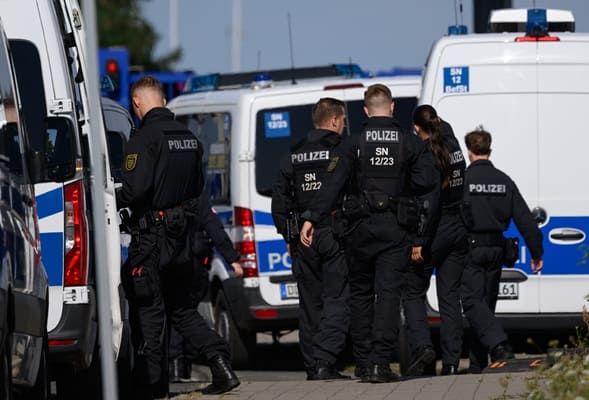
Germany has formally blamed Russia for an attempted explosive drone attack at Leipzig/Halle Airport, in another significant escalation of concerns over Moscow’s growing campaign of hybrid warfare across Europe.
The incident occurred on 4 August when a drone carrying an explosive device and detonator was discovered inside the airport’s security area, close to Ukrainian cargo aircraft.
Germany’s federal prosecutor opened an investigation, describing what happened as a serious attack against German transport and logistics infrastructure while authorities say three drones are now believed to have been involved.
The German government says its assessment is based on police investigations, intelligence findings and evidence recovered from the incident, including components, explosives and detonation technology.
Interior Minister Alexander Dobrindt said the preparation demonstrated a high degree of expertise and fitted an established pattern of Russian hybrid operations in Europe.
The German government has now concluded that Russia was responsible.
“We are not at war, but we are a daily target of hybrid warfare,” Dobrindt said.
The statement is significant because Berlin is no longer treating incidents of suspected sabotage, espionage, cyber activity and interference with critical infrastructure simply as individual criminal acts.
Germany increasingly sees them as components of a broader confrontation with Russia operating below the traditional threshold of conventional warfare.
Germany 🇩🇪 has formally accused Russia 🇷🇺 of orchestrating a failed explosive-drone attack at Leipzig/Halle Airport.
The drone was discovered near a Ukrainian Antonov cargo aircraft on 4 August. German authorities believe it was intended to detonate, but the device… pic.twitter.com/Wgsf1qDgPt
— Shaun Pinner (@ShaunPinnerUA) September 2, 2026
Berlin’s response goes considerably further than diplomatic condemnation, the Russian Consulate General in Bonn is to close from 18 September, while the agreement governing the Russian House in Berlin is being terminated.
Germany also plans tougher entry controls for Russian nationals, increased pressure against Russia’s so-called shadow fleet and additional European measures against individuals believed to be connected with hybrid operations.
Foreign Minister Johann Wadephul said the Leipzig incident formed part of a longer series of destabilisation attempts, disinformation and threats directed against Germany, while Russia has denied responsibility and has promised retaliatory measures.
Moscow has subsequently announced that German cultural centres in Russia, including Goethe-Institut locations, will be closed in response to Berlin’s measures, demonstrating how quickly the Leipzig incident is spilling over into wider diplomatic relations.
The repercussions therefore extend considerably further than one airport, closing diplomatic and cultural institutions reduces Russia’s physical presence in Germany while signalling that Berlin increasingly considers Moscow a direct security threat.
NATO stands behind Germany
NATO Secretary General Mark Rutte has publicly backed Berlin, saying the alliance stands in “full solidarity with Germany” following what he described as the Russian hybrid attack.
Rutte said NATO would continue strengthening its ability to deter and defend allies against threats and warned that Russian attempts to intimidate Europe, undermine its unity and weaken support for Ukraine would fail.
The European Union has also backed Germany, while further sanctions and restrictions against Russia are under discussion.
Germany has stopped short of invoking NATO’s Article 4 consultation mechanism, but the attack is being discussed with allies through both NATO and EU structures.
That distinction is important.
Russian propaganda at its finest. You simply can’t work with this Man from U.N.C.L.E.-era, outdated Soviet crap. https://t.co/lpEVtN0V4h
— Shaun Pinner (@ShaunPinnerUA) September 2, 2026
Hybrid warfare deliberately occupies the grey area between peace and conventional war.
Cyberattacks can be difficult to attribute. Sabotage can resemble an accident. Operatives can be distanced from governments, while disinformation creates enough doubt to make attribution politically difficult.
But when individual incidents begin displaying similar targets, methods and patterns across several countries, they become increasingly difficult to dismiss as coincidence.
Meanwhile, Russian skies are changing
There is also considerable irony in the timing.
President Volodymyr Zelenskyy has warned international airlines, insurers and governments that Russian airspace is becoming increasingly unsafe as Ukraine’s long-range drones operate deeper inside Russia.
Ukraine has subsequently urged the International Civil Aviation Organization to support restrictions on civilian flights through Russian airspace.
Western airlines have largely avoided Russia since the full-scale invasion began, but airlines from several other countries continue to use Russian routes.
Putin responded by accusing Ukraine of “state terrorism.”
The irony is difficult to ignore.
The accusation comes as his own government is being blamed by Germany for an attempted explosive-drone attack against infrastructure at a major European airport, while the destruction of Malaysia Airlines Flight MH17 still remains fresh in many minds.
In 2014, 298 people were killed when MH17 was shot down over eastern Ukraine by a Buk missile system brought in from Russia. In 2025, both the European Court of Human Rights and the ICAO Council found Russia responsible for the downing of the aircraft.
Ukraine’s long-range strike campaign has also changed the geography of this war.
Refineries, military facilities, airfields and other strategic targets hundreds of kilometres inside Russia, and sometimes considerably further, are now within range, with much of the country no longer beyond Kyiv’s reach.
Russian airports have faced disruption as Ukrainian drones penetrate increasingly deep into Russian territory, undermining the Kremlin’s long-standing ability to keep the physical consequences of its invasion largely away from its own population.
That creates an increasingly uncomfortable political picture for Putin as Germany is accuses Russia of conducting a hybrid attack on NATO territory, Russian diplomatic and cultural institutions are being closed, NATO and the European Union are publicly standing behind Germany while Ukraine’s long-range strike capability continues to expand and the security of Russian airspace is increasingly being questioned internationally.
Putin launched his full-scale invasion believing Russia could dictate where and how this war would be fought.
More than four years later, the opposite is happening.
Russia’s hybrid confrontation is spreading westwards into Europe, while Ukrainian drones are travelling increasingly deeper eastwards into Russia.
For Putin, the war he started is becoming increasingly difficult to keep away from home and finally, he may just be recognising his own political mortality.


Leave a Comment