
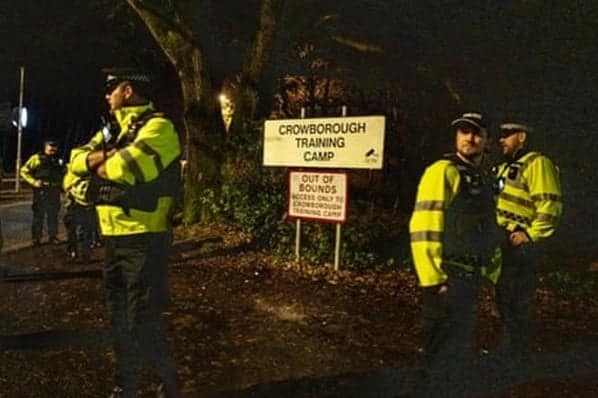
The arrest of an asylum seeker on suspicion of possessing indecent images of children has intensified scrutiny of the Government’s use of large-scale accommodation sites, reigniting debate over safeguarding, community confidence and the management of Britain’s asylum system.
The National Crime Agency confirmed that a man in his twenties was arrested in the Crowborough area on July 10 on suspicion of possessing indecent images of children after the material was allegedly found on his mobile phone.
The agency said it would be inappropriate to comment further while the investigation remains ongoing.
The individual is understood to have been housed at the Crowborough camp, where around 540 male asylum seekers are currently being accommodated by the Home Office.
The arrest is likely to add political pressure on ministers over the expansion of asylum accommodation, an issue that has become increasingly contentious as migrant arrivals have remained high and local authorities have raised concerns over capacity and consultation.
It is important to note that the arrest relates to one individual and does not imply wrongdoing by other residents at the site. The allegations have not been tested in court.
Nevertheless, the incident has sharpened anxieties among some residents, many of whom have opposed the use of the former military site since it was first proposed.
Campaign group Crowborough Shield has argued that local communities were given little opportunity to influence the decision before the facility opened. Its chairman, Kim Bailey, previously said residents felt “abandoned” by the authorities and had been forced into a prolonged campaign to make their concerns heard.
Another local campaigner, Marmaduke Devereaux-Astley, accused ministers of failing to engage meaningfully with the community, arguing that residents had repeatedly sought greater transparency over the site’s operation and security arrangements.
The case also highlights the delicate balance facing policymakers. Britain remains legally obliged to process asylum claims while ensuring public confidence in the integrity and safety of the system. Incidents involving criminal allegations, even where isolated, risk undermining that confidence and intensifying calls for tougher oversight.
Successive governments have argued that larger accommodation centres reduce the cost of housing asylum seekers in hotels, but critics contend that concentrating hundreds of residents in a single location can place additional pressure on local services and heighten community tensions.
For ministers, the immediate focus will remain on the criminal investigation. More broadly, however, the case is likely to reinforce demands for greater transparency over safeguarding procedures, security screening and how asylum accommodation is managed as the Government continues to reshape Britain’s immigration system.
Speaking to GB News, Mr Devereaux-Astley said: “This Government have thrown us to the wolves. No one’s going to come and save us, no one’s coming to help us.
“We are having to fight back in a David and Goliath battle against this Government because they’ve treated us appallingly.”
He said: “We’ve never been consulted, we’re still not being consulted, and we feel that the Home Office’s intent is nefarious and their tactics are duplicitous and downright dishonest, and I’m putting that diplomatically.
“But we never imagined we would ever be in this situation.”


Leave a Comment