
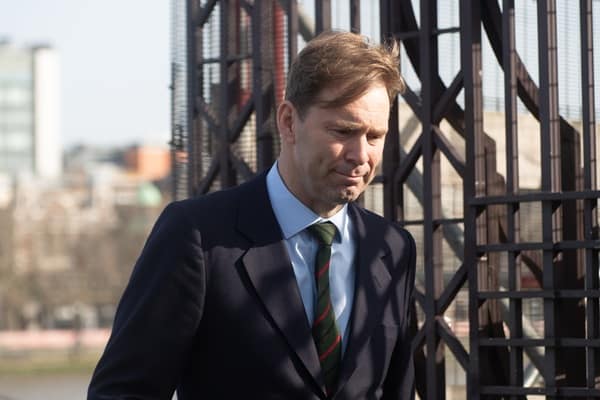
Russia could be moving towards another Novichok-style attack in Britain, with former defence minister Tobias Ellwood warning that it is “only a matter of time” before a prominent figure is targeted.
Ellwood, a former chairman of the Commons Defence Committee, said Moscow was increasingly exploiting the “grey area” between conventional warfare and covert operations, using tactics designed to destabilise western countries without triggering an open confrontation.
“This is a lovely grey area that Putin has become a specialist at,” he said.
Ellwood said Russia could combine cyberattacks, sabotage, coercion and poisoning to interfere with Britain while keeping its activities below the threshold of an overt military conflict.
“He knows he doesn’t want to escalate or risk losing his friendship with America if anything went too far,” he said, arguing that Vladimir Putin was conscious of the risks of crossing a line that could provoke a direct confrontation with the West or damage relations with Donald Trump.
Instead, Moscow could exploit weaknesses within British society using methods that were relatively inexpensive, difficult to attribute and capable of fuelling political and social divisions.
“It’s also a lot cheaper to interfere with our economy and get us arguing with each other,” Ellwood said.
“That can be done through disinformation, the internet, cyberattacks, and so forth, alongside the occasional act of sabotage, coercion, and probably poisoning too.”
He delivered his starkest warning over the prospect of another chemical attack, saying a prominent public figure could eventually become a target.
“I mean, it’s horrible to say this, but I think it’s only a matter of time before a dignitary, a personality, or someone else is targeted in another Novichok-type situation,” he said.
In 2018, Russian agents targeted former double agent Sergei Skripal and his daughter Yulia with Novichok, a highly toxic nerve agent, in Salisbury. Both survived the attack. Dawn Sturgess, who lived in nearby Amesbury, later died after being exposed to the substance from a perfume bottle that had been discarded by the assassins and was unwittingly given to her by her boyfriend.
Ellwood’s warning comes amid growing concern among western governments over hostile-state activity below the threshold of conventional warfare.
“The world is getting more dangerous, and we’ve still got our heads in the sand,” he said.
He said Russian operatives and sleeper agents remained a serious concern in Britain, citing an example in which individuals had rented cottages overlooking a nuclear submarine base and monitored naval activity.
Ellwood also highlighted the activities of the GRU, Russia’s military intelligence service, and argued that Britain had become less capable of conducting the intelligence work required to detect and disrupt such operations since the end of the Cold War.
“That’s the type of warfare we’re talking about, and we are not ready for it. We’re not geared for it at all,” he said.
Britain’s openness could itself provide opportunities for hostile governments, he argued, allowing them to recruit individuals to carry out attacks without those people necessarily understanding who was directing them.
“There are enough sad individuals out there whose lives aren’t going well who would take $15,000 or $20,000 to go off and do something,” Ellwood said.
“That distances the people who are actually behind the threat by using mules.”
He also raised concerns about the cyberattack on Jaguar Land Rover, which he said was “clearly from Russia”, as well as the possibility that British technology could be used by Ukraine in attacks deep inside Russian territory.
The former minister argued that Russia’s withdrawal from some established diplomatic and intelligence arrangements with Britain, combined with intelligence-sharing about the UK, could increase the pressure on Moscow to retaliate.
His warning underscores the changing nature of the security threat facing Britain, in which hostile states can conduct disruptive operations without formally declaring war — while using deniable intermediaries and covert tactics to make attribution more difficult.
For Britain, Ellwood’s central concern is that the next escalation may not resemble a conventional attack at all, but instead arrive through cyber disruption, sabotage or a targeted poisoning, with a prominent public figure potentially becoming the next victim.


Leave a Comment