
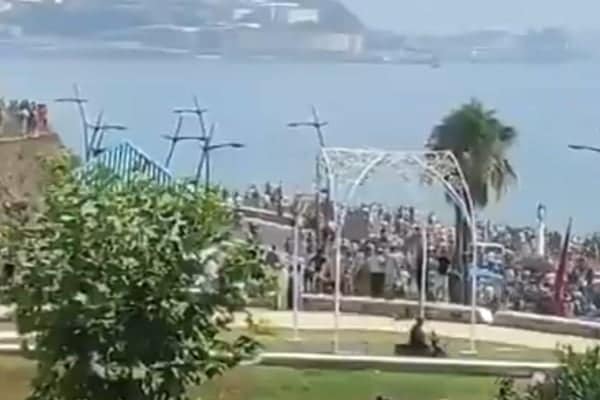
Spain has declared the mass arrival of migrants into its North African enclave of Ceuta a direct assault on its territorial integrity, triggering the most serious European migration dispute in years and prompting calls for tighter border controls across the continent.
Prime Minister Pedro Sánchez said Madrid would deploy the full resources of the Spanish state to restore control after thousands of migrants crossed into Ceuta, an EU territory surrounded by Morocco that represents one of Europe’s most sensitive external borders.
“What happened yesterday was an attack, a violation of Spain’s territorial integrity,” Sánchez said during a visit to the enclave.
The Spanish government said it was accelerating the repatriation of migrants who entered illegally, while security forces prepared new physical barriers along the coastline to prevent further crossings.
The response has quickly widened beyond Spain.
Several European governments have warned that the crisis exposes weaknesses in the Schengen free movement system, which depends on member states effectively protecting the EU’s external borders.
Criminal Pedro Sanchez greeted in Ceuta with insults and jeers. pic.twitter.com/nfJvnbZC6O
— RadioGenoa (@RadioGenoa) July 31, 2026
Swedish Prime Minister Ulf Kristersson urged Madrid to act rapidly to regain control and fulfil its obligations under Schengen cooperation, warning Stockholm was prepared to take measures if the situation threatened Sweden’s own migration and security environment.
Finland’s interior minister Mari Rantanen went further, backing Italy’s threat to suspend Schengen arrangements with Spain.
“Countries that do not fulfil their obligation to protect the external border cannot be members of Schengen,” she said.
The diplomatic pressure has intensified across Europe, with Dutch officials calling the situation “concerning” and urging both Spain and Morocco to take immediate action.
France has also moved to strengthen controls along its border with Spain.
Interior Minister Laurent Nuñez announced the activation of a rapid border intervention force, saying additional checks would be carried out in response to the developments in Ceuta.
The crisis has become a political flashpoint ahead of wider European debates over migration policy, with French politicians warning that uncontrolled movements between EU states could undermine public confidence in the Schengen system.
Esto ya es lo que me faltaba por ver: el mamarracho de Marlaska manda a la Policía a cargar con porras contra los españoles que querían recibir entre pitos a Sánchez en Ceuta.
Mientras lo hace siguen entrando cientos por minuto en nuestra frontera. Es delirante. pic.twitter.com/jD5MSdydBY
— Unai Cano (@unaicano10) July 31, 2026
Marine Le Pen called for France to immediately reinforce border controls, arguing that European free movement rules needed reform. Former French prime minister Michel Barnier also demanded tougher enforcement of existing return rules for people without legal status.
The confrontation places renewed pressure on Spain’s migration strategy.
Madrid has defended its approach, including recent measures granting legal status to large numbers of undocumented migrants, arguing that integration and legal employment are necessary for economic and social stability.
Critics across Europe argue that such policies risk creating incentives for further migration flows and placing additional pressure on neighbouring states.
Behind the political fallout lies a broader challenge facing the EU: how to maintain open internal borders while controlling its external frontier.
Um »schnell wieder Normalität herzustellen«, entsandte Sánchez wegen der 49.000 illegalen Eindringlinge ganze 60 Soldaten sowie 200 Spezialkräfte der Polizei nach #Ceuta. pic.twitter.com/o3rDql5iaR
— Dara 🇩🇪 (@Raeubertochtah) July 31, 2026
Ceuta has long been a pressure point because of its unique position. Together with Melilla, it represents the only land border between the European Union and Africa, making it a symbolic gateway for migrants seeking entry into Europe.
For Brussels, the latest crisis is not simply a Spanish problem. It is a test of whether Europe’s border system can withstand renewed migration pressure without triggering a political backlash between member states.
The coming weeks will determine whether Ceuta becomes a temporary emergency — or the latest turning point in Europe’s increasingly bitter migration debate.

![Hundreds of people are swimming across to Ceuta from Morocco [**********]](https://mloyoq1wv9pf.i.optimole.com/cb:6uVl.ffa/w:300/h:200/q:eco/f:best/https://londonlovesbusiness.com/wp-content/uploads/2026/07/Ceuta-Marcos-Moreno-Europa-Press-Avalon.jpg "Ceuta under siege as 60,000 flood into Spain as Europe’s border crisis spirals out of control")


Leave a Comment