
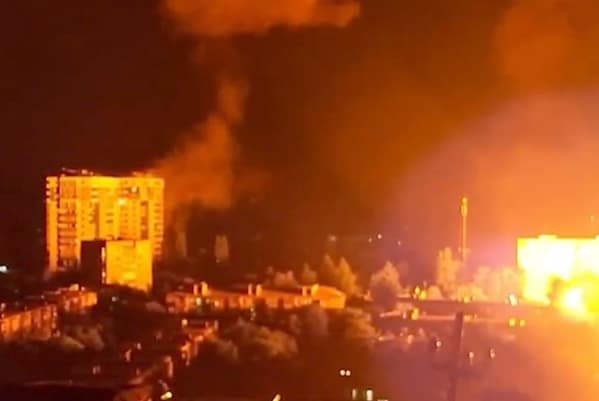
As civilians come under fire, the debate over Ukraine aid shifts from strategy to a stark test of moral responsibility.
As Russian missiles and drones continues to strike deep into Ukraine, the war is increasingly being fought far beyond the frontline in cities where civilians, not soldiers, bear the brunt of the violence.
Dnipro is one city in this latest example.
A major industrial and population centre in central Ukraine, home to around one million people, the city has once again come under sustained attack. Ballistic missiles and Iranian-designed Shahed drones have struck residential areas over the last days, injuring civilians and damaging homes in what has become a familiar pattern of warfare.
This is not incidental damage, it’s systematic and without what seems any consequences.
Since the start of the full-scale invasion in 2022, Russia has repeatedly targeted urban centres across Ukraine, from Kyiv to Kharkiv, Odesa to Zaporizhzhia. In Mariupol alone, conservative estimates suggest that as many as 20,000–25,000 civilians were killed during the siege, that’s a conservative estimate, while across the country millions have been displaced, with between 4-6 million Ukrainians forced to flee abroad.
Despite this, the battlefield itself remains largely static, frankly, I still don’t know how we remain cosmetically ok despite the 4 year attacks on Ukrainian cities, but the defensive lines have held in many sectors, while Russia has failed to achieve decisive breakthroughs. Instead, Moscow has increasingly relied on long-range strikes, targeting infrastructure, energy systems, and civilian areas, in an apparent attempt to erode morale and impose a cost on resistance.
But while the war continues on the ground, in the United States, voices questioning continued support for Ukraine are growing louder, among them is JD Vance, who recently described efforts to halt aid to Ukraine as one of his “finest achievements.”
It is a statement that cuts through his usual political framing, because this is no longer simply a debate about funding or foreign policy priorities, it is a question of principle.
At a time when cities like Dnipro are being struck in broad daylight, when civilians are being killed and emergency services are still responding to the aftermath, the withdrawal of support is not a neutral act, and it will have consequences.
History has repeatedly shown that when support fades, aggression does not, it accelerates.
This is where the debate moves beyond politics and into morality and Vance, like many in American public life, identifies as a Christian, yet, the core tenets of Christianity, the protection of the vulnerable, the defence of the oppressed, and the moral imperative to stand against injustice, appear increasingly difficult to reconcile with calls to step back from a nation under sustained attack.
This contradiction is not unique, because Ukraine today is not only defending its territory. It is resisting a form of warfare that deliberately targets civilian life as a means of pressure. A strategy rooted not in battlefield success, but in the infliction of fear.
To disengage in that context is not simply to “end involvement”, it is to shift the balance. As the war grinds on, the question facing Western policymakers is becoming harder to avoid: if not here, then where do these principles apply?
Because when this conflict eventually ends, as all wars do, the outcome will not only be measured in territorial lines or political agreements.
It will also be measured in the decisions made along the way.
Who stood firm.
Who stepped back.
And who chose to look away.


Leave a Comment