
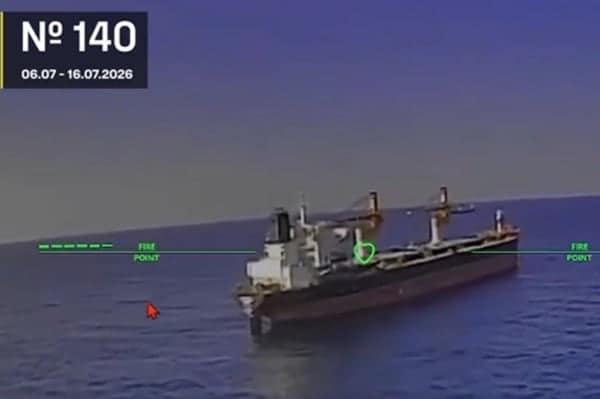
Ukraine’s escalating campaign against Russia’s sanctions-busting oil fleet is forcing Moscow to pull elite drone units away from the battlefield and redirect them towards protecting vulnerable vessels — exposing a new pressure point in the Kremlin’s war machine.
Russia is being forced into an uncomfortable military trade-off: defend its lucrative shadow fleet or keep some of its most effective drone warfare units on the front line.
According to Ukraine’s Unmanned Systems Forces commander Robert “Madyar” Brovdi, Moscow has begun reallocating elite drone personnel away from combat operations in Ukraine to protect oil tankers and other vessels targeted by Kyiv’s expanding maritime campaign.
The move highlights the growing importance of Ukraine’s drone warfare strategy, which is increasingly aimed not only at Russian military targets but at the economic networks helping to finance the Kremlin’s invasion.
Brovdi said Russia has deployed as many as 200 groups from the Rubicon unit — considered one of Moscow’s most capable drone formations — to defend its so-called shadow fleet.
The deployment means individual vessels could now have dedicated Russian security teams assigned to protect them from Ukrainian attacks.
For Moscow, the decision represents a costly diversion.
Every drone operator moved to protect an oil tanker is a soldier removed from the battlefield. Every air defence system guarding a ship is one potentially unavailable for frontline operations.
The battle for Russia’s hidden oil lifeline
Ukraine launched its “MoLoCHKa” operation on July 6, a campaign aimed at striking Russia’s shadow fleet — a network of mostly ageing tankers operating under foreign flags to transport Russian oil around Western sanctions and the G7 price cap.
The fleet has become a critical part of Moscow’s wartime economy.
Despite sanctions imposed after the invasion of Ukraine, Russia has maintained significant oil export revenues through alternative shipping networks, allowing the Kremlin to continue funding military production and battlefield operations.
Kyiv’s strategy is designed to attack that financial lifeline.
Brovdi said Ukrainian forces struck 172 Russian-linked shadow fleet vessels during a 13-day operation, targeting tankers, dry cargo ships, ferries, floating cranes and tugboats.
The campaign has since continued, with Ukraine claiming further strikes against Russian vessels in both the Black Sea and the Sea of Azov.
A new front in the economic war
The attacks represent a shift in Ukraine’s approach.
Rather than focusing solely on destroying tanks, ammunition depots and military infrastructure, Kyiv is increasingly targeting the systems that allow Russia to sustain the war.
The shadow fleet has become a symbol of Moscow’s ability to adapt to sanctions pressure.
But Ukraine’s drone offensive is testing whether that adaptation can survive under sustained attack.
The Kremlin now faces a dilemma familiar throughout modern warfare: protecting critical assets requires resources, but every resource committed to defence reduces pressure elsewhere.
Crimea under siege
The maritime campaign is also part of a wider Ukrainian effort to isolate occupied Crimea.
Kyiv has launched what it describes as a “logistical lockdown” strategy, targeting bridges, supply routes, fuel infrastructure and military facilities linked to Russia’s control of the peninsula.
Former Defence Minister Mykhailo Fedorov previously warned that continued Ukrainian strikes could eventually transform Crimea into an isolated territory dependent on increasingly vulnerable supply routes.
The strategic goal is clear: make Russia’s occupation of Crimea more expensive, more difficult and harder to sustain.
Russia’s drone dilemma
The redeployment of the Rubicon unit reveals another reality of the war.
Drones are no longer simply battlefield weapons. They have become tools of economic warfare, naval disruption and strategic pressure.
Ukraine has used relatively inexpensive unmanned systems to force Russia into expensive defensive responses, creating a constant security burden across thousands of kilometres of territory and coastline.
The Kremlin can protect its fleet — but doing so comes at a cost.
The question now is whether Russia can defend the economic arteries keeping its war machine running while maintaining enough combat power to continue its offensive in Ukraine.
The shadow fleet battle may therefore become one of the defining contests of the next phase of the war: a struggle between Ukraine’s ability to disrupt and Russia’s ability to absorb the pressure.


Leave a Comment