
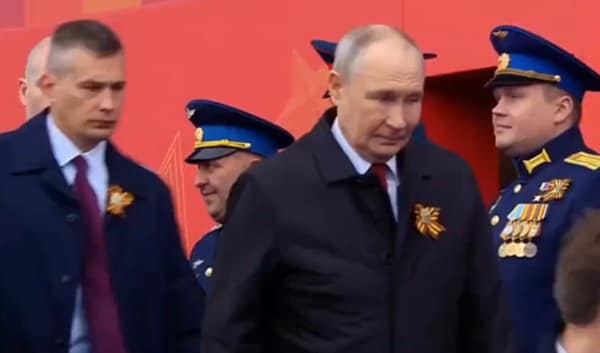
Vladimir Putin used Russia’s Victory Day celebrations to insist that Moscow would triumph in Ukraine, even as the Kremlin staged one of the most subdued and heavily secured parades seen on Red Square in decades.
In a speech laced with familiar anti-Western rhetoric, the Russian president claimed his forces were confronting not merely Ukraine, but the combined might of NATO — a narrative the Kremlin has increasingly relied upon as the war drags into a grinding conflict of attrition.
“The great feat of the generation of victors inspires the soldiers carrying out the goals of the special military operation today,” Putin declared, once again using the Kremlin’s preferred euphemism for the invasion.
Yet behind the defiant language, this year’s parade betrayed unmistakable signs of strain.
For the first time since 2007, no tanks, missile launchers or heavy military hardware rolled through Red Square, reducing the spectacle largely to marching formations and ceremonial displays. The omission will inevitably fuel speculation over both battlefield losses and fears of Ukrainian long-range strikes deep inside Russian territory.
Security across Moscow reached extraordinary levels. Authorities reportedly shut down mobile internet access and restricted messaging services in central districts before the ceremony began, while the entire event lasted just 45 minutes — unusually brief by Kremlin standards.
It’s genuinely sad that a doddering old fool chasing imperial fantasies now has to openly rewrite history on a day that’s supposed to honour suffering, sacrifice and the defeat of tyranny.
That’s why Victory Day matters so much to him now, not because of the people who suffered,… https://t.co/UmlCJkV2gK
— Shaun Pinner (@ShaunPinnerUA) May 9, 2026
Perhaps the most striking image came with the reported participation of North Korean troops, who marched in a separate column after previously fighting alongside Russian forces in the Kursk region. Their presence underscored Moscow’s growing dependence on authoritarian allies as Western sanctions and military pressure continue to bite.
International attendance was conspicuously thin. Belarusian leader Alexander Lukashenko appeared alongside a small handful of foreign dignitaries, but the broad coalition of international guests once cultivated by the Kremlin was notably absent.
The parade commander, General Andrei Mordvichev — associated with the brutal siege of Mariupol — embodied the increasingly hardline military face of the Russian campaign.
Notably, the celebrations unfolded under a temporary reduction in Ukrainian drone activity following a limited humanitarian arrangement between Kyiv and Moscow. According to Ukrainian officials, President Volodymyr Zelenskyy approved a temporary exclusion zone around Red Square to facilitate negotiations linked to a major prisoner exchange involving 1,000 captives.
I have no doubt many remember, but it’s this lunatic who’s used the platform for a desperation plea.
Pathetic https://t.co/OncZDVmOsR
— Shaun Pinner (@ShaunPinnerUA) May 9, 2026
Kyiv insisted the decision reflected humanitarian priorities rather than any softening of its military posture, stressing that the safe return of prisoners outweighed symbolic attacks during Russia’s most politically charged national commemoration.
Even so, the contrast was stark: a Russian leader proclaiming inevitable victory while presiding over a pared-back parade in a capital operating under near wartime security conditions.
For critics of the Kremlin, the message from Red Square was less one of confidence than controlled vulnerability — a carefully choreographed display shaped as much by fear of attack as by triumphalism.


Leave a Comment