
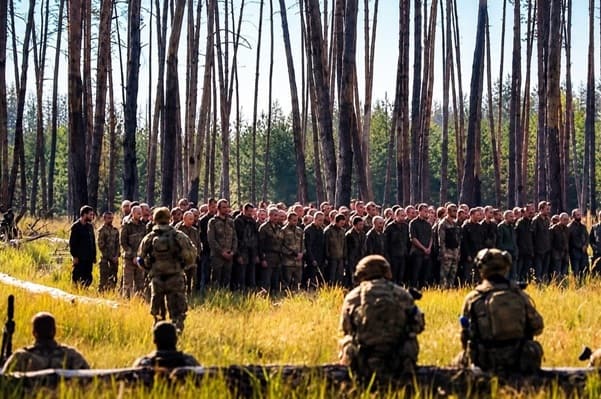
Ukraine’s Third Army Corps says it has captured more than 250 Russian servicemen and retaken another 51 square kilometres of territory during the latest phase of Operation Vivaldi on the Lyman axis.
The latest gains bring the total territory recovered during the operation in northern Donetsk Oblast to 176 square kilometres, according to Brigadier General Andrii Biletskyi, commander of the Third Army Corps.
Ukrainian forces liberated Nove, Ridkodub and Katerynivka, while restoring control over Karpivka and Novomykhailivka during what the Corps describes as the third “season” of Vivaldi.
Biletskyi said Russian forces also suffered approximately 2,000 personnel losses during the latest phase, with more than 250 taken prisoner; obviously, we can’t verify those figures.
The scale of the operation is significant, though, because the Lyman sector forms part of the wider battle for northern Donetsk and the approaches towards Ukraine’s heavily defended urban belt around Sloviansk, Kramatorsk, Druzhkivka and Kostiantynivka.
The Institute for the Study of War has assessed that Ukrainian operations in the area achieved the “operationally significant” effect of disrupting Russian attempts to develop a wider encirclement of this so-called Donetsk “Fortress Belt”, in some places wiping out 2 years of Russian advances.
According to Biletskyi, deception formed an important part of the latest phase.
NEW: Ukrainian forces appear to be shifting their counteroffensive tactics toward systematically targeting Russian efforts to reinforce initial Russian infiltrations rather than focusing on clearing the infiltrators immediately in various sectors of the frontline.
Other Key… pic.twitter.com/KPGTsZJ04H
— Institute for the Study of War (@TheStudyofWar) September 27, 2026
Russian commanders were led to believe that Ukraine’s principal attack was developing along the Shandryholove–Zelena Dolyna axis, prompting Russian forces to commit reserves to counter-attacks there.
The principal Ukrainian objective was instead Nove, which the Third Army Corps described as an important Russian hub commanding high ground across the bridgehead.
“The Russians slept through the real attack,” Biletskyi said.

The operation has also demonstrated Ukraine’s increasing integration of conventional forces with unmanned systems.
During earlier phases, the Corps described using drones, robotic systems and infantry together, while Ukrainian unmanned systems targeted Russian logistics and fuel infrastructure. The first publicly disclosed phase cleared Russian infiltration from approximately 75 square kilometres and liberated another 10 square kilometres. Biletskyi estimated Russian personnel losses during that stage at around 1,500.
During the latest fighting, Soviet-era BTR-60 armoured personnel carriers were converted into unmanned explosive vehicles and used against fortified Russian positions, according to the Third Army Corps.
Combined with artillery, electronic warfare, air defence, reconnaissance and attacks on logistics, the operation provides an example of how Ukraine is adapting combined-arms warfare to a battlefield increasingly dominated by drones.
Operation Vivaldi has also renewed scrutiny of the accuracy of Russian battlefield reporting.
On 1 September, Vladimir Putin claimed Russian forces had captured Sviatohirsk, north of Sloviansk. Six days later, Biletskyi filmed himself openly in the Ukrainian-controlled city and said the area was effectively in Ukraine’s rear.
ISW assessed that the episode demonstrated the falsity of Putin’s claim and reported that even a Kremlin-affiliated Russian military blogger acknowledged Ukrainian control.
The same Russian commentator warned that inaccurate reports of territorial gains can create genuine operational problems: neighbouring formations can plan around an incorrect frontline, while Russian forces may encounter difficulties requesting strikes against locations their command officially claims to control.
Russian military commentators have themselves described such exaggerated battlefield reporting as “beautiful reports”, information moving upwards through the command structure that can present territorial gains greater than those actually achieved.
There are important results from our troops in the Lyman sector of the Donetsk region as part of Operation Vivaldi, as well as from the Airborne Assault Forces grouping as part of another one of our active defense operations. The occupiers continue to be eliminated, and the…
— Volodymyr Zelenskyy / Володимир Зеленський (@ZelenskyyUa) September 27, 2026
The Ukrainian counter-offensive comes as Kyiv continues to report high Russian casualty figures across the wider front.
Ukraine’s General Staff estimated on 28 September that Russian forces had suffered approximately 1,531,060 personnel losses since February 2022, including 2,090 during the preceding 24 hours.
Ukraine also reported destroying or damaging 49 Russian artillery systems, eight armoured fighting vehicles and 490 vehicles and fuel tankers during that period. These figures are Ukrainian battlefield estimates and cannot all be independently verified.
The significance of Vivaldi therefore extends beyond the territory recovered around Lyman.
Ukraine has demonstrated that it can still conduct coordinated offensive operations combining infantry, armour, artillery, drones, unmanned ground vehicles, electronic warfare, air defence and deep interdiction, while simultaneously deceiving Russian commanders about the direction of its main effort.
Russia continues to hold roughly 80% of Donetsk Oblast and maintains considerable manpower and firepower across the eastern front, meaning the Ukrainian gains do not fundamentally change the overall balance of the war, however, they have complicated Moscow’s operations towards the northern Donetsk urban belt.
Biletskyi previously explained the operation’s unusual name by noting that Vivaldi composed The Four Seasons.
Ukraine has now publicly revealed three phases of the operation.
If the analogy holds, there is still another “season” to come.


Leave a Comment