
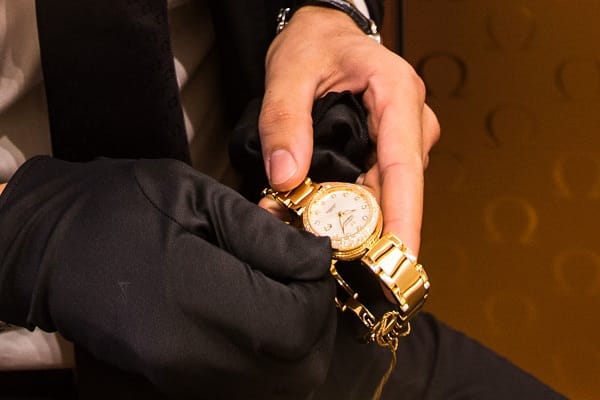
Walk into any major UK jewellery retailer, drop off a luxury Swiss watch for servicing, and there is a strong chance the actual work is carried out six miles east, in a workshop above Kirby Street.
SwissMade in Hatton Garden has been the official UK service centre for nine Swiss watch houses since 1985. In the four decades since, it has serviced more than 70,000 luxury timepieces for private clients and, far more frequently, for the trade. Roughly 98% of the workshop’s volume comes from the British jewellery industry’s largest retailers (Goldsmiths, H. Samuel, Watches of Switzerland and several others), who quietly send their watches to Hatton Garden for the mechanical work their boutique floors do not do.
For most consumers, this is the invisible layer of London’s luxury retail. For anyone looking at the economics of specialist urban trades, it is a working case study in how a London quarter survives when the surrounding retail landscape does not.
How the trade work actually flows
When a customer leaves an Omega with a Bond Street boutique for a full service, the watchmaking is almost never carried out at that boutique. The economics do not support it. Maintaining an in-house watchmaking team covering nine Swiss brands at manufacturer-approved standards is a seven-figure overhead that only Watchfinder-scale operations or the brand service centres themselves can justify.
Instead, retailers outsource to a small number of accredited independent workshops. The arrangement works both ways. The retailer avoids a workshop cost it cannot amortise. The workshop secures a predictable volume base that justifies maintaining manufacturer accreditation across multiple Swiss houses, each of which requires its own tooling, parts access and watchmaker certification.
SwissMade is one of the longest-running of those workshops. The multi-brand accreditation position (Omega, TAG Heuer, Cartier, Baume & Mercier, Longines, Tissot, Hamilton, Certina, Ebel and Fortis) is unusually broad for an independent operation. Few UK workshops hold accreditation across this many houses simultaneously, which is what makes the trade business viable at scale.
Why Hatton Garden specifically
Hatton Garden has been London’s diamond and jewellery quarter since the nineteenth century. The specialist trades inside the quarter (cutting, setting, valuation, repair, watchmaking) have long defined its commercial character.
What makes the quarter interesting from a London-economic point of view is that it is still operating as a working-trade district at a time when most of the city’s other specialist quarters are not. Fleet Street’s print trade is gone. Soho’s music industry has largely dispersed. Savile Row has partly held, but at a scale that is a fraction of its mid-century footprint. The pattern across the capital has been that specialist clustering gives way to residential or hospitality conversion.
Hatton Garden has resisted that pattern more than most. The reasons are partly geographic (the Barbican and Farringdon surround it with mixed-use density rather than the pure residential pressure that priced out some other quarters) and partly economic (the jewellery and watchmaking trades still benefit from physical proximity to each other in ways that remote-work-era service businesses do not). Dealers, parts merchants, specialist suppliers and finishing workshops all operate within walking distance. An equivalent workshop running from a dispersed Essex industrial estate would face materially higher logistics costs on exactly the kind of small, specialist orders that make up the daily workflow.
That density is doing commercial work that does not show up on any single business’s profit and loss sheet, but matters enormously for the quarter’s continued viability.
The accreditation that gates the whole model
What distinguishes an accredited service centre from a general watchmaker is specialist tool access and manufacturer parts. Swatch Group, which owns Omega, Longines, Tissot, Hamilton and several other houses, restricts distribution of movement parts to accredited workshops. Richemont, which owns Cartier and Baume & Mercier, operates similar restrictions. LVMH, which owns TAG Heuer, is less restrictive but still gates access to its specialist tooling.
A high street jeweller can replace a battery and give a case an external clean. A full mechanical service on a modern Omega Co-Axial calibre, or a Cartier Tank movement overhaul, needs the accreditation, the tooling and the parts. Any workshop offering ‘Omega servicing’ without accreditation is, in practice, either shipping the watch elsewhere or using aftermarket parts that invalidate the manufacturer warranty and reduce the watch’s resale value.
The commercial consequence is that the trade work follows the accreditations. A multi-brand accredited workshop in a jewellery district with established retailer relationships is a defensible business position. A general watchmaker on a high street without accreditation is not, in 2026, a business with much structural future.
The economics of a specialist trade workforce
A watchmaker typically trains for several years before being bench-ready at manufacturer-approved standard. SwissMade’s team represents around 200 years of collective experience. That figure reflects a reality particular to horology: watchmakers tend to stay in workshops where the work is varied and the equipment is current, which means that experience compounds across careers rather than resetting with every job change.
That continuity matters commercially in a sector where skilled hands are the capacity constraint. The industry’s training pipeline is thin. The watchmaking schools in Birmingham and Switzerland produce a limited annual cohort, and most of them are absorbed by brand service centres rather than independent workshops. Any UK workshop losing a senior watchmaker takes months to recover the lost capacity.
The implication for the sector is that the workshops with established teams are better positioned than those recruiting into churn. SwissMade’s forty-year tenure in the quarter has translated into retained senior talent, which translates into volume handling capacity, which translates into viable trade relationships with the retailers. The chain is long but each link is load-bearing.
What London stands to lose if the specialist quarters go
London Loves Business recently covered how London’s bakery culture is changing as niche food trades consolidate and shift geographically. The parallel with Hatton Garden is instructive. Specialist urban trades are a different kind of business asset: easy to lose quickly, difficult to replace at the same depth and density.
Watchmaking is a slower-moving example of the same pattern. A workshop that closes does not simply reopen somewhere else. The accreditations have to be re-earned from scratch, the trade relationships have to be rebuilt, and the senior watchmakers (if they even stay in the trade) disperse into brand service centres or retire. The time cost of reconstructing a Hatton Garden-scale operation elsewhere is measured in decades, not quarters.
For the retailers that currently depend on the quarter’s workshops, the margin cost of losing that infrastructure would be material. Sending servicing work back to Switzerland adds four to five months to turnaround times. Routing it through brand-direct London service centres puts the retailer back in a dependency position they have spent years outsourcing out of. The current arrangement, with specialist independent workshops absorbing the trade volume, is the equilibrium most of the retailers have settled on.
The next decade
The UK luxury watch servicing market has grown steadily since the pandemic surge in mechanical watch ownership and the pre-owned and vintage market boom. The post-helpful-content era in retail has pushed consumers back toward trusted, verifiable service providers (manufacturer-authorised wherever possible). Multi-brand accredited independent workshops are the main beneficiary of both trends.
For Hatton Garden specifically, the pressure now is less about commercial viability and more about continuity. The workshops that survive the next decade will be the ones with established accreditations, deep trade relationships, retained senior watchmakers, and vintage capacity for the growing inheritance market. SwissMade’s fortieth-year position reflects all four.
The broader London story is that specialist trade quarters are commercial infrastructure, not nostalgia. Keeping them operationally viable, through the accreditations, the training pipeline and the physical cluster, is the quiet work that keeps a city able to service its own luxury economy without routing the work abroad.
After forty years in Hatton Garden, SwissMade is one of the quieter examples of that work being done. The watches passed across Bond Street counters, the restorations commissioned by inheritors, the service work routed through major UK retailers (all of it depends on specialist urban trades remaining operationally viable). What happens in the quarter over the next decade will determine whether the capital’s luxury watch servicing stays in London, or disperses to Birmingham, Switzerland or elsewhere.
The betting at the moment is that it stays.
SwissMade Ltd is based at 21–22 Arundel House, 43 Kirby Street, London EC1N 8TE. The workshop is the official UK service centre for Omega, TAG Heuer, Cartier, Baume & Mercier, Longines, Tissot, Hamilton, Certina, Ebel and Fortis. Trade and private client enquiries: [email protected].



Leave a Comment