
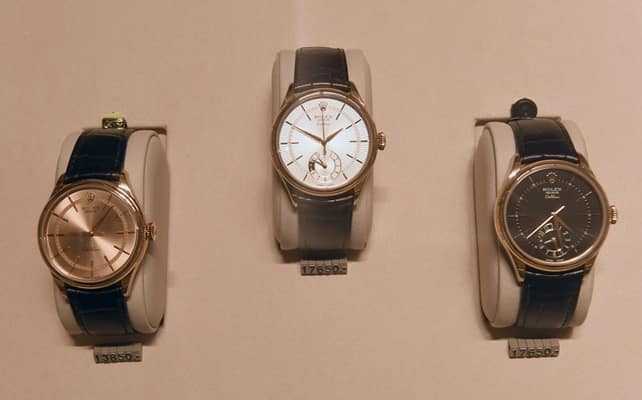
Luxury goods were and are famous for high craftsmanship and rare items which remain valuable even years after their release. Nonetheless, the approach to luxury adopted by owners changes and is being reassessed. Previously, the primary attention was paid only to the brand new products available in the market. Currently, however, the accent shifts to the products with a history, particularly when craftsmanship and durability are concerned.
This tendency prevails when it comes to such items as luxurious watches, jewellery, and heritage collection. People can enjoy an antique watch for its unique dial or its movement, whereas vintage jewellery provides a lot of features not present in contemporary collections. Older luxury goods become characterized by some additional value apart from their initial retail cost.
The increasing popularity of circular luxury can be regarded as a part of the general assessment of the value of any object. Age becomes irrelevant in this case if the quality of the product is maintained.
How circular luxury is changing traditional ownership
A circular luxury is the practice of ownership through keeping the good quality of products for as long as possible through their maintenance, repair, restoration, and resale. In contrast to the linear economy where any product becomes considered used by its owner once they stop needing it, circular ownership accepts the fact that quality items can keep fulfilling their function over generations.
According to the Ellen MacArthur Foundation, reuse, repair, and the circulation of products are one of the basic principles of the circular economy. They stress the need to preserve the value embodied in the products rather than to dispose of them as soon as possible.
For the luxury market, this idea is particularly relevant since many of the existing categories have always valued durability and reparability of the products. The watch mechanisms can be repaired, the jewellery can be restored, and the accessories kept for decades if taken care of properly.
However, circular ownership should not automatically be confused with environmental sustainability. A previously owned product still carries environmental impacts associated with transportation, maintenance and possible restoration. The broader environmental benefit depends partly on whether extending its life reduces demand for additional production.
What makes circular luxury interesting is its emphasis on continued usefulness. The value of an object is no longer necessarily tied to being its first owner.
Why younger consumers are exploring the pre-owned market
Changing attitudes between consumers and second hand luxury goods are backed by evidence regarding the secondary watch market.
According to Deloitte’s Swiss Watch Industry Study 2025, which conducted surveys among consumers in major markets such as the UK, 40% of Millennials and Generation Z consumers were expected to purchase a pre owned watch in the coming year. The survey also found that 53% of customers in the secondary market were driven by the cost factor, whereas 36% were motivated by unique designs unavailable in the market.
This evidence suggests that used luxury goods have value for various reasons. Consumers might find it satisfying to engage with well established craftsmanship or rare designs that are no longer available in the market.
Consumers who are younger might have different attitude towards ownership in comparison to past generations. While older consumers move from entry level items to luxury ones through the usual process, younger consumers might have interest in specific time periods, movements or design features.
Social media and specialist watch communities have made it easier to discover these distinctions, although online information still requires careful evaluation. Collecting knowledge is increasingly shaped through discussions about originality, design history and mechanical construction rather than brand recognition alone.
For the wider luxury industry, the significance lies in the growing acceptance of previous ownership as part of a product’s identity.
Why provenance matters more than age alone
An older luxury item does not automatically become more desirable simply because it has survived for several decades. Collectors often place considerable importance on provenance, originality and condition when assessing its significance.
Provenance refers to the documented history of an object, including details of its ownership, origin and relevant historical associations. In established collecting categories, reliable documentation can help explain how an item has changed hands and whether important characteristics have been preserved.
For mechanical watches, this assessment may involve original papers, service records, reference information and the relationship between the case, dial, hands and movement. These details can provide useful context about how a particular timepiece has been maintained or altered.
Collectors researching established secondary markets, including those exploring pre owned rolex uk at BQ Watches, may encounter these considerations as part of a broader interest in historical watch design and continued ownership.
Nevertheless, provenance should never be considered in isolation. Documentation does not automatically establish mechanical condition, while a watch without its original papers may still possess considerable historical and aesthetic interest.
The important distinction is between an object that is merely old and one whose surviving characteristics make its history worth understanding.
Craftsmanship and the appeal of objects built to last
The continuing attraction of older luxury pieces is closely connected to the quality of their original construction. Materials, engineering and attention to detail can determine whether a product remains useful and attractive long after its introduction.
Mechanical watchmaking provides an interesting illustration. A traditional movement relies on a coordinated arrangement of gears, springs, wheels and other components to measure and display time. Depending on its construction, condition and the availability of appropriate parts, such a movement may continue functioning through successive periods of ownership.
Servicing is an important part of this longevity. Lubricants deteriorate, components experience wear, and water resistant seals may require replacement. A mechanical watch is therefore not maintenance free, even when its construction allows it to operate for many decades.
The same relationship between craftsmanship and care can be observed elsewhere. A well made piece of jewellery may require restoration or adjustments, while a leather accessory may retain its usefulness through appropriate maintenance.
These characteristics explain why repairability deserves greater attention in discussions about luxury. An object’s ability to remain functional can be just as important as its original appearance.
It also gives collectors a reason to study traditional manufacturing techniques. Understanding how something was made often deepens appreciation of why it has survived.
The cultural appeal of discontinued designs
Fashion and product design do not develop in a straight line. Preferences change, established styles are reconsidered, and details that once appeared outdated can acquire renewed appeal.
This is particularly visible in watchmaking, where case proportions, bracelet construction and dial layouts have changed considerably across different production periods.
A compact case associated with an earlier generation may appeal to collectors who prefer restrained proportions. Similarly, unusual dial finishes, distinctive numerals or older bracelet designs can provide a visual character that contemporary models do not necessarily reproduce.
The appeal of discontinued designs also extends beyond watches. Vintage jewellery often reflects the artistic influences of its period, while heritage accessories can reveal changing attitudes towards materials, decoration and everyday practicality.
For collectors, these historical differences create opportunities to develop individual preferences rather than choosing exclusively from current releases.
There is also an emotional dimension. Objects associated with a particular decade, family member or personal achievement can carry meaning that cannot easily be measured through their market value.
This combination of cultural history and individual attachment helps explain why certain luxury possessions remain meaningful across generations.
Does pre-owned luxury always represent better value?
Although the secondary market offers access to previously owned items, it would be misleading to assume that every purchase represents a financial opportunity.
Luxury resale values can fluctuate according to supply, collector demand, rarity, condition and wider economic circumstances. A model that attracts considerable attention during one period may experience weaker demand later.
The distinction between market value and collecting value is therefore important.
Someone interested in mechanical engineering may appreciate a particular calibre because of its construction or historical importance. Another collector might favour a specific design because it relates to a significant personal memory. Neither motivation necessarily depends on future price appreciation.
Practical considerations also matter. Restoration expenses, servicing requirements, insurance and transaction costs can affect the overall cost of ownership.
In the United Kingdom, collectors should also consider how an item’s condition and documentation relate to the information provided about it. Specialist knowledge is valuable when evaluating originality, alterations and maintenance history.
A thoughtful collecting approach therefore involves more than comparing asking prices. It requires an understanding of what makes a particular object distinctive and what responsibilities come with preserving it.
Why the future of luxury may depend on longevity
Interest in second-hand items does not undermine the significance of modern design and craftsmanship. On the contrary, it increases the scope of ways for enjoying extraordinary products.
The innovation and improvement of materials used in the process of production may become a characteristic of new items. Old ones keep the methods and decisions of their producers alive. Both kinds of items could be helpful in studying luxury.
A major step that is being taken is a shift in attitude towards possession of products. The value of a good product does not diminish during the process of its change of hands. Its story may still go on thanks to proper use and conservation of the item.
Thus, for collectors, there appears a focus on quality, originality and suitability for further usage.
Circular luxury is based on the following idea: the importance of craftsmanship increases if its relevance lasts. It can be done with the help of a mechanical watch, an item of jewellery or any other accessory.





Leave a Comment