
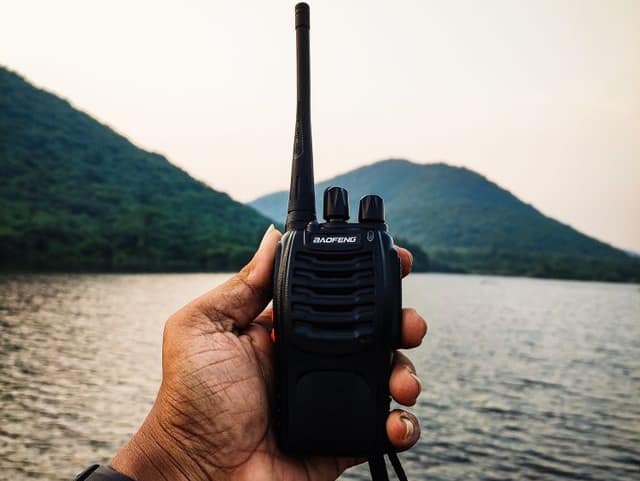
Long-range two-way radios improve communication across large business sites by giving teams immediate voice contact without relying on mobile apps, individual phone calls, or constant screen access. For warehouses, construction projects, logistics yards, factories, event venues, and multi-building facilities, that speed matters when staff are spread across wide areas and need to coordinate work in real time.
Smartphones and workplace software remain valuable for records, schedules, files, and detailed conversations. Radio communication serves a different purpose. It gives operational teams a direct channel for short instructions, status updates, safety notices, and requests that need a quick response.
Why does communication become harder across large business sites?
Distance is only one part of the problem. Large sites often include concrete walls, metal structures, machinery, separate buildings, loading zones, stairwells, basements, and outdoor areas. Employees may also be moving continuously or working in noisy conditions where checking a phone is inconvenient.
A warehouse supervisor, for example, may need to contact staff in receiving, dispatch, stock control, and the loading yard at the same time. Calling each person separately creates unnecessary delay. Group messaging is faster, but it still depends on workers noticing a notification.
This is where long-range two-way radios fit naturally into business operations. PMC Telecom supplies licensed business radios designed for environments where teams need stronger coverage and more dependable communication than short-range licence-free equipment can provide.
The main advantage is not simply distance. It is the ability to reach one person or an operational group quickly while staff continue working.
How do long-range two-way radios differ from other communication tools?
Radio, mobile phones, and workplace platforms each work best for different types of communication. Treating them as interchangeable often creates inefficient workflows.
| Communication tool | Best suited to | Main limitation |
| Long-range two-way radio | Immediate operational voice communication | Not designed for detailed records or documents |
| Smartphone call | Private one-to-one discussion | Slow for contacting several workers |
| Messaging app | Written updates and group messages | Requires staff to check a screen |
| Business software | Tasks, records, schedules, and reporting | Less practical for urgent spoken instructions |
A radio system therefore does not need to replace existing digital tools. It can sit alongside them. An urgent loading instruction can be delivered by radio, while the related shipment record remains in the warehouse management system.
Where do long-range two-way radios add the most value?
The strongest use cases involve people who work across the same physical operation but cannot remain at desks. Different industries create different communication demands, but several patterns appear repeatedly.
Construction teams need to coordinate deliveries, machinery movements, site access, and work across separate zones. Logistics businesses may have staff moving between warehouses, yards, loading bays, and vehicle areas. Large hospitality or event operations need communication between entrances, security, facilities, and management.
Manufacturing sites present another challenge because machinery and building materials can affect signal performance. In these environments, the correct radio type and site configuration matter more than an advertised maximum range.
Businesses considering a radio system should assess:
- Site layout: Identify separate buildings, floors, outdoor areas, and known weak-signal locations.
- Working environment: Consider concrete, steel, machinery, hills, trees, and other obstacles.
- Team structure: Decide whether departments need shared channels, separate groups, or both.
- Shift length: Make sure battery capacity matches normal operating hours.
- Noise levels: Test audio clarity where employees actually work.
- Durability: Match the equipment to dust, rain, impact, or other site conditions.
- Coverage testing: Check real operating areas before a full deployment.
How do UHF and VHF radios affect coverage across large sites?
Choosing between UHF and VHF depends heavily on the physical environment.
UHF radios are commonly used in built-up sites because their shorter wavelengths generally perform better around walls, shelving, and other structural obstacles. This makes them relevant to warehouses, factories, commercial buildings, and many urban operations.
VHF equipment is usually better suited to open environments with fewer physical barriers. Farms, outdoor events, large worksites, and other operations spread across open ground may benefit from this type of radio system.
Neither option should be chosen solely from a headline distance figure. Real-world radio coverage depends on buildings, terrain, antenna position, interference, equipment configuration, and where workers actually need to communicate.
For especially large or difficult sites, repeaters can also extend coverage beyond what direct handset-to-handset communication can achieve.
Why does faster communication matter for business operations?
Small communication delays can accumulate across a busy site. A delivery waiting because the receiving team was not contacted, a technician searching for a supervisor, or a loading crew missing a schedule change can all consume time without appearing as major operational failures.
Direct radio communication reduces the number of steps between an issue and the person who can respond. A worker presses a button, delivers the message, and receives an answer without leaving the work area.
That simplicity is especially useful when communication is frequent but brief. Most operational exchanges do not require an email, formal task entry, or telephone conversation. They need a clear answer at the moment the work is happening.
How should businesses use radios alongside digital systems?
A practical communication strategy assigns each tool to the job it handles best. Radios manage immediate spoken coordination, while digital systems preserve information that needs to be stored, shared later, or analysed.
For example, a facilities team can receive an urgent maintenance request over radio and then record the completed repair in its management software. A warehouse supervisor can redirect staff quickly while inventory movements continue to be tracked digitally.
The value of long-range radio communication is therefore less about replacing modern technology and more about filling a gap that screens and apps do not always handle efficiently. On large business sites, where distance, movement, and time-sensitive decisions shape daily work, immediate voice contact remains a practical part of the wider communication infrastructure.





Leave a Comment