
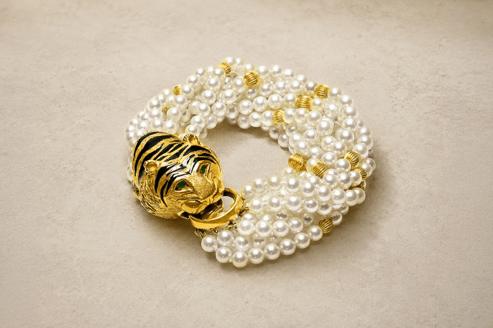
For today’s international jewellery buyer, rarity is only part of the equation. Trust, context and the ability to understand a piece have become equally important.
Luxury jewellery is entering an era in which the story behind an object can matter almost as much as the object itself. A buyer considering a vintage Cartier brooch, an Art Deco ring or a rare coloured gemstone is not evaluating materials alone. They are also asking who made it, when it was created, whether it remains true to its original design and how confidently its history can be understood.
That change is creating new opportunities for specialist dealers. It also places greater responsibility on them. In a market filled with one-of-a-kind pieces, trust cannot be produced through branding alone; it has to be earned through knowledge, careful examination and clear communication.
A more informed definition of luxury
London has always understood the cultural importance of jewellery. The breadth of the V&A’s jewellery collection demonstrates how jewels can preserve changes in fashion, craftsmanship, social identity and artistic taste across centuries.
Today’s collectors are bringing that same historical curiosity to the commercial market. They increasingly want jewellery with individuality and context rather than objects defined only by carat weight or a familiar logo. A maker’s mark, an unusual construction detail, a period-specific technique or an original fitted box can materially change the way a piece is understood.
This does not mean that beauty has become less important. It means beauty is being considered alongside rarity, authorship, condition and provenance. The modern luxury client is not simply asking, “Is this valuable?” They are also asking, “Why does this particular piece matter?”
A New York business built around careful selection
This approach is central to DSF Antique Jewelry, a New York-based dealer serving collectors and clients internationally. Established in 2011 and drawing on more than 50 years of experience in the wholesale jewellery business, DSF handles fine jewellery, signed designer pieces, rare gemstones, estate, vintage and antique jewels, watches and collectible objects.
The breadth is intentional. Rather than limiting luxury to one period, DSF’s collection can move from ancient and Renaissance objects to Georgian, Victorian, Art Nouveau, Art Deco, mid-century and contemporary design. What connects the pieces is not simply age. It is the combination of quality, craftsmanship, rarity, design and historical or artistic interest.
That distinction matters because “old” and “collectible” are not interchangeable. Age can provide context, but it does not automatically establish importance. A specialist must assess whether a piece has the design strength, condition, originality and market relevance that discerning collectors expect.
Why a signature is only the beginning
Signed jewellery has become especially visible as fashion collectors look beyond handbags and clothing toward the jewellery created by major houses. Cartier, Van Cleef & Arpels, Tiffany & Co., Bulgari, Boucheron, Chanel, Christian Dior and Hermès all have distinct histories, yet their output can vary significantly by country, period, collection and production method.
For that reason, a signature should never be treated as the whole story. Evaluating signed designer jewellery also requires attention to construction, design language, metal marks, serial numbers where applicable, period-appropriate craftsmanship and signs of repair or alteration.
Condition requires equally careful judgement. Evidence of age can be entirely consistent with an estate or antique jewel, but later restoration may affect originality and collectability. The goal is not to demand that every historic piece appear untouched. It is to understand what has changed, what has survived and how those details should be communicated to the next owner.
This is where specialist knowledge becomes part of the product. The client is not purchasing information separately from the jewel; the confidence created by that information is part of the experience.
Digital retail raises the standard for trust
Selling collectible jewellery online has expanded access to an international audience, but it has also removed some of the assurances traditionally provided by an in-person viewing. A buyer may be making a significant decision from another country, relying on photographs, measurements, hallmark images, condition notes, documentation and conversations with the dealer.
For businesses in this space, transparency is therefore not an optional courtesy. It is the infrastructure of the transaction.
Detailed descriptions, additional photographs and videos, clear condition reporting and access to a knowledgeable person all reduce uncertainty. Private consultations by video or telephone can also recreate some of the dialogue that would ordinarily happen across a counter. The technology is useful, but the real value remains human: answering the question that a client did not know to ask.
Craftsmanship and tomorrow’s heirlooms

Pearl Atelier
The growing interest in provenance is not confined to antique and estate jewellery. It can also be seen in contemporary businesses that design with longevity in mind.
Pearl Atelier, a handcrafted pearl jewellery specialist with a studio in Haifa, focuses on cultured Akoya, South Sea, Tahitian and freshwater pearls, alongside less familiar varieties such as cultured Arabic pearls. The atelier makes all the jewellery it sells, pairing carefully selected pearls with settings designed for enduring beauty and wearability.
Its work ranges from refined Akoya studs and classic strands to South Sea, Tahitian and Arabic pearl designs with greater presence and individuality. By explaining the distinctions between pearl origins, qualities and visual characteristics, Pearl Atelier also helps buyers make more informed choices about a material that can otherwise be difficult to understand online.
Pearls have a natural connection to weddings, anniversaries, graduations and family milestones. By combining material knowledge with handcrafted design, Pearl Atelier creates jewellery intended not simply for a single occasion, but to be worn, cared for and eventually passed from one generation to another.
What other luxury businesses can learn
The lesson extends beyond jewellery. Specialist luxury retailers increasingly compete on interpretation as much as inventory. Customers can see thousands of products online; what they cannot obtain everywhere is informed selection and credible context.
Three principles stand out:
Curation must be visible
A tightly reasoned collection communicates expertise. Buyers should be able to understand why an item belongs, whether the answer is rarity, design, craftsmanship, provenance or cultural relevance.
Education builds confidence
Explaining signatures, hallmarks, materials, condition and period details does more than support a sale. It gives clients the language to become better collectors, strengthening the relationship over time.
Service should match the significance of the object
High-value jewellery often marks a personal milestone or becomes part of an estate. Responsive communication, insured delivery and thoughtful after-sale support recognise that the transaction carries emotional as well as financial weight.
The future of collectible jewellery
The strongest jewellery businesses will not be those that rely on rarity alone. They will be those able to place rarity in context.
DSF Antique Jewelry’s model reflects that future: a broad but carefully selected collection, supported by examination, research and direct communication. For international buyers—including London’s established community of jewellery collectors—the appeal is clear. A jewel can be beautiful at first sight, but knowledge is what allows its significance to endure.
In an industry built on objects that may outlive their owners, trust is not merely good service. It is part of the legacy.


Leave a Comment