
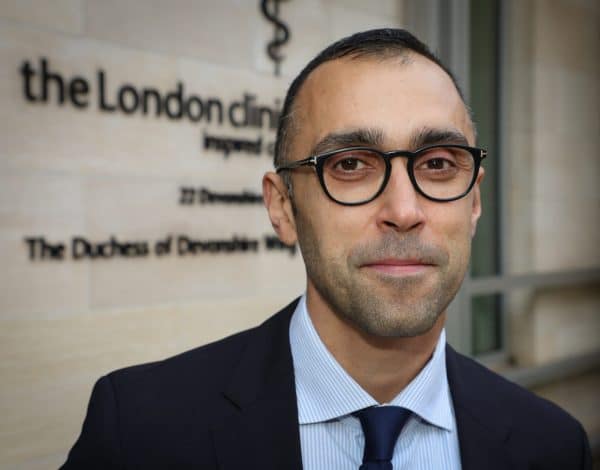
In a cosmetic surgery market crowded with bold promises, the surgeons worth knowing tend to talk less about transformation and more about restraint. Amir Sadri is one of them. A Consultant Plastic Surgeon whose week is split between reconstructing the faces of children at Great Ormond Street Hospital and a private practice on London’s Devonshire Place, he has built a reputation on a quietly unfashionable idea: that the best result is often the one nobody can point to.
That philosophy is rooted in where he spends the other half of his time. A consultant at Great Ormond Street Hospital and a specialist in rhinoplasty and facial surgery, Amir Sadri, FRCS (Plast) and on the GMC Specialist Register, reconstructs children born with cleft lip and palate and complex facial differences, some of the most demanding work in the field. It’s a discipline that leaves little room for shortcuts, and it shapes how he approaches aesthetic surgery for adults.
A reconstructive foundation
Most people meet a cosmetic surgeon at the point of a consultation, with little sense of the training behind the chair. Mr Sadri’s path runs through some of the UK’s most respected units, Chelsea and Westminster, Alder Hey Children’s Hospital and Great Ormond Street, followed by a specialist aesthetic surgery fellowship at The London Clinic and visiting fellowships to leading surgeons in the United States, Turkey, Italy and France.
The reconstructive grounding matters. Rebuilding a child’s face to work and look natural for a lifetime is a very different challenge from a purely cosmetic one, and it instils a deep respect for anatomy, function and proportion. Applied to aesthetic surgery, it produces a surgeon more interested in facial harmony than in dramatic change.
The case for natural results
Mr Sadri’s particular interest is rhinoplasty, including the more technically demanding preservation and revision techniques, alongside selected facial procedures. His stated aim is consistent across all of it: results that respect how a face is meant to move and age, rather than ones that announce themselves.
That approach reflects a wider shift in the field. Patients today are increasingly wary of the overdone look and are seeking surgeons who prioritise subtlety and function, exactly the ground a reconstructive specialist is trained to occupy. It’s also backed by a serious academic record: more than 40 peer-reviewed papers, presentations across Europe, USA, South America and Africa, and membership of the Rhinoplasty Society of Europe.
Beyond the Clinic
There is another thread to his work that sits outside private practice entirely. Mr Sadri travels internationally with the Global Smile Foundation, helping to treat children with facial differences in parts of the world where that care is hard to reach. It is a reminder that, for some surgeons, the skill on display in a London consulting room was first honed in service of something else.
For anyone weighing up facial or nasal surgery, the takeaway is a simple one. The credentials that matter most are not always the ones on the advertising, but the depth of training and the philosophy behind the scalpel. In a field that often rewards the loudest voice, Amir Sadri makes the quieter, and arguably more reassuring, case: that good surgery is the kind you never notice.



Leave a Comment