
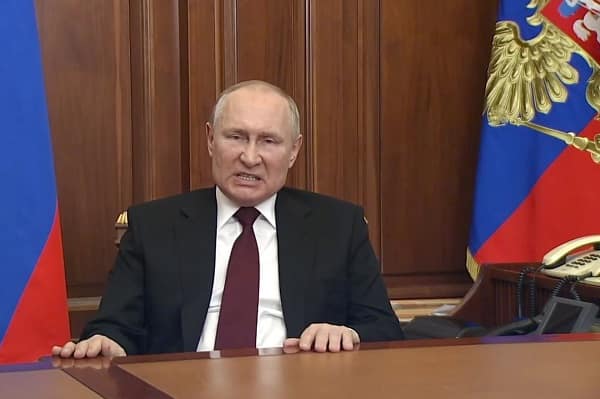
Vladimir Putin is accused of escalating a covert campaign against Europe’s defence industry, with intelligence agencies warning executives that Russian operatives may be preparing assassination attempts against individuals supplying Ukraine.
The reported threat marks a potential expansion of Moscow’s sabotage campaign beyond infrastructure and industrial disruption, raising fears that the Kremlin is seeking to undermine Western support for Kyiv by making cooperation with Ukraine a personal security risk.
According to the Financial Times, European intelligence services have warned defence industry leaders that attacks on senior figures are more likely. Small companies producing drones and critical components are considered particularly vulnerable as European governments accelerate efforts to strengthen Ukraine’s battlefield capabilities.
The warnings come amid broader concerns that Russia is expanding sabotage and hybrid operations across Europe in an effort to weaken support for Ukraine in the coming months.
Read more related news:
Trump and Putin’s bromance revealed as ‘friendly’ call leaves mounting questions
Kyiv warns ‘prepare for three days without power’ as strikes cripple vital infrastructure
Trump is helping to ‘bankroll Putin’s slaughter’ as Johnson blasts Russian oil deal
Zelensky offers 60-day ceasefire and elections as Trump escalates pressure on Kyiv
Germany has stepped up its response. The Federal Office for the Protection of the Constitution (BfV) has intensified engagement with defence companies and their employees, advising them to consider private security where necessary, RBC-Ukraine reported.
Its chief, Sinan Selen, has warned German lawmakers that Russia is deliberately preparing violent acts against selected individuals through state agencies and organisations under state control.
The methods and personnel involved are also changing, Selen said, with Russian operations increasingly drawing on organised criminal networks.
The Financial Times report identifies Russia’s military intelligence agency, the GRU, as a central force behind the alleged campaign. Rather than relying predominantly on individuals recruited online to carry out isolated tasks for money, Russian intelligence officers are reportedly developing cross-border networks in which separate participants handle surveillance, logistics, planning and execution.
Such arrangements can complicate investigations, obscure the chain of command and allow intelligence officers to maintain distance from those carrying out operations.
The reported shift presents European security services with a difficult challenge: disrupting networks that may combine state-directed objectives with criminal intermediaries operating across national borders.
But the strategic calculation may extend beyond any physical attack. Even without an assassination attempt being carried out, persistent warnings and the prospect of violence can generate uncertainty among executives, employees and investors.
For Moscow, the alleged objective is to raise the perceived cost of supporting Ukraine, particularly among smaller manufacturers whose specialist products have become increasingly important to modern warfare.
“They want individuals to think twice before doing business with Ukraine,” one insider told the Financial Times.
If that is the intended effect, the pressure campaign would seek to weaken Ukraine’s supply chain not simply through destruction, but through intimidation — making the decision to help Kyiv appear increasingly dangerous.
The intelligence warnings underline the growing security burden facing Europe’s defence industry as governments attempt to expand production while protecting the people and businesses responsible for sustaining Ukraine’s war effort.


Leave a Comment