
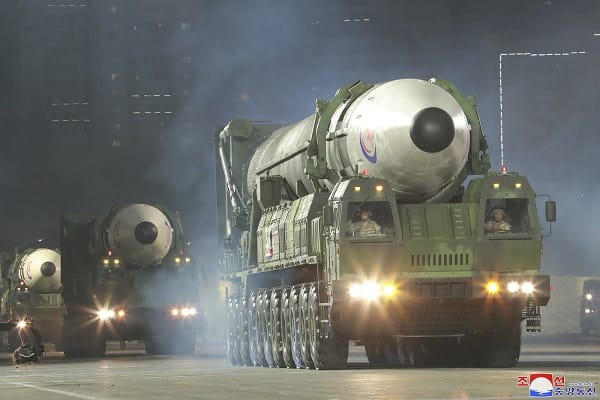
Dmitry Medvedev has warned that Russia’s threat to use nuclear weapons is “not a scare tactic — it is reality”, as Ukraine intensifies long-range attacks deep inside Russian territory and the Kremlin continues to threaten escalation if the war does not end on Moscow’s terms.
Medvedev, a former Russian president and deputy chairman of the Kremlin’s Security Council, said western governments should treat Moscow’s repeated nuclear warnings as a genuine possibility rather than political theatre.
“These are not hints,” he told Vedomosti newspaper.
“Everyone needs to understand nuclear weapons could be used in certain circumstances,” he added.
The senior Kremlin ally pointed to Russia’s nuclear doctrine, which he said gives Moscow the right to use nuclear weapons when the country’s security faces a critical threat.
“This is not a scare tactic – it is reality. Russia’s nuclear doctrine, under which our country reserves the right to use such weapons in the event of a threat to our state’s security, can hardly be described as a mere hint….”
He added: “The list of military threats requiring nuclear deterrence measures has also been expanded.”
Medvedev specifically warned that aggression against Russia or its ally Belarus by a non-nuclear state, if backed by a nuclear power, could be treated by Moscow as a joint attack.
Such a scenario, he argued, could include Ukraine receiving support from Britain and could lead to a nuclear response.
“We have every right to respond to a critical threat to our sovereignty. The final decision will rest with the Head of State (Putin),” he said.
His comments came as Ukrainian forces continue to demonstrate their ability to strike targets far beyond the traditional battlefield, raising the prospect of a wider confrontation over the vulnerability of Russian military and energy infrastructure.
Medvedev accused western leaders of a “Neanderthal mindset and abysmal ignorance”, claiming they were “trying to push the world to the brink of nuclear apocalypse”.
“Such a conflict would obliterate the entire history of human civilisation and plunge it back into a primitive state—assuming any of the planet’s billions of people survived at all,” he said.
Asked whether the Ukraine war could develop into a third world war, Medvedev said the danger would increase if Russia sought to impose its preferred terms for ending the conflict.
“It must end on our terms to prevent any possibility of it recurring in the future or escalating into a global conflict,” he said.
The warnings followed an overnight Ukrainian attack on Sochi, Russia’s major Black Sea resort, involving aerial and sea drones. The strike caused fires along the port’s embankment and disrupted a nighttime concert, while eight people were reportedly injured, five of whom were taken to hospital.
The attack was particularly sensitive for the Kremlin given Sochi’s proximity to President Vladimir Putin’s official residence at Bocharov Ruchey.
Ukrainian President Volodymyr Zelensky, speaking during an official visit to Canada, said: “Russia continues its terror against Ukraine every day. And every day it receives a just response.”
Ukraine also struck the strategic Caspian Sea port of Makhachkala in Dagestan, which has previously been used to receive Iranian military supplies.
The latest attacks follow an increasingly ambitious Ukrainian campaign against targets deep inside Russia, including a reported strike roughly 2,100 miles from Ukraine on Novy Urengoy, a major Russian gas hub south of the Arctic Circle.
The growing geographical reach of Ukraine’s strikes has placed Moscow under renewed pressure to demonstrate that its nuclear warnings can deter attacks — without turning repeated threats into a dangerous cycle of escalation that neither side can easily control.


Leave a Comment