
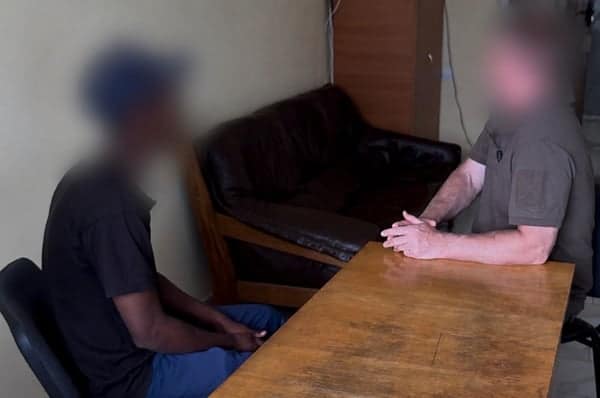
A little over a year ago, I walked through the gates of a Ukrainian prisoner-of-war camp in the west of the country and last week, I went back.
Some of the prisoners I met during my first visit were still there, still waiting for an exchange that may never come, but something else had visibly changed.
The demographics were striking.
Where once the overwhelming majority of prisoners I encountered were recognisably Russian, today the nationalities represented inside tell a much bigger story about Vladimir Putin’s war.
Somalia. Egypt. Sri Lanka. Cameroon. Armenia. Uzbekistan. China.
Across Africa, Central Asia, the Middle East and beyond, men are being recruited into the Russian military and ultimately finding themselves fighting, and sometimes being captured thousands of miles from home.
A striking estimate recently cited by Andriy Biletskyi, commander of Ukraine’s 3rd Army Corps, suggests that as many as one in three prisoners now being captured could be foreign nationals serving with Russian forces.
Putin is already making his war Global. https://t.co/QHPrDDS9gf pic.twitter.com/vfaPA83i7R
— Shaun Pinner (@ShaunPinnerUA) August 29, 2026
That figure still requires wider independent substantiation and should not be treated as a confirmed nationwide statistic, but what I witnessed inside the camp makes the direction of travel difficult to ignore and it’s what led me to find out for myself how much has changed since my last visit.
What we do know is according to Ukraine’s Coordination Headquarters for the Treatment of Prisoners of War, by 30 March 2026 Ukraine had identified 27,407 foreign nationals from 135 countries who had been recruited into Russia’s armed forces.
That was up from more than 18,000 foreign nationals from 128 countries in November 2025, an increase of roughly 52% in just over four months. Of those identified by November, 3,388 had already been killed, according to Brigadier General Dmytro Usov, Secretary of the Coordination Headquarters.
The numbers also show just how geographically widespread Moscow’s recruitment operation has become.

Shaun Pinner
Ukraine says hundreds of foreign nationals are now being held as prisoners of war, with Ukrainian forces capturing between one and three citizens of third countries every week. The government-run I Want to Live project has separately published information on more than 10,000 identified living and dead foreign nationals serving in Russian forces.
Africa has become one of the clearest examples.
In February, Ukrainian Foreign Minister Andrii Sybiha said at least 1,780 Africans from 36 countries were fighting in the Russian military. Ukrainian authorities and African governments have increasingly linked recruitment to networks offering lucrative employment, training or other opportunities before recruits find themselves inside Russia’s military system.
And the numbers continue to rise.
Ukraine’s military intelligence has reported that Moscow is preparing to recruit at least another 18,500 foreign nationals during 2026, suggesting this is no longer simply opportunistic recruitment but an increasingly important component of Russia’s manpower strategy.
The individual stories I heard inside the POW camp differed, but the themes were remarkably familiar.
Some knew they were signing Russian military contracts. Others told me they had travelled expecting civilian employment while others were attracted by salaries vastly beyond anything they could realistically earn at home, and many recruited from prisons.

Shaun Pinner
Several described signing contracts written in Russian, a language they could barely, if at all, understand.
And again and again, I heard another phrase from men describing what happened once they reached the battlefield:
They were left behind by their Russian commanders.
For Moscow, the attraction is obvious.
Russia continues suffering enormous battlefield casualties while simultaneously attempting to sustain offensive operations across a huge front. Every foreign recruit who signs a contract is one fewer Russian citizen the Kremlin immediately needs to mobilise.
And the recruitment network now stretches far beyond Russia’s borders, becoming a global manpower pipeline.
That creates another uncomfortable question: what happens when those foreign recruits are captured?
For Russian nationals, there is an established exchange mechanism.
For many foreigners, the situation appears considerably more complicated, with some of the men I met more than a year ago remaining inside Ukraine.
Russia does not appear to be prioritising their return in the same way it does some of its own citizens, but there may also be a brutal logic behind that. A prisoner sitting inside a Ukrainian POW camp cannot return to Somalia, Egypt, Sri Lanka or elsewhere and tell another potential recruit what happened after he signed the Russian contract.
A man who goes home can.
That matters when Russia is attempting to maintain an international recruitment system built heavily around money, opportunity and, according to numerous accounts, deception.

Shaun Pinner
The conditions I witnessed inside Ukraine also complicate Russia’s propaganda surrounding captivity.
Prisoners receive three meals per day, there is medical treatment, they can work, exercise and receive care packages. During my visit I saw prisoners making furniture and performing other jobs.
Ukraine remains legally obliged to treat these men in accordance with the Geneva Conventions regardless of how or why they joined Russia’s war.
That does not make captivity comfortable.
A POW Camp, is still a POW Camp
These men have lost their freedom, and many have no idea when they will leave unlike a normal prison.
Having experienced Russian captivity myself, including torture, starvation and ultimately a death sentence, I am also acutely aware that the treatment of prisoners on opposite sides of this war cannot simply be viewed through the same lens.
But perhaps the most important story here is not what happens inside the camp, is what their presence tells us about Russia outside it.
Four and a half years into the full-scale invasion, Putin has not abandoned his war but expanding his pool of people available to fight it.
The world is foolishly ignoring North Korea’s dangerous entry into Europe’s war
North Koreans have already fought alongside Russian forces. Recruitment networks now extend through Africa, Asia, the Middle East and beyond. The Kremlin increasingly appears willing to internationalise its manpower supply rather than confront the political consequences of relying solely on another huge mobilisation at home.
And that is why the changing faces inside Ukrainian prisoner-of-war camps matter.
They are not simply prisoners.
They are evidence of how Russia’s war machine is changing.
If anywhere near one in three of those now being captured are no longer Russian, then Putin’s war may already be far more global than many in Europe realise.


Leave a Comment