
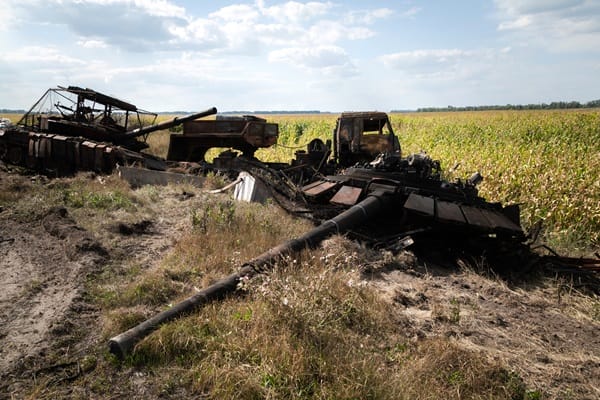
For years, the Kremlin carefully sold Russians the image of a strong, stable and resurgent state standing against the West and the so-called “special military operation” was presented as swift, necessary and inevitable, but instead, more than four years later, Russia finds itself trapped in a grinding war of attrition facing growing economic pressure, deepening repression and an increasingly frustrated population quietly watching their country change around them.
The reality is that the war which was supposed to restore Russian power is slowly beginning to consume Russia itself, while despite endless propaganda, patriotic concerts and aggressive state messaging, ordinary Russians are increasingly living with the consequences of a conflict that has fundamentally reshaped daily life.
The battlefield remains largely stagnant, casualties continue to mount and the Kremlin’s original strategic goals have long since collapsed, while the propaganda itself has lost its swagger, now resorting to damage limitation and constant firefighting.
More importantly, Kyiv still stands.
Read more related news:
Russian drone breaches spark alarm across NATO’s eastern flank
GCHQ chief warns UK is under sustained Russian hybrid attacks
NATO Article 5 in focus as Poland warns Russia over embassy strikes in Ukraine
Kremlin issues nuclear warning they ‘will wipe everyone out’ amid UK cruise missile strikes
Ukraine still fights, and is increasingly putting pressure on the southern logistics lines supplying Crimea from Mariupol, while Russia remains bogged down in a war it cannot decisively win, yet also, politically cannot afford to lose. Moscow is now increasingly reliant on a softer Moscow-leaning Trump administration in Washington, itself becoming distracted by its own Middle East crises (Special Military Operation) and stalled so-called trilateral peace talks.
The contradiction is becoming harder for Moscow to hide as it desperately tries to assert power, something Ukrainians have been remarkably effective at exposing the lack of. The Kremlin, meanwhile, continues to portray Russia as the victim of Western aggression, more so now than at any other point of the war, while simultaneously escalating the largest conflict in Europe since the Second World War.
Russian officials repeatedly describe missile attacks on Ukrainian cities as “retaliatory strikes”, despite the fact Russia initiated the full-scale invasion and remains the only country actively using nuclear-capable ballistic and hypersonic missile systems in Europe during an ongoing conflict.
For those following this war closely, that marks a distinct shift in rhetoric.
Russia now increasingly speaks the language of escalation while simultaneously attempting to frame itself as acting defensively. Threats surrounding further strikes on Kyiv have intensified again this week, including rhetoric that has alarmed diplomats still operating inside the Ukrainian capital. Russian Foreign Minister Sergey Lavrov told US Secretary of State Marco Rubio that Russia would carry out “systematic and consistent strikes” on facilities in Kyiv and so-called “decision-making centres,” while Moscow also advised foreign diplomatic staff to leave the city.
At the same time, Maria Zakharova, spokeswoman for the Russian Foreign Ministry, claimed the “Kyiv neo-Nazi regime continues to take out its battlefield frustrations on civilians and civilian infrastructure,” continuing Moscow’s long-running narrative surrounding so-called “denazification” in Ukraine.
In reality, however, Russia is already conducting the very escalation it threatens.
This weekend’s attacks once again highlighted that contradiction, with strikes overwhelmingly targeting non-military locations, including residential housing, civilian infrastructure, cultural sites and even a ballet school, continuing a pattern Ukrainians have now lived under for years. According to Ukrainian officials, Russia launched around 90 missiles and 600 drones during the latest wave of attacks, damaging dozens of residential buildings in Kyiv alone. While Moscow routinely labels such attacks “retaliatory strikes,” the target patterns increasingly point towards a campaign designed to terrorise urban populations, exhaust Ukrainian air defences and psychologically pressure both civilians and Ukraine’s international partners.
Meanwhile, UN High Commissioner for Human Rights Volker Türk recently warned that “the conflict is escalating,” particularly through Russia’s increasing use of “long-range weapons against cities.”
The wider strategic aim now appears increasingly obvious: to create enough fear, instability and diplomatic uncertainty that foreign governments begin distancing themselves physically and politically from Kyiv itself.
Russia understands symbolism.
The continued presence of embassies, diplomats, journalists and international delegations inside Kyiv directly undermines one of Moscow’s central narratives, that Ukraine is collapsing, isolated or incapable of functioning as a sovereign state. Every diplomatic visit, every reopened embassy and every international conference held inside the capital sends the opposite message: that Kyiv remains politically alive, internationally connected and unbroken despite years of war.
That message was reinforced this week when the EU Ambassador to Ukraine, Katarína Mathernová, made clear diplomats would not be intimidated out of Kyiv by Russian threats, stating diplomatic missions would continue operating despite Moscow’s escalating rhetoric surrounding further strikes on the capital.
That is why the rhetoric surrounding diplomats matters.
Russian officials increasingly blur the line between military threats and political intimidation, while simultaneously portraying Russia as the victim of escalation. Even as Kremlin propagandists openly discuss striking Kyiv harder and targeting civilian infrastructure, Moscow continues attempting to frame the war as defensive and somehow forced upon Russia by the West.
For Ukrainians, however, the reality behind the rhetoric is far more brutal. Apartment blocks are hit during the night, museums damaged and schools shattered. Children waking to air raid sirens and ballistic missile alerts has become a daily occurrence across much of the country.
Increasingly, the Kremlin appears to be compensating for battlefield limitations through fear, spectacle and psychological pressure rather than decisive military success, something that has been escalating for quite some time.
At the same time, pressure inside Russia itself continues to build.
The Russian economy is increasingly showing signs of long-term wartime strain. Massive defence spending, growing labour shortages, rising inflation and continued sanctions pressure are creating structural problems that propaganda alone cannot solve. Even figures inside the State Duma have begun openly voicing concerns about growing budget deficits and fears of returning to the economic instability associated with the collapse of the Soviet Union.
During recent discussions surrounding Russia’s growing financial problems, State Duma Deputy Valery Gartung openly questioned how Moscow intends to sustain the war economy, reportedly warning: “What are we going to do about it? Print money or what? Like in ’92, when prices rose 30% every week.” The comparison to the chaos and hyperinflation of the early 1990s was striking, particularly given how heavily the Kremlin relies on projecting economic stability and national resilience.
When Russian politicians start openly talking about “11 trillion, already f*cked” and the State Duma is warning about a massive federal budget deficit, it’s probably far worse behind closed doors than even they admit.
“What are we going to do about it? Print money or what? Like… https://t.co/JemgVimqRb pic.twitter.com/6sY8dPyYDS
— Shaun Pinner (@ShaunPinnerUA) May 27, 2026
Russia’s wartime economy now depends on constant mobilisation of resources simply to maintain momentum. While military production may create the illusion of growth in certain sectors, the long-term reality is far darker. Civilian industries continue to suffer, infrastructure ages, social spending tightens and ordinary Russians increasingly feel the pressure of a state prioritising war above everything else. Recent figures show Russia’s federal budget deficit has already exceeded annual targets, fuelled by weakening oil and gas revenues alongside rapidly rising wartime expenditure, with the so-called “gas station of the world” now even moving to restrict certain diesel exports in an attempt to stabilise domestic supply and prices.
Alongside economic strain comes growing repression.
Over the last several years, the Kremlin has systematically dismantled much of what remained of Russia’s independent media and online freedom. Western social media platforms have been blocked or throttled, journalists prosecuted in absentia, opposition figures jailed or exiled and even the use of VPNs increasingly targeted by authorities attempting to control the flow of information.
But the crackdown no longer stops with traditional politics.
Russian authorities are now paying increasing attention to gaming communities, online forums and messaging applications, fearing they may become spaces where uncensored information spreads beyond state control. Platforms once viewed as harmless entertainment are increasingly scrutinised due to concerns over communication, organisation and exposure to alternative narratives surrounding the war.
The irony is that the Russian government, which claims to be defending Russia from foreign influence, increasingly fears its own population accessing information outside Kremlin-approved narratives.
This atmosphere reflects a growing insecurity inside the Russian system itself.
For years, the Kremlin maintained stability through a simple unspoken arrangement: stay out of politics and life remains predictable. The war shattered that balance. Russians are now being asked to sacrifice economically, socially and politically while being told everything remains under control.
Yet the battlefield tells a different story.
Despite enormous manpower losses, repeated mobilisation drives and staggering financial costs, Russia’s advances remain painfully slow. Entire offensives have produced only limited territorial gains at devastating human cost. The war has exposed serious weaknesses inside the Russian military system itself, including corruption, poor logistics, command failures and an overwhelming reliance on attritional warfare.
Even after years of fighting, Moscow still speaks in the language of maximalist objectives while struggling to achieve meaningful strategic breakthroughs, unable to fully seize even Donetsk Oblast, something Russian forces and their proxies have been attempting to achieve since 2014.
At the same time, fear remains one of the Kremlin’s most powerful weapons domestically.
Public opposition inside Russia is heavily suppressed and criticism of the military can lead to severe legal consequences. This creates the appearance of unity, but silence should never automatically be mistaken for support. Many Russians may not openly oppose the war, yet increasingly they are living with shrinking freedoms, rising economic anxiety and growing uncertainty about the future.
A generation is now growing up inside an environment shaped by wartime censorship, aggressive nationalism and permanent confrontation with the outside world with the Kremlin continuing to insist Russia is winning. Meanwhile, Russians are being asked to accept fewer freedoms, worsening economic conditions and growing isolation in order to sustain that narrative.
The longer the war drags on, the harder it becomes to reconcile official propaganda with Russian lived reality.
And that may ultimately become the Kremlin’s greatest problem of all.
For now, Moscow continues to escalate abroad while tightening control at home.
But beneath the patriotic rallies, staged symbolism and carefully managed television narratives, frustration is quietly growing. Russians were promised a quick victory, a weakened Ukraine and a resurgent Russia. Instead, they have inherited a grinding war, mounting losses, economic uncertainty and a state increasingly reliant on censorship and intimidation to maintain control with a young population now asking what they will inherit?
And for many Russians, it is becoming increasingly clear that this war is no longer winnable, and that the Russian war which began by targeting Ukraine is now beginning to turn against Russia itself.


Leave a Comment