
Anyone reading the business pages this month will recognize the mood: hiring is tough, recruiters are reporting a jobs market that “remains as tough as” it has been for a while, and a lot of companies are being asked to hold output steady with the people they already have. In that environment, the quiet productivity gains matter more than the headline strategies. And one of the largest sources of quiet waste in almost every organization is the same thing: meetings and the information that evaporates after them.
Estimates of how much of the average knowledge worker’s week goes to meetings range from roughly 11 to 15 hours, depending on the source, and Asana’s Anatomy of Work research puts the cost of unnecessary meetings alone at around 103 hours per person per year. Senior people carry more: Harvard Business Review has reported executives spending close to 23 hours a week in meetings. For a small or mid-sized business where the same few people sit in most of the important conversations, that’s an enormous portion of scarce time — and much of what’s discussed is never captured in a form anyone can use later.
Why AI note-taking has moved from curiosity to line item
PwC’s 2026 Global Workforce Hopes and Fears Survey, which polled 49,364 workers across 48 countries and regions, found that 64% had used AI at work in the past year, and that daily generative AI use had risen from 14% to 22%. At the same time, only 51% said they had access to the learning and development resources they need, down from 59%. In other words, businesses are adopting AI faster than they’re training people to use it well, which makes the choice of first use case important. The best early use cases are bounded, easy to check, and tied to something people already do.
Note-taking fits that description. The AI note-taking market is projected to cross $740 million in 2026, within a broader note-taking app market growing from about $11 billion in 2025 to $13.3 billion this year at a 20.6% compound annual growth rate — a sign that businesses are voting with budgets for tools that turn spoken and written material into something organized.
What a practical AI note taker does for a small business
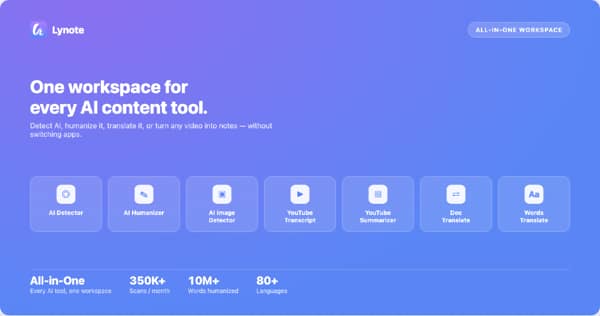
An ai note taker is only as useful as the range of things you can feed it. A business doesn’t just have meetings; it has supplier PDFs, recorded calls, scanned documents, training videos, and webinars. Lynote’s AI note generator at lynote.ai/ai-note-generator accepts documents like PDF, DOCX, and TXT, images, audio such as MP3, WAV, and M4A, video such as MP4 and MOV, and pasted YouTube links or web URLs. It turns them into structured notes you can edit, ask questions of, and reuse, free and online.

Lynote
Some everyday cases. A manager records a weekly operations call and gets notes with decisions and owners, rather than relying on whoever took minutes. A finance lead uploads a long supplier contract and asks the notes direct questions — payment terms, notice periods — before the meeting rather than during it. A founder turns a conference session into a one-page summary to circulate. A new hire is given notes from recorded training videos and can search them instead of asking colleagues the same questions.
The accuracy point every business should take seriously
There’s a risk that deserves plain language. A 2023 study in JMIR Mental Health found that the best-performing automatic transcription service reached a median word error rate of 8.9%, close to professional human transcription at 7.6%, while another built-in service reached 19.2%. A systematic review of clinical speech recognition found error rates from under 9% in controlled dictation to over 50% in real multi-speaker conversations, which is what most business meetings sound like. And a 2024 study by Kirstein and colleagues, as cited in industry analyses, found hallucinated content in up to 37% of AI-generated meeting summaries, depending on the model.
For a business, the lesson is governance, not avoidance. Notes that feed into contracts, invoices, or compliance records should be checked against the source by a person. Notes that support internal recall, planning, and onboarding can be used more freely. A sensible policy distinguishes between the two and keeps original recordings and documents where they can be re-checked.
From notes to client-ready writing
Notes are rarely the end product. They become proposals, reports, newsletters, case studies, and emails. When AI helps draft those, the writing tends to converge on a recognizable, slightly flat style — even rhythm, safe phrasing, no distinctive voice. Customers and partners increasingly notice it, and many platforms and procurement teams run automated checks on submitted text.
This is where tools that humanize ai writing earn a place after the notes stage. The old approach of swapping synonyms doesn’t work, because detectors measure statistical patterns, not individual words. Lynote’s humanizer at lynote.ai/ai-humanizer rewrites at the sentence and paragraph level, targeting the flat rhythm and low perplexity that make text read as machine-written. It offers three levels — a light pass, a standard pass, and an enhanced pass built for stricter scanners such as GPTZero — while preserving meaning and target keywords, producing output designed to pass plagiarism checks like Copyscape, and supporting more than 80 languages, useful for UK businesses selling into other markets.

Lynote
A workflow that respects lean budgets
A workable routine for a small team: record or collect the inputs that matter, generate notes, check anything consequential against the source, draft the document from the notes, then use a humanizing pass on the sentences that still sound generic before it goes out under your name. Each step takes minutes, and none requires a new platform contract or a specialist.
The honest pitch isn’t that AI replaces anyone. It’s that when the jobs market is tight and teams are lean, getting back even a few hours a week from meetings and document handling is real money. The businesses that benefit most will be the ones that start with a modest, checkable use case, keep a human on the review step, and make sure what reaches customers still sounds like them.
For small businesses, even simple tools that make meetings and document handling easier can free up time for more important work. If you’re looking for more practical advice on AI tools, software, and technology for everyday business use, take a look at kemotech.





Leave a Comment