
There is a pattern emerging in this war that Moscow can no longer easily dismiss.
Ukraine’s reported strike on the Yaroslavl oil refinery — a facility located hundreds of miles from the front lines and uncomfortably close to the Russian capital — is the latest sign that Kyiv’s long-range campaign is moving from symbolic disruption to sustained economic pressure.
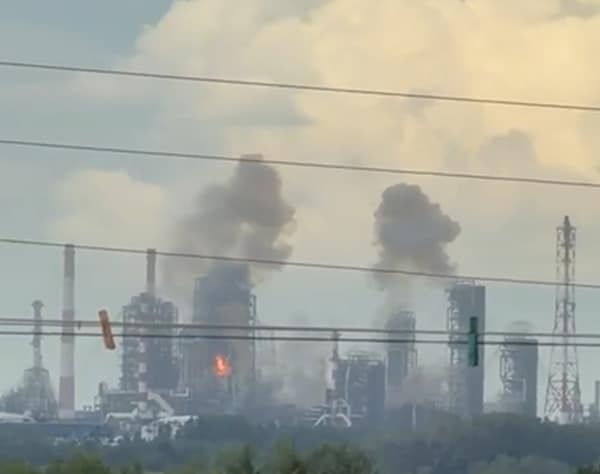
Russian Telegram channels claimed the refinery was hit overnight on July 6, with residents posting images and video allegedly showing smoke rising from the industrial site.
While the exact extent of the damage remains unconfirmed, the location alone is what matters most: this is not a border facility, not a frontline depot, but a core node in Russia’s domestic energy network.
The attack has not been independently verified, and Ukraine’s military has not commented. But the broader trend is increasingly difficult to ignore.
Read more related news:
RAF F-35s scramble as Russian spy planes buzz Britain’s £3bn aircraft carrier
Russia can’t win the war it started, now it can’t even hide it
A single miscalculation could pull NATO into its gravest crisis
NATO scrambles fighter jets as Putin unleashes deadly missile blitz on Kyiv
Kyiv has leaned heavily into long-range drone warfare, often targeting refineries, storage depots and fuel infrastructure deep inside Russian territory. The logic is straightforward: Russia’s war economy runs on oil, and oil infrastructure is one of the few pressure points Ukraine can reach without matching Moscow tank-for-tank on the battlefield.
And it appears to be working — at least in part.
Reports from inside Russia over recent months have pointed to fuel shortages, export restrictions and price volatility in certain regions. President Vladimir Putin himself has acknowledged disruption in domestic fuel supply, including queues at petrol stations and inconsistencies in gasoline availability — an admission that sits awkwardly alongside the Kremlin’s usual narrative of economic resilience.
Energy facilities like Yaroslavl are not just industrial assets; they are financial lifelines. They fund the state, sustain logistics chains and underpin the Kremlin’s ability to keep its military machine running. That is precisely why Ukraine considers them legitimate targets.
Moscow's fuel supply relied on four key refineries. Three were already shut down or heavily damaged. So today, the Yaroslavl Refinery is no longer the exception.
A joint operation by @1usc_army operators, the 412th Brigade “Nemesis”, and @Raid_413, in coordination with…
— Defense of Ukraine (@DefenceU) July 6, 2026
The strategy marks a clear evolution in Kyiv’s approach under sustained pressure from the war. Unable to match Russia’s manpower or artillery stockpiles head-on, Ukraine has increasingly turned to asymmetrical warfare: hitting infrastructure far from the front in order to stretch Russian air defences, complicate logistics and increase the domestic political cost of the conflict.
The Yaroslavl refinery has reportedly been targeted before, underlining another uncomfortable reality for Moscow — that key facilities may no longer be able to rely on distance as protection.
The refinery lies roughly 250 kilometres from Moscow and around 700 kilometres from Ukraine’s border. In earlier phases of the war, such depth would have been considered relatively secure. That assumption has now eroded.
What makes this phase of the conflict particularly sensitive is the cumulative effect. One strike is an incident. A sustained pattern becomes a pressure campaign. And a pressure campaign on energy infrastructure becomes something closer to economic attrition.
Russia’s domestic response has already begun to reflect that strain. Authorities have adjusted fuel standards in an effort to stabilise supply, and regional disruptions have forced the Kremlin into reactive policy-making rather than strategic control — an uncomfortable position for a government that projects strength and stability as core political assets.
For Kyiv, the message is equally deliberate. Every refinery fire, every disrupted pipeline, every strained fuel depot feeds into a wider attempt to reshape the battlefield beyond Ukraine’s borders — not by occupying Russian territory, but by making the costs of the war increasingly visible inside Russia itself.
Whether this shifts the Kremlin’s calculations remains uncertain. Moscow has shown a high tolerance for economic pressure and disruption in the past. But wars are not judged solely on resilience; they are also shaped by accumulation — of inconvenience, of cost, and of political pressure at home.
And that is where Ukraine’s strategy now appears to be aimed.
The Yaroslavl strike — if confirmed — would not be decisive on its own. But it would add another entry in a growing ledger of attacks that suggest the war is no longer contained to the battlefield, or even to Russia’s border regions.
It is now reaching into the infrastructure that keeps the Russian state functioning.
And that is a very different kind of pressure altogether.


Leave a Comment