
Somewhere between £8,000 and £30,000. That’s the range most UK small business owners spend on paid advertising in a typical year, and it’s the figure sitting behind one of the more misunderstood debates in UK small business marketing.
The debate is usually framed as a choice. Paid ads or SEO. Google Ads or organic search. Short-term visibility or long-term ranking. Business owners are told to pick a side, commit the budget, and hope the numbers work.
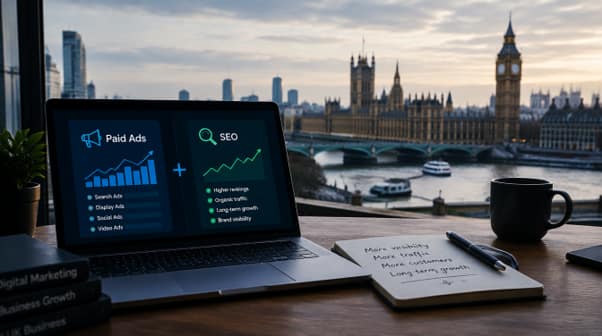
The problem is that the framing is wrong. The UK small businesses actually growing most consistently aren’t choosing between paid ads and SEO. They’re doing both, deliberately, with each channel doing the job it’s actually best suited for. Paid ads capture the customers ready to buy today. SEO builds the ranking that captures customers every day for years to come. The commercial value comes from running the two together, not treating them as rivals.
For UK business owners currently spending on paid ads and wondering whether the returns justify the investment, or considering starting on SEO and unsure whether that means switching off paid, understanding how the two channels actually work together is worth doing properly.
The alternative approach the smarter UK SMEs are actually using
The approach isn’t hidden or complicated. It’s what marketers call an “integrated search” strategy, and it starts from a commercial observation that changes how business owners should think about marketing spend.
The observation is this. At any given moment, a proportion of the UK adult population is actively searching for what your business sells. Someone is typing “emergency plumber London” into Google right now. Someone else is searching “wedding photographer Manchester” as you read this. Someone in your service area is looking for exactly what you offer, and their search represents the highest-quality customer intent your business will ever encounter.
The commercial question is whether your business appears in front of them at that moment. Paid ads and organic search results both put you there, in different ways. Paid ads guarantee a position at the top of the results page, immediately, for as long as you pay for the click. Organic results (SEO) put you there without paying for each click, but only if you’ve done the work to rank.
The smartest UK SME approach uses both. Paid ads capture the high-intent buyers today while SEO investment builds the ranking that captures the same buyers for free in six, twelve, twenty-four months’ time. Every pound spent on paid ads produces exactly one pound of traffic and then stops. Every pound spent on SEO builds an asset that keeps producing traffic for years after the initial investment. Combining them means capturing customers now while building the foundations that reduce your paid ad dependency later.
Matt Gwynne at Brandspace, a UK digital marketing agency working with small businesses across the country, said: “The UK small business owners we work with who commit properly to combining paid ads with SEO typically see much better returns than the businesses treating them as separate decisions. Paid ads work brilliantly for capturing high-intent buyers today. SEO builds the ranking that captures the same buyers organically over the years that follow. Business owners running both channels intelligently, with each doing what it’s actually best at, end up with lower customer acquisition costs, better paid ad performance and a growing base of free organic traffic. The commercial value of running them together, rather than choosing between them, is genuinely difficult to overstate.”
Why paid ads on their own have become harder
Running paid ads without the SEO foundations underneath has quietly become harder over the past five years, driven by a combination of factors most SME owners haven’t fully priced in.
Ad costs have climbed hard across every major platform. Google Ads costs per click in competitive UK service categories now regularly hit £15 to £50 per click, and often much higher for legal, financial, medical and adjacent professional service categories. Facebook and Instagram ad costs have climbed steadily as platform algorithms increasingly favour higher-spending accounts. LinkedIn costs for B2B categories have moved into territory that many UK SMEs simply cannot sustain across a full marketing calendar.
The auction dynamics reward larger budgets. Paid advertising platforms are auction-based, which means every UK small business bidding for the same customer attention competes directly against businesses with much larger budgets. Established competitors with £50,000-a-month ad budgets consistently outbid SMEs with £3,000-a-month budgets for the same customer clicks, and it gets worse as competitive pressure increases.
SEO reduces this exposure. Once a page ranks organically for a search term, competitors bidding harder on paid don’t push you off the results page. Your organic position is yours, at zero cost per click, regardless of what happens in the ad auction sitting above it.
Platform algorithm changes affect performance without notice. UK small businesses relying only on paid advertising are subject to the algorithm decisions of Google, Meta, LinkedIn and adjacent platforms. Sudden changes in ad delivery, cost per click or audience targeting can affect campaign performance overnight, with no meaningful recourse for the businesses affected. Building organic ranking alongside paid activity provides a buffer against this exposure.
Paid traffic converts, but organic converts better. Industry research consistently shows that visitors arriving from paid ads convert at lower rates than visitors arriving from organic search results. The reason is intent and trust. Someone typing a search into Google and clicking an organic result has actively expressed their interest and often perceives organic results as more trustworthy than the ads sitting above them. Running both means capturing both audiences, at both intent levels.
Combined, these factors mean that paid ads on their own increasingly represent an expensive way to compete against better-funded rivals without building any long-term commercial asset. Adding SEO alongside paid ads addresses both problems.
How the two channels actually work together
The practical work of running paid ads and SEO together, rather than as rival channels, breaks down across five components.
- Use paid ads to test what actually converts. Paid ads produce immediate data on which search terms produce paying customers versus which produce clicks that go nowhere. That data is invaluable for SEO strategy. The keywords converting best on paid are exactly the keywords worth investing in for long-term organic ranking.
- Use SEO to reduce paid ad dependency on high-cost terms. Once a page ranks organically for a search term, paid ad spend on that term becomes optional rather than essential. Many UK SMEs reduce paid spend on the highest-converting terms as organic ranking builds, freeing budget for testing new keywords or expanding into adjacent categories.
- Combine paid ads and organic listings to dominate the results page. Appearing in both the paid results at the top and the organic results below produces materially higher click-through rates than appearing in either alone. UK small businesses ranking organically and running paid ads on the same terms often see click-through rates 20 to 40% higher than the sum of the two channels running separately.
- Use paid ads for the terms SEO can’t win. Some search terms are too competitive for realistic organic ranking within reasonable timeframes. Paid ads capture those buyers while SEO focuses on the terms where organic ranking is genuinely achievable.
- Build the technical foundations that support both. Page loading speed, mobile compatibility, secure hosting, structured data markup and internal linking all affect both paid ad quality scores and organic ranking. Investment in the technical foundations improves paid ad performance and SEO ranking simultaneously.
What UK business owners should actually be doing
For UK business owners considering how to combine paid ads with SEO properly, six practical steps make the biggest immediate difference.
- Audit current paid ad performance honestly. Look at which terms are producing paying customers and which are producing clicks that go nowhere. The terms producing customers are the ones to prioritise for SEO investment.
- Start SEO investment on the terms your paid data already validates. Rather than guessing which keywords to target with SEO, use the data your paid ads have already produced. Terms converting well on paid are the highest-priority SEO targets.
- Keep running paid ads while SEO builds. SEO takes 4 to 6 months to produce meaningful initial results and 12 to 24 months for full impact. Switching off paid ads while waiting for SEO to deliver leaves a customer acquisition gap that competitors will happily fill. Keep paid running through the SEO build period.
- Reduce paid spend gradually on terms where organic ranking establishes. As specific keywords start ranking organically, reduce paid spend on those terms rather than eliminating it entirely. Some paid presence alongside organic ranking often produces the best combined results.
- Invest in the technical foundations that serve both channels. Page speed, mobile compatibility, structured data and internal linking improve both paid ad quality scores and organic ranking. This is one of the highest-value investments UK small businesses can make, because it improves both channels simultaneously.
- Engage specialist support properly where it fits. Combining paid and SEO effectively is more nuanced than running either alone. For most UK small businesses, engagement with digital marketing support produces better outcomes than fully in-house approaches, particularly for the technical foundations and authority-building work most business owners aren’t equipped to handle themselves.
The wider picture
The shift from thinking about paid ads and SEO as rival channels toward running them together reflects a broader change in how the smarter end of the UK SME sector is thinking about marketing investment. Long-term commercial thinking, focused on building assets that compound over time alongside the paid channels producing immediate results, has quietly become the approach that separates the UK small businesses actually growing from the ones stuck in either-or thinking.
The commercial opportunity for UK small business owners willing to run the two channels together is genuine. Paid ads deliver the customers ready to buy today. SEO builds the ranking that delivers customers every day for years. Together, the two produce lower customer acquisition costs, better paid ad performance, growing organic traffic and a marketing engine that becomes more efficient over time rather than more expensive.
For UK business owners currently spending £8,000 to £30,000 a year on paid advertising and quietly wondering whether the returns justify the investment, the answer isn’t to stop paid ads. It’s to keep paid ads running while investing in the SEO foundations that make the paid ads work harder and eventually reduce your dependency on them.
The £15,000 marketing mistake isn’t spending on paid ads. It’s spending on paid ads without ever building the organic foundations that would let the paid spend work harder. UK business owners running the two channels intelligently together are the ones quietly building the customer acquisition engines that support sustainable growth across the next decade.



Leave a Comment