
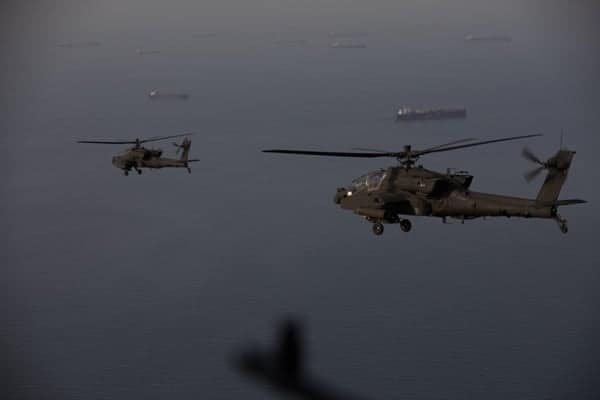
Donald Trump has ordered the US Navy to open fire on any vessels suspected of laying mines in the Strait of Hormuz, marking a sharp escalation in the standoff with Iran.
In a post on his Truth Social platform, the US President said he had authorised forces to “shoot and kill any boat” involved in mining operations in the vital shipping lane, adding there should be “no hesitation”.
Trump said: “I have ordered the United States Navy to shoot and kill any boat, small boats though they may be (Their naval ships are ALL, 159 of them, at the bottom of the sea!), that is putting mines in the waters of the Strait of Hormuz.
“There is to be no hesitation.
“Additionally, our mine ‘sweepers’ are clearing the Strait right now. I am hereby ordering that activity to continue, but at a tripled up level!”
The directive significantly raises the risk of direct confrontation in one of the world’s most strategically important waterways, through which a large share of global oil supplies pass.
Trump’s comments come amid mounting tensions following a series of maritime incidents in the Gulf, including attacks on commercial vessels and the seizure of tankers. US officials have accused Iran of attempting to disrupt shipping routes as part of its response to Western pressure.
The Pentagon has released footage showing US personnel boarding a seized oil tanker in the Indian Ocean, underlining Washington’s increasingly assertive posture in the region.
The President’s rhetoric has grown progressively more combative in recent days, including a warning that “a civilisation will end tonight” in reference to the conflict with Tehran.
Military analysts warn that the new rules of engagement dramatically increase the chances of miscalculation, particularly given Iran’s reliance on small, fast-moving boats and asymmetric naval tactics.
Any escalation in the Strait of Hormuz risks immediate consequences for global energy markets, with even limited disruption capable of driving sharp increases in oil prices and threatening supply chains worldwide.
The latest developments leave diplomatic efforts hanging by a thread, as both sides harden their positions in a confrontation that shows little sign of easing.
A Pentagon statement said: “We will continue global maritime enforcement to disrupt illicit networks and interdict vessels providing material support to Iran, wherever they operate.”
Ship-tracking data has revealed that the Majestic X, a tanker seized by US forces, was operating in the Indian Ocean between Sri Lanka and Indonesia at the time of its interception—close to where another vessel, the Tifani, had previously been detained.
The tanker was reportedly en route to Zhoushan, a major hub for oil imports into China, raising further questions over the destination of its cargo.
According to records, the vessel had previously operated under the name Phonix and had been sanctioned by the US Treasury Department in 2024.
Officials said the sanctions were imposed over allegations the ship was involved in smuggling Iranian crude oil in breach of restrictions placed on Iran.
The latest seizure underscores Washington’s intensifying efforts to clamp down on what it sees as a shadow network of tankers moving sanctioned oil across global shipping routes, often under changing names and flags to evade detection.
It also highlights the widening geographic scope of enforcement operations, stretching well beyond the Gulf and into key international maritime corridors linking the Middle East with Asia.


Leave a Comment