
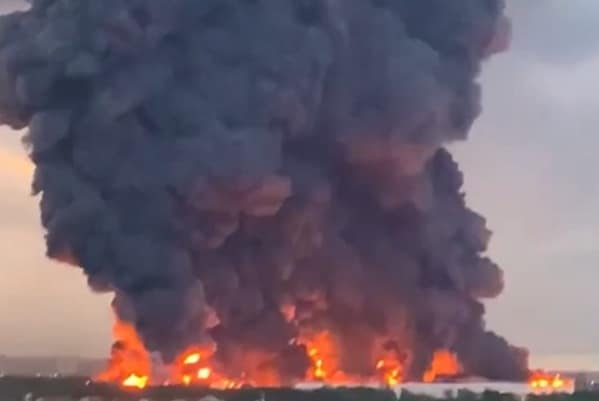
Ukraine has struck a major Russian oil storage and distribution hub in the Samara region, in one of the latest attacks aimed at disrupting the energy infrastructure supporting Moscow’s war effort.
The Samara Linear Production Dispatch Station (LPDS), near the settlement of Prosvet, was targeted by operators from the 1st Separate Centre of Ukraine’s Unmanned Systems Forces, according to the military.
Ukrainian officials described the facility as a major hub for receiving, storing and blending Russian crude and said it forms part of the infrastructure used to supply the Russian military.
The attack underscores Kyiv’s increasingly ambitious campaign against Russia’s energy system, as Ukrainian forces seek to impose costs far beyond the immediate battlefield.
Read more related news:
Burnham embarrassment exposed as majority of Brits fear UK cannot withstand Russian attack
Royal Marines storm Faroe Islands in first British land exercise since WWII amid Russian threat
Russia threatens to unleash ‘entire arsenal’ if NATO targets Kaliningrad
Putin tells troops ‘there are no rules’ to warfare and orders civilian attacks
The station is part of the Transneft oil pipeline network and covers more than 216 hectares. Its storage tanks have a combined capacity of more than 1.6mn cubic metres of oil, according to Ukrainian reports.
The facility caught fire following overnight explosions, according to the Russian-language Telegram channel Astra, cited by RBC-Ukraine.
President Volodymyr Zelenskyy said Ukrainian forces had struck oil infrastructure in both the Samara and Volgograd regions over the preceding 24 hours, alongside attacks on military and industrial targets across Russia and the Black Sea.
“Over the past 24 hours, oil facilities in the Samara and Volgograd regions were hit,” Zelenskyy said.
“Successful operations were carried out in the Black Sea and in the Voronezh, Nizhny Novgorod, Volgograd, Samara, and Krasnodar regions, targeting airfields, industrial facilities, oil refineries, a missile and space center, and an ammunition depot belonging to the occupiers.”
The Ukrainian president characterised the attacks as “long-range sanctions”, arguing that Kyiv was responding to Russia’s escalation with strikes against infrastructure sustaining its military capacity.
“Significant results are being achieved virtually every day,” Zelenskyy said.
We are giving justified responses to Russia’s escalation with our own long-range sanctions. Important results are achieved practically every day. Over the past 24 hours, oil facilities in the Samara and Volgograd regions were hit. Successful operations were carried out in the… pic.twitter.com/alRknkt4kl
— Volodymyr Zelenskyy / Володимир Зеленський (@ZelenskyyUa) October 2, 2026
The attacks represent a widening economic dimension to Ukraine’s war strategy. Rather than limiting operations to Russian military formations near the front, Kyiv has increasingly targeted the infrastructure that enables Moscow to generate revenue, move fuel and maintain its armed forces.
Russia’s oil industry is particularly significant because energy exports remain a crucial source of state revenue, while domestic refineries, storage terminals and pipeline infrastructure are essential to supplying the country’s armed forces and civilian economy.
Ukraine has repeatedly targeted Russian refineries, oil depots and other energy installations with long-range drones. Moscow has responded with its own sustained campaign against Ukrainian energy infrastructure, including power generation and distribution facilities.
The latest Ukrainian operation also highlights the growing reach of Kyiv’s unmanned systems. Ukrainian drone attacks have repeatedly reached targets hundreds of kilometres inside Russian territory, forcing Moscow to devote additional resources to protecting critical infrastructure far from the front.
Zelenskyy thanked personnel from Ukraine’s Security Service, military intelligence, Unmanned Systems Forces, Special Operations Forces and Foreign Intelligence Service for what he called their “precision and professionalism”.
For Ukraine, the strategic calculation is increasingly clear: if Russian forces can use long-range weapons to attack Ukrainian cities and infrastructure, Kyiv wants the ability to impose comparable pressure on the industrial and energy systems underpinning Russia’s war machine.
The Samara strike demonstrates the scale of that ambition. A facility holding more than 1.6mn cubic metres of oil is not simply another target on the battlefield — it is part of the logistical network that allows Russia’s energy economy and military campaign to function.


Leave a Comment