
The latest revelation out of Washington should chill anyone still harbouring illusions about Moscow’s intentions.
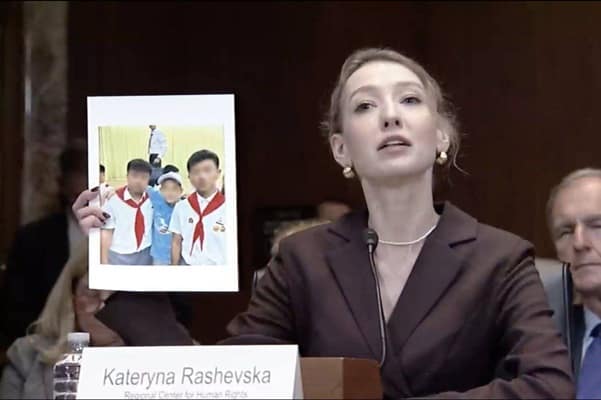
During a U.S. Senate Appropriations Committee hearing on 3 December, new evidence was presented suggesting that Ukrainian children abducted by Russia have been transferred to North Korea, where they are reportedly held in military-style camps.
The information, brought forward by Ukrainian journalist and media adviser Ostap Yarysh, marks one of the starkest escalations yet in Russia’s forced displacement campaign, a campaign already recognised internationally as a war crime and the subject of International Criminal Court indictments against Vladimir Putin and Russia’s Commissioner for Children, Maria Lvova-Belova.
The idea that abducted Ukrainian minors are being exported to one of the world’s most repressive dictatorships underscores the strategic and ideological nature of Russia’s actions.
These children are not “evacuees,” nor are they being “protected,” as the Kremlin insists. They are being trafficked, systematically removed from their homeland, stripped of identity, and transferred into environments designed to break them down and rebuild them in the image of the regimes that hold them.
As First Lady Olena Zelenska highlighted at a high-level meeting in Paris under the Bring Kids Back UA initiative, Ukraine has successfully returned 1,859 children so far. But this is only a fraction of the total number abducted. Thousands remain missing across Russia, Belarus, and now, reportedly, North Korea. Yale’s Humanitarian Research Lab, Nathaniel Raymond, told RFE/RL in an interview that the unit was currently tracking the location of 35,000 children abducted from Ukraine by Russia. Abducting children is a war crime, and Russian President Vladimir Putin has been indicted for it by the International Criminal Court (ICC).
This practice is not unprecedented. History provides grim echoes.
Hitler’s Lebensborn programme forcibly relocated children to engineer a loyal population. Stalin deported entire ethnic groups across the Soviet Union under the guise of “security measures.” During the Balkan conflicts of the 1990s, children were systematically removed to extinguish cultural identity.
The common thread is clear: To erase the future to reshape the present. Russia’s strategy fits this pattern precisely.
International law is equally explicit. Under the Rome Statute and the Fourth Geneva Convention, the deportation of children by an occupying power is a war crime. When carried out with the intention of destroying a national group, cultural, linguistic, or familial identity constitutes genocide. The ICC made this point when it issued warrants in 2023, a moment Moscow dismissed publicly but has been unable to shake diplomatically.
At least two Ukrainian children abducted by Russian forces were forcibly transferred to a camp in North Korea, legal expert Kateryna Rashevska told a U.S. Senate subcommittee on Dec. 3.
She said a 12-year-old boy from occupied Donetsk and a 16-year-old girl from Simferopol were… pic.twitter.com/NghyZmKzPt
— Clash Report (@clashreport) December 4, 2025
What makes these recent revelations even more concerning is their timing. While these abuses continue, various “peace initiatives” and “ceasefire frameworks” have been floated by political actors and private intermediaries, some of whom lack any mandate to negotiate on behalf of states or victims. Several of these proposals conveniently skirt around the issue of abducted children, as though justice were a bargaining chip rather than a prerequisite for any legitimate settlement.
A ceasefire that ignores abducted children is not peace, it is capitulation.
The forced transfer of minors to North Korea should eliminate any doubt. This is not a misunderstanding, nor an unfortunate by-product of war. It is a deliberate policy, executed across borders, involving multiple authoritarian regimes. The intentions could not be clearer, nor the consequences more devastating.
The world has the evidence. The law is unambiguous. And the children cannot wait for geopolitics to catch up with morality.
Russia’s actions must be confronted, not negotiated around, because no peace built on stolen children can ever endure.


Leave a Comment