
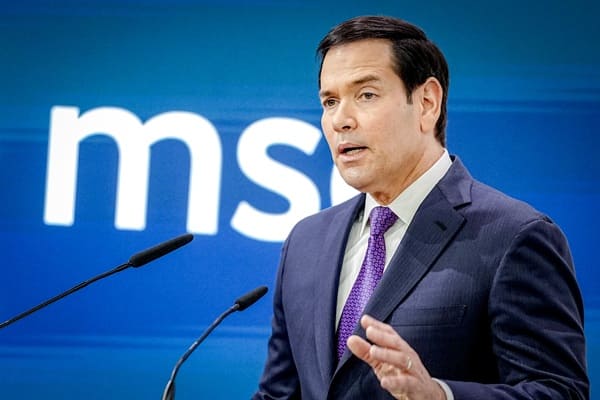
Washington is increasingly doubtful that Vladimir Putin will agree to a negotiated settlement to end Russia’s war against Ukraine before the spring of 2027, according to European officials briefed on discussions with US Secretary of State Marco Rubio, casting a shadow over Donald Trump’s efforts to broker an end to the conflict.
Rubio reportedly told European diplomats that the Russian president was unlikely to accept a settlement in the near term, while warning that Ukraine’s accession to Nato was not a realistic security guarantee because Moscow would never consent to Kyiv joining the alliance.
The assessment, reported by Radio Free Europe/Radio Liberty correspondent Alex Raufoglu, suggests that the administration’s diplomatic ambitions are running up against the fundamental obstacles that have repeatedly frustrated negotiations.
The reported timeline is particularly significant for Kyiv. It raises the prospect that the conflict could continue well into 2027, despite Trump’s repeated expressions of confidence that he can bring the fighting to an end.
Speaking at the Group of 20 foreign ministers’ meeting in Atlanta, Rubio adopted a notably cautious public position, rejecting suggestions that a breakthrough was imminent.
Read more related news:
From Kalashnikov lessons to combat drones, Russia is turning Crimean schools into military training grounds
Putin issues chilling threat to Britain ‘we are ready for war’ as Russia and NATO edge closer to conflict
Record Russian losses raise questions over Moscow’s ability to sustain Ukraine offensive
“I don’t know if negotiated peace is achievable in Ukraine. That’s what we’re trying to find out,” he said. “I don’t think anyone here is claiming that we are on the verge of a negotiated settlement.”
The secretary of state said Washington was attempting to establish whether the two sides could identify common ground, rather than presenting negotiations as evidence that an agreement was close. His remarks indicate that the administration remains in an exploratory phase, testing Moscow’s and Kyiv’s positions without any clear indication that either is prepared to accept the other’s essential demands.
The uncertainty is also reflected in preparations for the G20 leaders’ summit in Miami on December 14-15. Putin has received an invitation from the White House, but Rubio expressed scepticism that the Russian president would attend.
Trump, however, indicated that Ukrainian President Volodymyr Zelensky could also be invited. Asked during Halloween celebrations at his Mar-a-Lago estate whether he would welcome the Ukrainian leader to the gathering, the US president replied: “Yes, no problem.”
Rubio said the decision ultimately rested with Trump, while leaving open the possibility that Zelensky could participate if it helped advance negotiations.
“This is a leader-level meeting. The decision on that has to be made by the president,” he said. “I wouldn’t rule out that possibility. Especially if something positive could happen as a result of his participation, but today I have no announcements to make on that front.”
The Kremlin has previously linked Putin’s potential attendance to the outcome of an anticipated trilateral meeting involving Trump and Chinese President Xi Jinping on the sidelines of the Asia-Pacific Economic Cooperation summit in Shenzhen on November 18-19.
The possibility of bringing the leaders together illustrates Trump’s preference for high-level diplomacy. But the central obstacle remains the territorial dispute, particularly over Ukraine’s eastern Donbas region.
Rubio has previously described the conflict as fundamentally revolving around territory that Russia has failed to capture militarily but continues to demand.
“At its core, it’s about 11 percent of one part of that country that Russia wants and cannot take militarily and that Ukraine is unwilling to give up,” he said on October 22. “And they have good reasons why they don’t want to do that – for sovereignty and their own security long term.”
The formulation exposes the dilemma confronting Washington. Moscow wants territorial concessions, while Kyiv regards surrendering sovereign territory as a threat to its long-term security and a potential invitation to further Russian aggression.
Rubio has argued that neither side can secure an absolute military victory and that a settlement will ultimately require concessions. He has also insisted that diplomacy, rather than further fighting, offers the only route out of the conflict.
“This war is not going to be solved militarily. This war is only going to end diplomatically,” he said.
“Can you arrive at an outcome in which both sides receive something of benefit but also give concessions and bring this to an end? As hard as it is, it is impossible to do unless both sides are at the table talking, and we’re happy to play the mediating role in that regard.”
Zelensky has previously said Ukraine is prepared to freeze fighting along the existing front lines to halt the bloodshed, while refusing to recognise occupied territories legally as Russian sovereign territory.
That distinction is fundamental to Kyiv’s position: a ceasefire could stop the fighting without legitimising Moscow’s territorial claims.
But without a credible security arrangement to deter another invasion, any armistice risks becoming a pause rather than a durable peace.
For Trump, the challenge is no longer simply getting Putin and Zelensky into the same room. It is finding an agreement that neither side considers more dangerous than continuing the war. Rubio’s reported assessment suggests Washington is preparing for that impasse to last considerably longer than the White House might have hoped.


Leave a Comment