
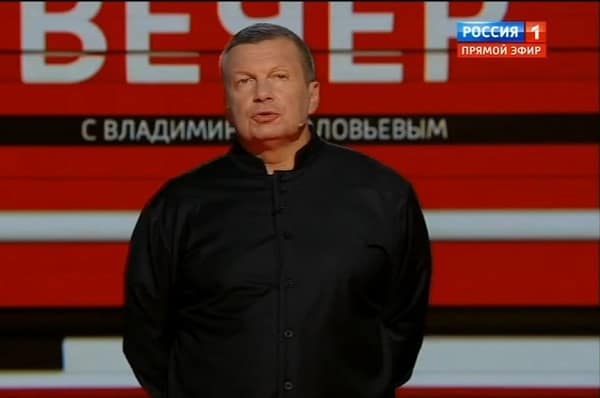
Vladimir Solovyov’s latest outburst on Russian state television calls for Britain to be wiped out and Ukrainian cities razed, as Moscow’s rhetoric over Western military support for Kyiv grows more extreme.
Britain has been subjected to another menacing outburst from one of the Kremlin’s most prominent television propagandists, with Vladimir Solovyov questioning why Russia has not already destroyed the British Isles and demanding the devastation of major Ukrainian cities.
The broadcaster’s remarks, made on Russian state television amid anger over reports of British long-range weapons being supplied to Ukraine, offered a stark illustration of the increasingly belligerent language used by pro-Kremlin commentators as the war continues.
“The British said, ‘We will give Ukraine ballistic missiles,’” Solovyov said. “All of you should drown! Why are we sparing these freaking islands? What good are they to us?”
Read more related news:
Trump ‘surrenders to Putin’ waives Russian sanctions betraying Ukraine and defies congress
‘No one negotiates with the weak’: Ukraine urged to hit Putin’s oil lifeline
Army chief warns ‘war is no longer unthinkable’ and MPs will have to tell Brits ‘where the risk lies’
He accused Britain of interfering in Russian affairs throughout history and urged the British public to leave the country, telling viewers that people should “get into boats and head for America”.
The comments were threats delivered by a television personality, not an announcement of Russian government policy or evidence that an attack on Britain is imminent. Nevertheless, the language underlines the hostility directed at the UK by prominent voices in Russia’s state-controlled media over its support for Kyiv.
Calls for the destruction of Ukrainian cities
Solovyov’s tirade extended beyond Britain, with the presenter demanding a far more destructive campaign against Ukraine’s urban centres.
He called for Kyiv to be erased, suggesting residents should be given three days to evacuate before the capital was destroyed. He also questioned why Odesa, Kharkiv and Sumy had not been reduced to rubble.
Arguing for the creation of a buffer zone, he called on Russian military commanders to unleash overwhelming firepower across a 40-kilometre area.
“If we want to create a sanitary zone, let’s create it,” he said, advocating a campaign that would render Kharkiv unusable.
“Is it cruel? No, it isn’t cruel. This is war, we will pity everyone later on,” he added.
The remarks amount to a call for destruction on a scale that would place civilian populations and essential infrastructure at grave risk. They also reflect a recurring feature of Russian state-media rhetoric: the presentation of escalating violence as a necessary response to Western involvement in the conflict.
Solovyov further questioned why Nato representatives could continue to visit Kyiv and why Western embassies remained open in the Ukrainian capital, implying that Russia should be less restrained in its conduct of the war.
Nuclear warnings raise the temperature
Appearing alongside Russian television weatherman Evgeny Tishkovets, Solovyov portrayed Moscow as being pushed towards a wider confrontation with the West.
He alleged that Western countries intended to strike Russia directly and warned that a nuclear attack would follow as soon as they were able to carry one out.
“They’ve dragged us into this war not to end it in a draw,” he said, claiming that Russia should not expect sympathetic treatment from the West.
Tishkovets backed Solovyov’s position, saying he agreed “150 per cent” that Russia should not have to ask anyone’s permission.
Such statements add to the atmosphere of confrontation surrounding the war, but claims about Western plans for a nuclear strike should not be treated as established facts without independent evidence. Nor do the presenter’s threats, by themselves, demonstrate that the Kremlin has decided to attack Britain or use nuclear weapons.
Britain caught in Moscow’s rhetoric
The UK has been among Ukraine’s prominent military supporters, providing assistance as Kyiv seeks to resist Russia’s invasion. That support has repeatedly drawn condemnation from Moscow, which portrays Western weapons deliveries as evidence of direct hostility towards Russia.
Solovyov’s comments place Britain at the centre of that narrative, depicting the country not simply as an opponent of Russian policy but as a target deserving destruction.
His dismissal of Russians living in Britain was similarly uncompromising. He described them as people who had fled Russia and declared that they deserved no sympathy, extending his denunciation to Russians who had made their homes abroad.
The broadcast illustrates the breadth of the rhetoric: threats against a Western country, calls for the destruction of Ukrainian population centres and warnings of nuclear conflict were all presented within the same argument about Russia’s confrontation with the West.
For British policymakers, the distinction between incendiary television commentary and concrete military threats remains crucial. State-media statements can help illuminate the political atmosphere in which Russia’s war is being discussed, but they cannot, on their own, establish military intentions or the likelihood of an attack.
The immediate significance of Solovyov’s outburst is therefore not proof that Britain faces an imminent strike. It is the extraordinary bluntness with which a prominent Kremlin-aligned broadcaster has spoken of destroying the country — and the willingness with which he has advocated devastation across Ukraine.
As Western support for Kyiv remains a central point of friction between Moscow and its opponents, such rhetoric risks further hardening public hostility and normalising language that treats the destruction of cities and the threat of wider war as legitimate instruments of political pressure.


Leave a Comment