
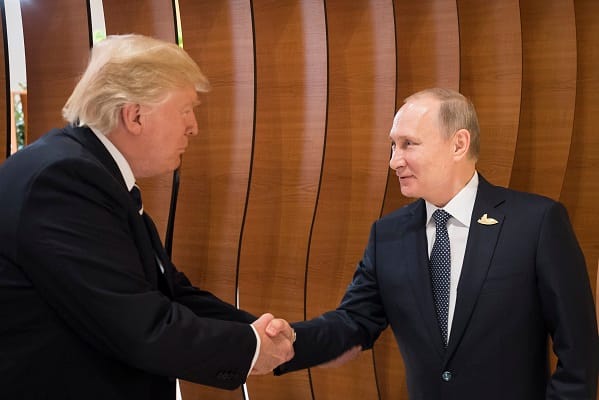
Britain is entering a more dangerous era of insecurity in which it can no longer take American support for granted, former defence minister Tobias Ellwood has warned, as Donald Trump’s decision to ease restrictions on Russian diesel exports raises fresh questions about the strength of the transatlantic alliance.
Mr Ellwood said the move to relax sanctions on Moscow, despite Russia’s continuing war against Ukraine, had undermined confidence in Washington at a time when Britain faces growing threats to its security, the Express reported.
“Buying diesel from our adversary removes any doubt that DC no longer has our back,” he said.
His intervention comes amid mounting concern over the UK’s readiness for a more volatile international environment, with a new poll suggesting nearly half of Britons would refuse to take up arms for their country under any circumstances.
Mr Ellwood, a former chair of the Commons defence select committee, said public attitudes towards national service appeared to be shifting as the scale of the threats facing Britain became more apparent. Two years ago, he said, about two-thirds of respondents had been unwilling to fight.
Read more related news:
MI5 chief warns Britain faces ‘seismic shock’ as Russia prepares for years of confrontation
Royal Navy chief delivers damning warning to Burnham over Britain’s defences
Former NATO commander asks ‘is the West asleep?’ as Russian shadow war is underway
Britain ‘wants an army, but won’t fight for it’: Poll exposes the political nightmare facing Labour
“The dial is shifting as we all become aware of how dangerous our world is becoming,” he said. “Conflict is growing on multiple fronts.”
But he argued that the government needed to be more candid about the risks facing the country if it wanted to build public support for stronger national preparedness.
His vision of national service extends beyond conventional military training to include strengthening Britain’s ability to withstand attacks, protect critical infrastructure and maintain essential services during periods of disruption.
“There is a false stereotype of what modern national service would look like,” he said, adding that it should encompass both conventional defence capabilities and measures to improve “our homeland resilience”.
The warning reflects a broader debate over whether Britain’s security planning has kept pace with a changing threat environment, particularly as Russia continues to target Ukraine and Western governments accuse Moscow of conducting hostile activity across Europe.
Mr Ellwood has previously warned that the international climate has a “1938 feel”, invoking the period before the outbreak of the second world war, when European leaders struggled to respond to Nazi Germany’s expansionism.
He has also argued that Britain is already exposed to forms of conflict that fall short of conventional warfare but can still inflict significant economic and political damage.
“We are attacked daily by Russia, let me make that clear,” he told GB News, describing activity that he said was designed to “cause economic harm” and “sow political confusion”.
Russia, he argued, probes for weaknesses through covert influence, proxy actors and deniable attacks, allowing it to exert pressure without necessarily triggering a conventional military response.
“What Russia does is to probe, to see where there are weaknesses,” he said, referring to unofficial operatives sometimes described as “green men”.
The potential consequences for Britain could include disruption to power supplies, attacks on critical infrastructure or incidents that interfere with essential services. Mr Ellwood cited hypothetical scenarios involving a power outage in London or a drone attack that disrupted water supplies.
Such scenarios underline the vulnerability of modern economies, in which energy networks, communications systems and water infrastructure are interconnected. However, the specific examples he outlined were warnings about possible risks, not evidence that such attacks were imminent.
The concern over American reliability adds another dimension to the debate. The US remains central to NATO’s collective defence, intelligence-sharing and military capabilities, but Trump’s approach to Russia and Ukraine has prompted questions among European allies about the durability of Washington’s commitments.
For Britain, that uncertainty strengthens the argument for investing in its own defence capabilities and preparing the public for disruption, rather than assuming that threats will remain distant or confined to conventional battlefields.
Mr Ellwood said the country needed to ask difficult questions now about its vulnerabilities and its readiness to respond.
As Europe enters what he described as “a new era of insecurity”, the challenge for ministers is to turn warnings into credible preparations — and to persuade a sceptical public that national resilience is no longer a peripheral concern, but a central part of Britain’s security.


Leave a Comment