
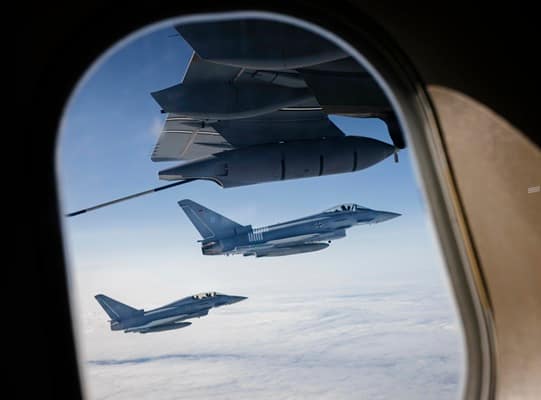
Nuremberg Airport suspended operations after an unexplained aviation emergency triggered a police investigation and a Eurofighter escort, renewing concerns over drone threats to European transport infrastructure.
Flights at Germany’s Nuremberg Airport were temporarily halted on Tuesday after reports of an unidentified object near the airport prompted a security response, with Eurofighter jets escorting an incoming passenger aircraft before it landed safely.
The incident triggered an investigation by regional police and renewed scrutiny of drone-related disruptions at German airports. Authorities later said there was no danger, allowing passengers to leave the affected aircraft and be transferred by bus to the arrivals hall.
The airport initially announced that operations had been suspended because of an “aviation emergency”, without providing further details.
Read more related news:
Spy chief warns Germany risks being dragged into ‘violent conflict’ with Putin
Europe on red alert as Russia’s sabotage campaign raises fears of catastrophic miscalculation
Putin flexes military muscle in Belarus on NATO’s doorstep ‘escalating’ tensions
‘Absolutely unacceptable’: Bulgaria savages Moscow as a ship is sunk off NATO coast
An airport spokesperson said Eurofighter jets had escorted a plane arriving from the Greek island of Corfu. Flight-tracking data showed the aircraft landed at 12.16 pm, about a minute behind schedule.
Police described the incident as an “uncertain air emergency”, saying the aircraft had landed safely and that investigations into the cause were under way.
The response followed reports from three pilots who independently claimed to have seen an unidentified object, believed to have been a drone, while taking off or landing between 2 am and 4 am local time. Police deployed a helicopter to search for the object but could not confirm its presence.
The airport’s border police inspectorate investigated the reports, while officers reportedly cordoned off parts of the airport. Authorities subsequently said their ground investigation had identified no danger.
The episode comes amid heightened concern in Germany over the potential use of drones to disrupt transport infrastructure and target sensitive military or commercial facilities.
At Leipzig Airport, a separate incident in recent months led to the discovery of a drone equipped with an explosive device. Security teams deployed a specialist robot to examine a suspicious object near the airport’s southern runway, temporarily disrupting flights.
Germany’s interior minister described that incident as an example of a new form of “hybrid attack”, referring to operations that exploit unconventional methods to create disruption or threaten security. German authorities attributed the earlier case to Russia, but there is no established evidence linking Moscow to the latest Nuremberg incident.
Investigators examining the Leipzig case subsequently recovered what appeared to be approximately 50 grams of hexogen, a powerful military explosive, in a field near Kabelsketal, west of the airport. The discovery raised questions about whether several drones had been involved in the operation.
German media have also reported a separate security scare at Leipzig/Halle Airport involving a modified drone spotted close to a Ukrainian Antonov An-124 cargo aircraft operated by Antonov Airlines. Reports suggested the aircraft was carrying ammunition and may have been targeted by an explosives-equipped drone.
The incidents have sharpened concerns about the vulnerability of airports and logistics hubs, where inexpensive unmanned aircraft can potentially threaten high-value targets or force costly interruptions to operations.
But the distinction between a confirmed attack and an unexplained sighting remains critical. At Nuremberg, police have not established that the object reported by pilots was a drone, nor have they identified a suspect or confirmed a connection to previous incidents.
For European security officials, the challenge is to investigate possible hostile activity without treating every unidentified object as evidence of a coordinated campaign. The Nuremberg suspension demonstrates how quickly uncertainty in the air can disrupt civilian aviation — even when no immediate danger is ultimately identified.


Leave a Comment