
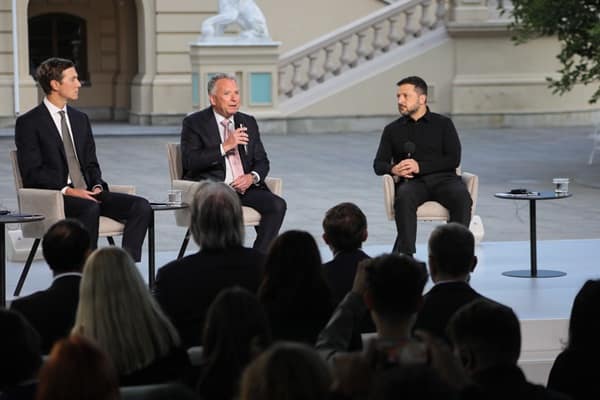
Steve Witkoff and Jared Kushner finally made it to Kyiv.
Before arriving in Ukraine, Witkoff had already met Vladimir Putin eight times. This weekend, the two American envoys went to Moscow first, sitting down with Putin inside the Kremlin before travelling onwards to meet President Volodymyr Zelensky in Kyiv.
Washington says the objective is peace, I sincerely hope it is. But from Ukraine, the imbalance surrounding this diplomatic process is becoming increasingly difficult to ignore, and now the dust is settling, even more so.
The Moscow meeting produced plenty of familiar diplomatic language but no breakthrough. The Americans presented new ideas intended to restart direct negotiations between Russia and Ukraine, while Putin reportedly expressed his “full trust” in the American mediation effort. Then came Kyiv.
For all the talk of peace surrounding the visit, the reality of Russia’s war continued around it. Putin announced a temporary pause on strikes against Kyiv, but this was never a ceasefire across Ukraine as Russian military operations and strikes elsewhere continued.
As I wrote from Dnipro while Russian drones were flying overhead, Ukrainians have learned to judge ceasefires not by what Moscow or Washington says, but by what Russia actually does. And this morning we received another reminder.
Shortly after Witkoff and Kushner left Kyiv, Russia resumed its attacks on the Ukrainian capital with ballistic missiles.
The strikes injured six people, sparked fires and damaged residential buildings across Kyiv, according to Ukrainian officials, Poland also scrambled military aircraft to protect its airspace as the Russian attack unfolded.
Eight meetings later
Then there are the negotiators themselves.
Witkoff comes from property and business rather than traditional diplomacy while Kushner holds no formal government position, yet these two men have become central figures in negotiations that could ultimately influence Ukrainian territory, security guarantees and the future of millions of people.
Kushner has no official title, no defined role, no diplomatic experience and was elected by absolutely nobody. Yet somehow, he’s speaking for millions of people.
I mean, what the fuck, America? 🇺🇸🤷♂️ https://t.co/X0jzC9u5lX
— Shaun Pinner (@ShaunPinnerUA) September 7, 2026
That would perhaps matter less if their previous engagement with Moscow had inspired confidence.
Instead, Witkoff has repeatedly spoken about Putin in remarkably warm terms with diplomacy obviously requiring sitting across the table from people you despise. It requires professionalism and sometimes uncomfortable compromise.
It does not require admiration.
Yet sitting opposite Vladimir Putin, Witkoff told him: “We were all talking about when we retire, we’ll have all these incredible stories and incredible memories, and yours will be right at the top of it all.”
That comment caused considerable controversy, and understandably so. This wasn’t simply diplomatic courtesy. Here was an American peace envoy talking about his meeting with Putin as an “incredible” memory he would carry into retirement, while sitting opposite the man who launched the largest war in Europe since the Second World War, forcibly displacing millions, and killing and injuring millions more.
Diplomacy requires talking to your enemy, what it doesn’t require is sounding starstruck.
The Kyiv meetings however were described positively. Zelensky thanked Witkoff and Kushner for coming and said several rounds of discussions had taken place. Washington’s objective appears to be restarting a diplomatic process that effectively stalled months ago.
But again, there was no breakthrough.
I’m not shocked, and perhaps that tells us more than all the photographs, handshakes and diplomatic language.
Putin Needs Trump Too
Before this visit, I wrote on my Substack about something I believed was being overlooked in the rush to understand Donald Trump’s peace push:
Putin may actually need Trump too, with my argument was fairly simple.
Trump needs something he can present as progress before the US midterms. Putin, meanwhile, needs time, manpower and breathing space.
Those interests are not necessarily incompatible.
A limited ceasefire could potentially give Trump something politically valuable while simultaneously giving Russia an opportunity to regroup, replenish and prepare for whatever comes next.
Now, new reporting from Axios adds considerable weight to that argument.
Following his meeting with Witkoff and Kushner, Zelensky told Axios he believes Putin is counting on another difficult winter to weaken Ukraine, but also believes the Russian leader does not want to antagonise Trump before the US midterm elections.
That is enormously important.
It suggests there isn’t simply a political clock ticking in Washington.
There is one ticking in Moscow too.
Trump wants a result while Putin wants to preserve his relationship with the American president politically while Russia faces another winter of war, continuing battlefield losses and the manpower problem that comes with them.
That doesn’t prove some grand conspiracy between Washington and Moscow.
But it does mean we should look very carefully at what both men actually gain from any agreement, because a ceasefire that gives Trump a political victory while giving Putin time to rebuild forces and prepare for another offensive isn’t necessarily peace for Ukraine.
It could simply be a deal that happens to suit both Trump and Putin which ultimately would be a huge red flag
Whose peace?
Every credible avenue for peace should be exhausted, but wanting peace does not mean pretending every peace process is automatically a good one.
American political urgency cannot become pressure on Kyiv simply because Kyiv is easier to pressure than Moscow.
If Putin concludes that refusing to compromise eventually causes Washington to demand greater concessions from Ukraine rather than increasing pressure on Russia, why would he compromise?
Why stop fighting if fighting longer might eventually produce a better deal?
After Moscow and Kyiv, we therefore remain essentially where we started. The Kremlin says further negotiations are possible, Washington talks about restarting the process and Ukraine continues to say it wants a dignified and sustainable peace. Moscow has even raised the possibility of another Trump-Putin call.
But the fundamental disagreements remain.
After eight meetings with Putin, Witkoff has finally sat across the table from Zelensky in Kyiv.
About bloody time.
Now we need to see whether this is genuinely an attempt to find an agreement acceptable to Russia and Ukraine, or an attempt to discover what Vladimir Putin will accept and then persuade Ukraine to live with it.
Those are two very different versions of peace.
And perhaps Jared Kushner inadvertently exposed the problem when he openly described the American approach as searching for a “win-win” outcome, applying the logic of Donald Trump’s business background to negotiations and looking for opportunities for both sides to pursue their interests.
But what exactly constitutes a “win” for Vladimir Putin?
If Putin’s win involves keeping occupied Ukrainian territory, being handed land his military has failed to capture, weakening Ukraine’s future security or simply buying enough time to regroup and fight again, then who exactly is doing the losing?
Because those are two very different versions of peace.
And as Russian ballistic missiles once again fly towards Kyiv only hours after the American envoys leave the city, Ukrainians have every reason to question what a “win-win” actually means, and who is expected to pay the price for Putin’s win.


Leave a Comment