
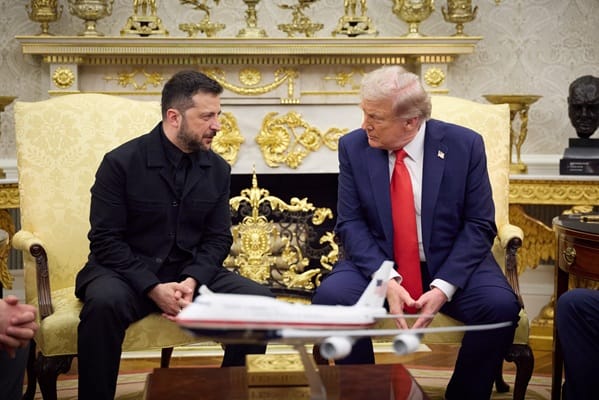
The US president has suspended key penalties targeting Russian energy buyers just days before they were due to take effect, prompting accusations that Washington is weakening its leverage over the Kremlin.
Volodymyr Zelensky has condemned Donald Trump’s decision to suspend a fresh package of sanctions and tariffs targeting Russia, warning that the move benefits Moscow while doing little to bring an end to the war in Ukraine.
The Ukrainian president’s criticism came after Trump signed an executive order effectively neutralising key provisions of the Graham Act, legislation designed to intensify economic pressure on Russia over its full-scale invasion of Ukraine.
The measures, which were due to begin this week, threatened steep tariffs on countries purchasing Russian oil and gas and penalties on Russian goods. Their suspension has raised fresh questions about Washington’s willingness to use economic pressure to force Vladimir Putin towards a settlement.
“The decision to undo all of this, to block all of it, seems wrong to me,” Zelensky said. “It definitely helps only the Russians.”
The White House has defended the decision as being in America’s national interest, while Russia’s investment envoy Kirill Dmitriev celebrated the move as “a truly historic moment”.
Read more related news:
Britain prepares troops for Ukraine deployment as Trump deepens rift with NATO allies
Senator savages Trump over Russian sanctions reprieve for that ‘bloodthirsty thug’ Putin
Putin accused of escalating strikes as Russian drones enter NATO airspace
For Kyiv, however, the timing is particularly damaging. Zelensky has warned that Russia is preparing to intensify its bombardment of western Ukraine, with more than 15 power generation and transmission facilities reportedly struck on Friday alone.
The Ukrainian leader argued that easing pressure on Moscow would do little to deter further attacks.
“It only fuels their satisfaction and their desire to keep killing people,” he said. “This certainly does not stop the war.”
A sanctions threat abruptly withdrawn
Trump signed the Lindsey O. Graham Sanctioning Russia and Iran Act of 2026 in mid-September. The legislation was intended to increase the economic cost of Russia’s war by threatening tariffs of up to 100 per cent on goods entering the US from major purchasers of Russian energy.
The potential penalties extended to countries knowingly buying Russian oil and gas or helping Moscow evade existing sanctions. The legislation was therefore designed not only to target Russia directly, but also to pressure the international buyers that sustain its energy revenues.
Yet the act contained a significant qualification: the president could waive the sanctions after notifying Congress that he considered them contrary to the national interest.
Trump’s executive order invoked that flexibility, keeping the waiver in place until he or senior officials determined that “further action is appropriate”.
The result is a sharp reversal before the measures could take effect. Rather than immediately confronting major buyers of Russian energy with the prospect of punitive tariffs, Washington has preserved its freedom to decide whether and when to deploy the penalties.
That distinction matters because the legislation’s potential force rested partly on the uncertainty it created for countries continuing to trade with Moscow. Suspending the measures removes an immediate threat, even if the administration retains the option of reintroducing pressure later.
Moscow welcomes the reprieve
Dmitriev, Russia’s investment envoy, praised the decision, arguing that the sanctions could have effectively ended economic cooperation between Russia and the US had they come into force.
His reaction offered an indication of the importance Moscow attached to avoiding the new restrictions. The proposed penalties threatened to extend the consequences of Russia’s invasion beyond its direct trading relationships with the United States, potentially affecting countries with far larger energy dealings with Russia.
China and India, two of the largest buyers of Russian crude, had objected to the legislation.
Beijing criticised what it described as baseless extraterritorial jurisdiction, while New Delhi warned that new tariffs could damage its relationship with Washington.
Those objections point to the diplomatic costs confronting the White House. Punishing third countries for buying Russian energy could place Washington in conflict with major trading partners, complicating its wider economic and strategic relationships.
There is also a domestic calculation. Analysts have warned that disrupting Russian oil supplies could push global energy prices higher, adding to the pressure on American consumers already facing rising costs amid the US-Israeli conflict with Iran.
The administration’s decision therefore reflects a clash between competing objectives: increasing the economic pressure on Putin, protecting US consumers from further energy-price increases and avoiding a wider confrontation with major trading partners.
Political pressure builds in Washington
The retreat has also exposed tensions within the American political establishment over how firmly Washington should confront the Kremlin.
Darline Graham, who was appointed to her late brother’s Senate seat and endorsed by Trump ahead of the midterm elections, declined to openly rebuke the president. But she made clear that her own preference was to maintain pressure on Moscow.
“Personally, I would choose to keep the pressure on Russia,” she told reporters at a campaign event on Saturday. “Because I don’t trust Putin and I don’t trust Russia.”
Democratic congressman Don Beyer of Virginia was more forceful, accusing Trump of undermining Ukraine and disregarding Congress’s intentions.
“Trump’s latest surrender to Putin again betrays our Ukrainian partners and defies clear congressional intent of legislation designed to punish Russia for its illegal war of aggression,” he said.
The criticism highlights the broader political question surrounding the legislation: whether the president’s authority to waive sanctions should be used to protect American economic interests or whether withdrawing the threat risks weakening Washington’s bargaining position against Moscow.
The act’s waiver provision gave Trump considerable discretion, but the abrupt suspension has nevertheless reignited debate over the credibility of US commitments to Ukraine.
Ukraine faces a worsening energy threat
For Zelensky, the economic decision cannot be separated from the military situation.
Russia’s continued attacks on Ukrainian energy infrastructure threaten electricity supplies and the resilience of a country already enduring prolonged war. Strikes on power generation and transmission facilities can leave households without power while forcing engineers to repair critical infrastructure under dangerous conditions.
The Ukrainian president’s warning that Moscow intends to intensify its bombardment of western Ukraine adds urgency to Kyiv’s demand for stronger international pressure.
Sanctions alone are unlikely to end the conflict, but their effectiveness depends on whether Russia and the countries sustaining its trade believe that restrictions will be imposed consistently. Suspending penalties before their scheduled introduction risks weakening that message, even if Washington retains the option to act later.
For the Kremlin, the immediate benefit is the removal of an impending economic threat. For the White House, the calculation appears to be that preserving flexibility and limiting economic disruption outweigh the advantages of imposing the measures now.
For Ukraine, the concern is more immediate: that a moment intended to increase pressure on Russia has instead given Moscow breathing space as its attacks continue.
Trump has not abandoned the possibility of further sanctions. But by suspending the new penalties before they took effect, he has left Kyiv facing a difficult question: if economic pressure is repeatedly delayed in the name of other priorities, what will persuade Putin that continuing the war carries a price he cannot afford?


Leave a Comment