
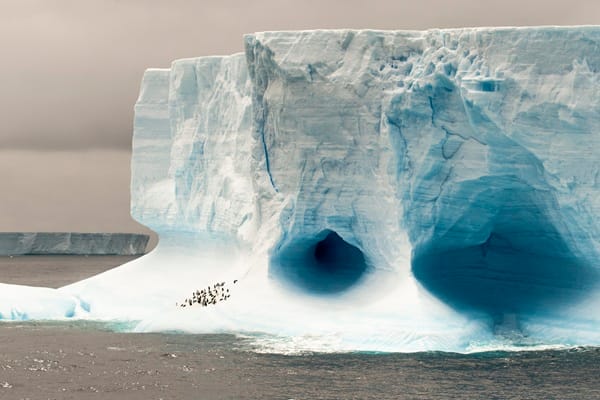
New modelling suggests Antarctica’s Thwaites Glacier could add 30mm to global sea levels by 2100, even without further warming, as hidden ocean currents accelerate melting beneath the ice.
Antarctica’s so-called “Doomsday Glacier” is disintegrating far faster than scientists had previously calculated, raising the prospect of substantially higher seas and greater coastal flooding even if global warming stops worsening, according to new research.
Thwaites Glacier, a vast expanse of ice roughly the size of Great Britain, could contribute up to 30mm to global sea-level rise by the end of the century, about twice previous projections, researchers from the University of California, Irvine and NASA’s Jet Propulsion Laboratory have estimated.
The revised forecast highlights how gaps in scientists’ understanding of the processes beneath the ice have left the world underestimating the risks posed by Antarctica’s rapidly changing glaciers.
Thwaites already accounts for about 4 per cent of global sea-level rise. Its complete collapse would raise oceans by more than two feet, while the wider destabilisation of the West Antarctic ice sheet it helps restrain could ultimately contribute to around 10 feet of sea-level rise, threatening coastal communities and infrastructure worldwide.
The immediate concern is that the glacier may be approaching a critical point at which its retreat becomes increasingly difficult to arrest.
The research, led by Mattia Poinelli, a project scientist at the University of California, Los Angeles, who conducted the work while at UC Irvine, focuses on a previously underestimated mechanism through which seawater penetrates beneath the glacier and melts it from below.
For decades, scientists modelled the boundary between grounded ice and the floating ice shelf as a relatively narrow, largely stationary line. Satellite observations have since revealed a much broader grounding zone, stretching several miles inland, where tidal movements repeatedly lift and lower the ice.
This process, known as tidal pumping, allows pressurised seawater — including relatively warm ocean water — to travel deep beneath the glacier, intensifying melting at its base.
Earlier models failed to capture the full extent of this mechanism, potentially understating how quickly Thwaites could lose its grip on the seabed.
“We have come to acknowledge a different arrangement beneath Earth’s major ocean-terminating glaciers,” Mr Poinelli said.
The implications extend beyond the amount of ice currently being lost. The new model identifies a 60 per cent probability that Thwaites will detach fully from Mouginot Ridge, one of two underwater formations that help anchor the glacier, before 2100.
Losing that support would leave the ice more exposed to retreat across a seabed that slopes downwards inland. As the glacier moves back into deeper terrain, increasing volumes of ice could become vulnerable to warm seawater, reinforcing a cycle of melting and retreat.
“Once that ridge is unpinned, the glacier will continually retreat across a predominantly retrograde seafloor towards its next topographic high, the South Ridge,” Mr Poinelli said.
Eric Rignot, professor of Earth system science at UC Irvine and a co-author of the study, said the revised model better captured the glacier’s observed losses and produced projections twice as large as earlier estimates.
“Most projections to date have struggled to match the rapidity of the mass loss because of missing physics,” he said. The updated findings, he added, pointed to greater exposure to coastal flooding in the coming decades.
The warning comes with an important qualification; the projected contribution of up to 30mm by 2100 is not a prediction that the entire glacier will collapse by then. The larger figures represent the potential consequences of a much broader destabilisation of the Antarctic ice sheet.
Researchers plan to return to Thwaites in 2028 to install instruments capable of measuring seawater movements beneath the ice directly, helping test the mechanisms incorporated into the new model.
But better monitoring will not undo the changes already under way. Even if emissions are cut immediately, Mr Rignot warned, the ocean will continue to feel the consequences of past warming.
“We can expect higher sea levels in the future resulting from the damage that has already been done.”


Leave a Comment