
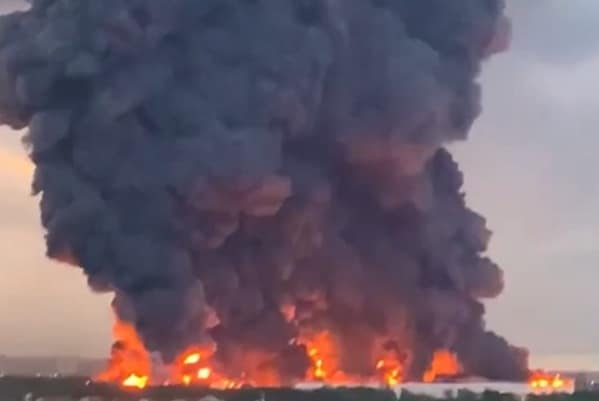
Ukraine intends to continue striking Russian oil refineries despite Donald Trump’s efforts to secure increased diesel supplies from Moscow, exposing a sharp divergence between Washington’s energy priorities and Kyiv’s strategy of degrading the infrastructure sustaining Russia’s war economy.
“We will burn [Russian] refineries,” a senior Ukrainian official told the Financial Times, dismissing US calls to halt attacks on Russian energy facilities.
The blunt declaration signals that Kyiv is unwilling to subordinate its campaign against Russia’s petroleum industry to a bilateral arrangement intended to increase fuel supplies and ease pressure on international markets.
The dispute centres on a fundamental question: whether Moscow can deliver the volumes of diesel promised by Trump while its refining industry struggles with repeated Ukrainian drone attacks, equipment shortages and emergency shutdowns.
Read more related news:
The machines taking the bullets: Ukraine deploys ground robots to rescue troops from Russia’s kill zone
Bodies on the road, profits on the table: Ukraine’s horror exposes the moral cost of negotiating with Putin
Sochi’s burning oil joke as Moscow says ‘no pollution’ as stricken ‘tanker has been liquidated’
Putin rejects peace receives diesel, Trump eases pressure and Ukraine get the bombs
Industry data cited by the Financial Times suggests Russian refineries are operating at about 60 per cent of installed capacity, reflecting the damage and operational disruption inflicted on the country’s downstream petroleum sector.
Michelle Brouhard, head of policy and geopolitical risk at energy intelligence firm Kpler, questioned whether Russia could meet the commitments announced by the White House.
“The biggest question for me is: where are they going to get the diesel from?” she said. “Russia does not have an export problem. It has a refining problem.”
The distinction is critical. Russia possesses substantial crude oil resources, but converting that crude into diesel requires functioning refineries, specialised equipment and reliable industrial operations. Disruptions at major processing facilities can constrain exports even when crude production remains available.
Ukraine has increasingly targeted this vulnerability, using long-range drones against refineries, distillation units, cracking facilities and storage infrastructure across European Russia and western Siberia. The attacks are designed to disrupt fuel production, complicate logistics and impose costs on an economy already committed to sustaining a prolonged war.
The consequences have extended beyond individual facilities. According to Kpler data cited by the Financial Times, Russia exported an average of 2.6mn tonnes of diesel by sea each month before 2025. Maritime shipments subsequently contracted sharply during 2026 as Ukrainian strikes damaged refining infrastructure.
In July, Moscow imposed restrictions on petroleum-product exports to protect domestic supplies and contain the risk of local shortages and inflation. With only limited exceptional consignments continuing, seaborne diesel exports have effectively ground to a halt, according to the report.
That contraction complicates Trump’s announcement that Russia would supply more than 300,000 tonnes of diesel immediately, followed by 500,000 tonnes in November and one million tonnes thereafter. The US president suggested deliveries could eventually reach three million tonnes, while acknowledging that volumes would depend on the condition of Russian refineries.
The commercial implications remain uncertain. Announced quantities are not the same as fuel physically available for delivery, and the timing, origin and practical arrangements for any shipments will determine whether the proposed deal can materially increase supplies.
The political stakes are nevertheless substantial. Trump has argued that Russian diesel deliveries, combined with US naval operations in the Strait of Hormuz, could help reduce fuel costs amid volatility associated with the US-Israeli conflict with Iran.
Following the announcement, the US Treasury Department issued a general licence authorising transactions involving Russian diesel through April 7, 2027.
The exemption came only three weeks after Trump signed the Lindsey O. Graham Sanctioning Russia and Iran Act of 2026 on September 18, legislation intended to expand statutory penalties targeting Russia’s energy, banking and defence sectors.
The sequence highlights the competing objectives confronting Washington: restricting the economic resources available to Moscow while seeking additional fuel supplies for international markets and relief for consumers facing elevated energy prices.
The United States has not imported Russian diesel since July 2022, following sanctions imposed after Russia’s full-scale invasion of Ukraine. Historically, American purchases represented only a limited outlet for Russian refined petroleum products. Kpler data cited by the Financial Times put average monthly volumes at about 77,000 tonnes during periods when US importers did buy Russian diesel, with a peak of 210,000 tonnes in January 2022.
Any renewed trade would therefore represent a policy shift, although its ultimate market impact would depend on the volumes delivered and the wider balance of global supply and demand.
For Kyiv, the concern is that easing restrictions could offer Moscow commercial relief while Washington simultaneously presses Ukraine to suspend attacks on the facilities constraining Russian fuel production.
Trump has repeatedly urged Ukrainian officials to stop striking Russian petroleum infrastructure, attributing high diesel prices to the attacks rather than to disruption in the Middle East. Moscow, meanwhile, has sought greater access to international markets, with Kremlin spokesman Dmitry Peskov previously arguing that Russian fuel could help lower global benchmarks if restrictions were removed.
Ukraine’s position reflects a different calculation. Refineries are not simply commercial assets: they form part of the industrial system that supplies transport, logistics and military operations. Disrupting them offers Kyiv a way to impose costs on a larger adversary without matching Russia’s conventional military capacity.
But the strategy also places Ukraine on a potential collision course with Washington’s efforts to manage energy prices and pursue a transactional relationship with Moscow.
The emerging confrontation is therefore about more than diesel. It exposes a strategic divide over the role of economic pressure in ending the war — and over whether the pursuit of cheaper energy should constrain Ukraine’s efforts to weaken the infrastructure supporting Russia’s military campaign.
For now, Kyiv has made its position clear. Whatever commercial commitments Moscow and Washington announce, Ukraine does not intend to abandon its refinery campaign. Whether Russia can deliver the promised fuel, meanwhile, remains an industrial question that diplomatic announcements alone cannot answer.


Leave a Comment