
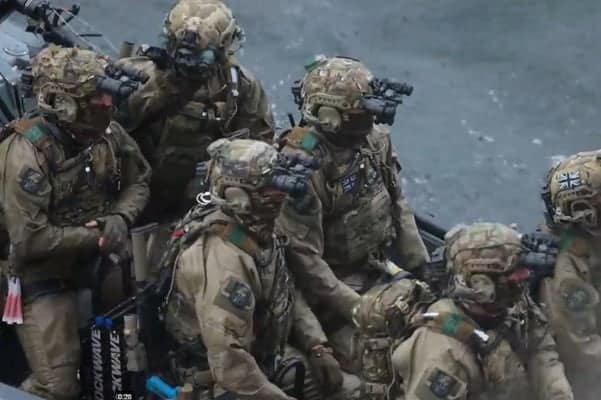
Britain has conducted its first land exercise on the Faroe Islands since the Second World War, deploying Royal Marines to the strategically important North Atlantic archipelago as concerns mount over Russia’s expanding activity across the High North.
Hundreds of British personnel from the Special Operations Maritime Task Group joined Danish forces for exercises in late September as part of Lion Protector, a wider multinational operation designed to strengthen the defence of critical infrastructure and maritime routes.
The drills included rehearsals for intercepting vessels linked to Russia’s so-called shadow fleet — civilian tankers used to transport sanctioned oil and generate revenue for Moscow’s war effort in Ukraine.
British forces also practised protecting undersea cables carrying energy and data between Britain and continental Europe, reflecting growing concern among European governments over the vulnerability of infrastructure beneath the North Atlantic and Baltic seas.
Wes Streeting, the Defence Secretary, said the exercises were intended to strengthen Britain and its allies’ ability to deter Russia.
The drills, conducted before a meeting of the Joint Expeditionary Force’s defence ministers in Keflavik, Iceland, come as the UK-led coalition increases its military presence across the North Atlantic, High North and Baltic region.
Streeting told the Telegraph: “The threat that Russia poses is manifesting itself publicly with increasing frequency, and we see that with the mapping of undersea cables.”
He pointed to what he described as “totally outrageous hostile action in Estonia, in Germany”, adding: “So the Russians are becoming more reckless and less discreet as they do so.”
The Defence Secretary said the British public needed to understand the scale of the potential threat.
“That should tell the public, who can’t always see everything we see in terms of Russia’s intentions and activity, the kind of risks that Russia is posing to us,” he said.
The Faroe Islands exercise carries particular historical significance. British forces last operated on land in the archipelago during the Second World War, when Britain occupied the islands in 1940 under Operation Valentine.
The latest drills included amphibious landings and vertical ascent training, designed to prepare troops for operations in difficult terrain and reinforce the ability of allied forces to move rapidly through strategically important territory.
The exercises also featured training on potential further interdictions of Russian shadow-fleet vessels.
Streeting said they involved “working together on exercising for further interdictions of Russian shadow fleet vessels”, suggesting that boarding operations against sanctioned tankers could become an increasingly important part of Britain’s maritime strategy.
In June, Royal Marines boarded and seized the shadow-fleet vessel Smyrtos in the English Channel.
The UK’s focus on the network has intensified as Russia seeks alternative methods of exporting oil and other commodities while circumventing western sanctions.
On Thursday, the Foreign Office accused the Kremlin of building a “dangerous new shadow fleet” to evade British sanctions. At least two 984ft liquefied natural gas tankers are already entering service this year, according to the government.
The wider Lion Protector operation began in August with a multinational maritime escort mission stretching across the Baltic Sea. A Danish vessel transported military equipment to Latvia, while Ukraine participated in the allied training programme for the first time.
The developments will be discussed at the JEF summit in Keflavik, where defence ministers from the coalition’s 10 northern European members are meeting alongside representatives from Ukraine and Canada.
Canada’s expected bid to join the UK-led grouping is also set to feature prominently.
For Britain, the exercises mark a shift towards a more persistent military presence in the northern approaches to Europe, where maritime trade, energy supplies and undersea communications increasingly intersect with the strategic competition between Russia and the west.
The Faroe Islands drills demonstrate that the UK and its allies are preparing not only for conventional military confrontation, but for a broader contest over the infrastructure and shipping networks underpinning Europe’s security.


Leave a Comment