
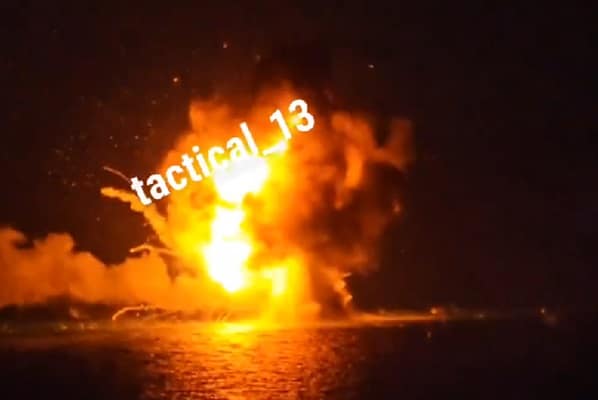
Ukraine has claimed a significant blow to Russian military logistics after a strike reportedly disabled a key transport route supporting forces in occupied Crimea, intensifying what has become a sustained campaign against Moscow’s rear supply lines.
According to Ukrainian military units, a precision overnight operation targeted infrastructure in Armiansk, striking what was described as the last intact bridge supporting Russian logistics flows into the peninsula.
The 1st Separate Assault Regiment named after Dmytro Kotsiubailo said the facility was hit during coordinated attacks involving multiple Ukrainian formations and special operations units.
Ukrainian forces said the bridge was rendered inoperable, with no further strikes required to complete its disablement. The claim could not be independently verified.
Read more related news:
Russia’s economy hit harder than expected by Ukraine’s long-range strikes
Russia’s rear comes under fire as Ukraine unleashes Flamingo missile strike wave
Mariupol port disabled by Alpha special forces in major blow to Putin’s war machine
Ukraine is preparing to take back and ‘isolate Crimea’ from Russia
At the time of the attack, Ukrainian sources said, up to 50 Russian trucks carrying ammunition and fuel were positioned near the site, reportedly preparing for redeployment towards front-line positions in the direction of Huliaipole.
If confirmed, the disruption would represent a further strain on Russia’s already contested supply network in southern Ukraine and occupied Crimea, where logistics routes have repeatedly come under attack from Ukrainian long-range systems.
Kyiv has increasingly focused on degrading Russian supply corridors rather than solely engaging front-line positions, reflecting a broader strategy aimed at reducing Moscow’s operational capacity through sustained disruption of fuel, ammunition and transport infrastructure.
In recent months, Ukrainian forces have intensified strikes on road and rail links connecting Russia to occupied territories, including the key southern corridor running along the Sea of Azov coast.
Ukrainian officials have previously described parts of this route as a “highway of death” due to repeated attacks on Russian convoys and reported shortages in protective air cover for logistical movements.
The reported strike in Armiansk forms part of what Kyiv says is a wider campaign to isolate Russian forces in Crimea and limit their ability to reinforce positions across southern Ukraine.
New footage has captured a massive blow dealt by Ukrainian forces to Russian logistics in Crimea, as they used FPV-2 and "Behemoth" drones to obliterate around 50 fuel and ammunition trucks.
The targeted strikes successfully hit key bridges near Armyansk, crippling the… pic.twitter.com/sc9T9kjEH8
— Kate from Kharkiv (@BohuslavskaKate) June 11, 2026
Ukrainian military statements also highlighted the involvement of coordinated multi-unit operations, including special forces and drone-enabled systems, which have become central to deep-strike capabilities behind Russian lines.
Officials in Kyiv have increasingly pointed to the role of advanced targeting systems, including AI-assisted navigation and reconnaissance tools, in enabling long-range strikes against infrastructure and military assets.
These systems, Ukrainian sources say, allow unmanned platforms to operate in environments where Russian electronic warfare is active, identifying targets and maintaining navigation even under heavy signal disruption.
Moscow has not yet commented on the reported strike, and battlefield claims from both sides cannot be independently verified.
However, the incident underscores the growing emphasis on infrastructure warfare in the conflict, as both Russia and Ukraine attempt to shape the battlefield far beyond immediate front-line contact zones.
Incredible Video of Ukrainian forces targeting the last remaining Armyansk bridge from Northern Crimea last night, which rendered it temporarily out of action. pic.twitter.com/7fqkihqdv4
— WarMonitor🇺🇦🇬🇧 (@WarMonitor3) June 11, 2026
For Russia, the vulnerability of supply lines into Crimea has long been a strategic concern, particularly as Ukrainian forces continue to target fixed crossings and alternative routes intended to bypass previously damaged infrastructure.
For Ukraine, the ability to disrupt those networks at range has become an increasingly central component of its wider military strategy.
As the war grinds on, the fight for logistics — not just territory — is emerging as one of its defining battlegrounds.


Leave a Comment