
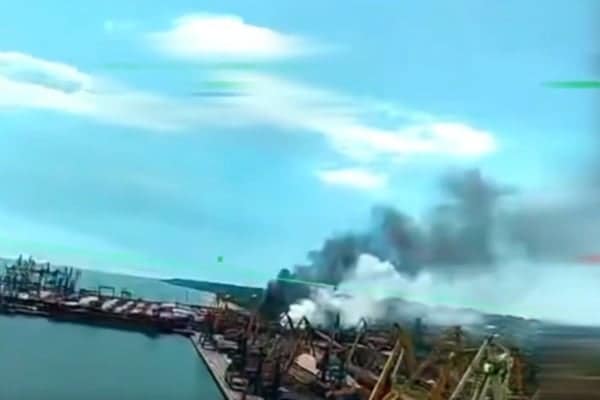
Ukraine has claimed to have disabled the Russian-occupied port of Mariupol in a major blow to Vladimir Putin’s military logistics network in southern Ukraine.
The National Guard’s 1st Azov Corps said a coordinated operation had left the strategically vital port without power after key infrastructure was destroyed in a precision strike.
Mariupol has served as one of Russia’s most important military supply hubs since its capture in 2022, linking occupied Donetsk, Crimea and southern Russian territory. The port has been used extensively to transport military equipment, ammunition and fuel to forces fighting on the southern front.
According to Ukrainian officials, the operation targeted electrical substations, radar installations, repair facilities, a control tower, fuel storage tanks and the cargo vessel Lady Augusta, which Kyiv claims is connected to Russia’s so-called shadow fleet.
The strike was carried out in conjunction with Ukraine’s Security Service (SBU), the elite Alpha special forces unit and the country’s Unmanned Systems Forces.
As a result, the port has reportedly been left largely inoperable, significantly disrupting Russia’s ability to move military supplies through one of its most valuable occupied territories.
The latest attack forms part of a broader Ukrainian campaign aimed at severing the Kremlin’s logistics routes across occupied southern Ukraine.
In recent months Kyiv has increasingly shifted its focus towards targeting supply lines, transport corridors and critical infrastructure supporting Russian operations.
Last month, the Azov Corps released footage showing reconnaissance and attack drones operating around Mariupol, signalling what commanders described as a renewed effort to contest Russian control of the city from the air.
The unit claimed its drones were capable of striking targets up to 100 miles behind the front line, dramatically extending Ukraine’s reach into occupied territory.
Ukrainian strike on Mariupol port. It significantly impacts Russia's ability to use the port in Russian-occupied Mariupol and will complicate the logistics of the Russian troops.
Electrical substations, radar equipment, repair infrastructure, a control tower and tanks with fuel… pic.twitter.com/ZqLuZJiXbH
— Anton Gerashchenko (@Gerashchenko_en) June 10, 2026
Additional footage released in late May appeared to show strikes along the Mariupol-Taganrog and Mariupol-Volnovakha highways, two major routes used by Russian forces to move troops and supplies.
Military analysts have increasingly highlighted the importance of Mariupol within Moscow’s so-called “land bridge” connecting Russia to occupied Crimea.
The city sits at the heart of a network of roads, railways and maritime routes that allow the Kremlin to sustain operations across southern Ukraine.
Any disruption to those routes risks placing additional strain on Russian forces already facing mounting pressure from Ukrainian drone attacks targeting fuel depots, ammunition dumps and transport infrastructure.
Mariupol became one of the defining battlegrounds of the war after enduring a devastating siege during the opening months of Russia’s full-scale invasion.
Azov are back in Mariupol, unimpeded. https://t.co/86naAgFnI5
— Shaun Pinner (@ShaunPinnerUA) June 10, 2026
Thousands of civilians were killed as Russian forces systematically destroyed large parts of the city before finally overwhelming Ukrainian defenders.
The last Ukrainian resistance centred on the Azovstal steel plant, where fighters from the Azov Brigade held out for weeks before eventually being ordered to surrender.
More than four years after the invasion began, Mariupol remains firmly under Russian control. However, Ukraine’s latest operation demonstrates that even deep inside occupied territory, Moscow’s military infrastructure remains vulnerable to increasingly sophisticated long-range attacks.
For Kyiv, disabling the port represents another step in a wider strategy aimed at isolating Russian forces and undermining the logistical networks that keep Putin’s war machine running.


Leave a Comment