
For those who follow the war closely, or live through it daily, Russia’s growing willingness to spill its war beyond the battlefield will come as little surprise.
Unable to secure decisive military breakthroughs, the Kremlin increasingly relies on intimidation, coercion and diplomatic pressure that are beginning to affect neighbouring states, international shipping and foreign missions.
Yesterday, warnings circulated of a potential large-scale attack on Kyiv, with intelligence sources indicating Russia may be preparing another major missile strike against Ukrainian cities within the next 48 hours.
Tu-95MS and Tu-160 strategic bombers were reportedly being readied alongside Iskander-M, Iskander-K and Zircon missile systems, while Russian frigates based in Novorossiysk were said to be undergoing preparations for combat operations.
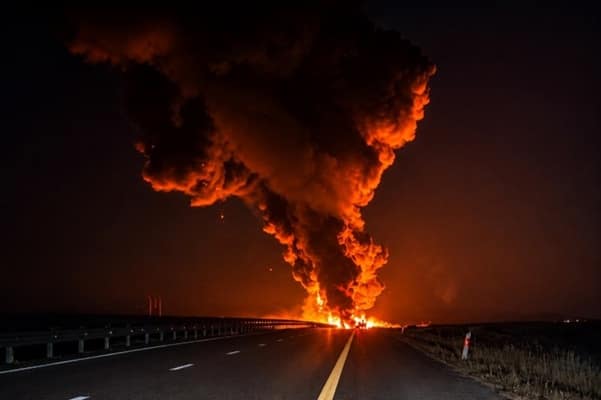
With that backdrop, this morning reports emerged of a Russian Shahed drone striking an apartment building in Romania, injuring civilians, also hours earlier, a Turkish-bound cargo vessel departing from Ukraine’s Odesa region was reportedly hit by a Russian drone attack, injuring crew members and setting the ship ablaze.
Read more related news:
Putin’s ‘quick win’ in Ukraine slips further into fantasy
NATO Article 5 in focus as Poland warns Russia over embassy strikes in Ukraine
Russia trapped in a war it cannot win or escape
Explosions rock NATO country as drone strikes apartment block in Europe injuring two
This week has also seen Russian officials and propagandists continue issuing threats towards diplomats and foreign representatives operating in Ukraine, prompting responses from both the European Union and the United States that diplomatic operations would continue unchanged and that it remained largely business as usual.
Taken together, these incidents paint a picture of a Kremlin growing more frustrated by developments on the battlefield and more willing to project pressure beyond Ukraine’s borders. Kyiv has increased pressure on Russia’s southern logistics routes and occupied Crimea, Moscow appears eager to demonstrate strength abroad at a time when strategic concerns are mounting at home.
The optics are becoming increasingly important for Vladimir Putin, recent public appearances have once again fuelled discussion about his leadership after he incorrectly referred to Kazakhstan’s President, Kassym-Jomart Tokayev, as “Semsjan Kamelievich” during a public event. While such moments are unlikely to alter Kremlin policy, they contribute to broader questions surrounding a Russian leadership facing mounting military, economic and political pressures as the war enters its fifth year, longer than the Soviet Union’s participation in what Russia calls the Great Patriotic War.
Putin couldn’t even pronounce the name of Kazakhstan’s President, Kassym-Jomart Tokayev, calling him “Semsjan Kamelievich.”
And it only adds fuel to the growing speculation that he’s losing his faculties. At this point, these public appearances are becoming not painful to watch.… pic.twitter.com/gyjGpb5OmU
— Shaun Pinner (@ShaunPinnerUA) May 28, 2026
For more than four years, Moscow has attempted to present its so-called “Special Military Operation” as a controlled and manageable conflict. Yet the strategic reality facing Russia today is considerably less favourable than the narrative promoted by the Kremlin, with the burden increasingly falling on ordinary Russians through casualties, economic strain and growing uncertainty.
Because nothing says a “three-day special military operation” is going to plan quite like entering its fifth year while fortifying the capital, deploying air defence systems across Moscow, enduring regular drone attacks and watching concerns over the war grow at home, while according to British intelligence assessments, Russian casualties have now exceeded 500,000 killed since the invasion began, a staggering figure for a war that was supposed to last days rather than years.
Which brings us to Crimea.
Because for Vladimir Putin, Crimea was never simply territory, it was the centrepiece of a political narrative, the symbol of a restored Russia and proof that the Kremlin could reshape Europe’s borders by force. If that narrative begins to unravel, the consequences could extend far beyond the battlefield.
Despite occupying significant territory, Russian forces remain locked in a grinding war of attrition. Casualties continue to mount, economic pressures are becoming more visible and Ukraine’s military has increasingly demonstrated an ability to strike Russian logistics, energy infrastructure and military facilities deep behind the front lines.
Nowhere is this pressure more significant than in southern Ukraine.

The land corridor connecting Russia to occupied Crimea has become one of the most strategically important pieces of terrain in the entire war. Stretching through occupied territories in southern Ukraine, it serves as a vital artery for Russian military logistics, troop movements and supplies flowing into Crimea and the southern front.
For Vladimir Putin, however, this corridor is more than a military objective, it is a political symbol.
Since illegally annexing Crimea in 2014, the Kremlin has repeatedly portrayed the peninsula as permanently Russian, secure and beyond challenge. The construction of the Kerch Bridge became the physical embodiment of that narrative, linking Crimea directly to Russia and showcasing what Moscow claimed was an irreversible geopolitical reality. It was Putin’s showcase project, intended to demonstrate that Crimea had been permanently absorbed into the Russian state.
Yet wars have a habit of exposing political myths.
As Ukrainian forces continue applying pressure against Russian logistics networks, rail infrastructure and supply routes across southern Ukraine, concerns are growing within Russian military circles about the long-term security of both Crimea and the corridor that sustains it. What was once presented as untouchable is increasingly being forced back into the realm of military reality.
Should Ukrainian operations significantly disrupt or sever sections of the southern land corridor, Crimea would once again become heavily dependent on the Kerch Bridge and maritime supply routes. Signs of that vulnerability are already beginning to emerge. Reports of fuel shortages have surfaced across parts of occupied Crimea, while the peninsula’s tourism sector is reportedly struggling to attract visitors as security concerns continue to grow.
Ukraine has already spent months targeting the infrastructure that supports these connections, including air defence systems, logistics hubs, fuel facilities and ferry crossings used to transport both military supplies and civilian traffic. The cumulative effect is increasing pressure on the networks that sustain Russia’s presence in occupied Crimea.
That reality would dramatically increase both the strategic importance and vulnerability of the Kerch Bridge itself.
The Kerch Bridge has already been struck multiple times during the war. While Russia has invested heavily in defending it, no defensive system is impenetrable. If the land corridor were placed under serious pressure, the bridge would inevitably become an even more critical military target.
This is where the implications extend far beyond military logistics. For Vladimir Putin, Crimea is not merely a piece of territory—it is the political centre of gravity underpinning much of the Kremlin’s narrative about the war. Any serious threat to Crimea could become a pivotal turning point in the conflict.
The Kremlin sold Crimea to the Russian public as a historic triumph and one of the central pillars of Putin’s domestic legitimacy and nationalist messaging. For more than a decade, Russians have been told that Crimea was safely and permanently returned to Russia, so if that perception begins to collapse, so too does much of the political justification for the war itself.
After years of fighting, hundreds of thousands of casualties and enormous economic costs, losing effective control over the very territory presented as the crown jewel of Russian expansionism would raise uncomfortable questions across Russian society. What was achieved? What was sacrificed? And was the price worth paying?
Four years of fighting, hundreds of thousands of casualties, enormous economic costs and growing international isolation, losing effective control over the very territory that was presented as the crown jewel of Russian expansionism would be politically devastating. The consequences would reverberate throughout Russian society, with questions that have largely been suppressed by state media becoming even harder to avoid.
History shows that military setbacks often become political crises when they expose the gap between propaganda and reality, the larger the myth, the greater the damage when it begins to unravel, and this helps explain why Russia’s behaviour is becoming increasingly aggressive beyond the battlefield itself. Strikes affecting international shipping, incidents involving NATO territory and threats directed towards diplomats are not indicators of confidence.
They are indicators of a state attempting to project strength while facing mounting strategic pressure, with escalation often being a sign of weakness rather than dominance.
Unable to achieve decisive battlefield victories, Moscow increasingly relies on intimidation, spectacle and psychological pressure to maintain the image of control. Yet such actions also carry significant risks, particularly when they affect foreign citizens, international trade routes and neighbouring countries.
In many ways, this is a familiar pattern. When strategic objectives become harder to achieve, attention is often redirected elsewhere. New threats emerge, new confrontations are created and new audiences are targeted. The Kremlin has long been adept at shifting attention away from setbacks and towards displays of strength, whether through diplomatic intimidation, attacks affecting international shipping or incidents beyond Ukraine’s borders, the message is designed to be seen far beyond the front line.
This war in Ukraine has never solely been about territory, but it has always been about narratives, legitimacy and power.
If Ukraine continues placing pressure on Russia’s southern logistics network and Crimea becomes increasingly vulnerable, the battlefield consequences may ultimately become even more political ones. Any future negotiations would place Ukraine in a far stronger position, while simultaneously increasing pressure on the Kremlin to explain the growing gap between its ambitions and reality.
For Vladimir Putin, losing Crimea would not simply represent a military setback, it would strike at the very foundation of the story he has spent more than a decade telling the Russian people.
If that moment comes, the consequences for Putin could prove far more dangerous than any battlefield defeat, and finally, the war could end.


Leave a Comment