
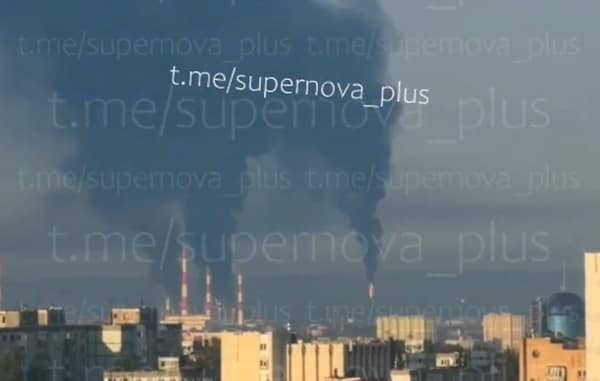
Volodymyr Zelensky has hailed a series of long-range Ukrainian strikes deep inside Russia after domestically produced missiles hit a key military factory more than 560 miles from the battlefield.
The overnight attacks targeted a drone and missile component plant, an oil refinery, fuel infrastructure and a sanctions-busting tanker used by Moscow’s shadow fleet, marking one of the most ambitious waves of Ukrainian strikes in recent months.
In a significant demonstration of Kyiv’s growing long-range capabilities, Mr Zelensky confirmed that Ukrainian-made FP-5 Flamingo missiles successfully struck a military manufacturing facility in Russia’s Chuvash Republic.
The target, located in the city of Cheboksary, approximately 900 kilometres from the front line, is involved in producing critical electronic components used across some of Russia’s most important weapons systems.
“Ukrainian FP-5 Flamingo missiles hit a military plant in Cheboksary that supplies the occupying army with components for drones and missiles,” the Ukrainian president announced.
The strike underlines Ukraine’s increasingly sophisticated ability to hit strategic targets deep within Russian territory despite Moscow’s extensive air defence network.
☀️ Morning greetings from the Ukrainian military, a Flamingo 🦩 in the sky over Chuvashia.
The Chuvash Republic lies in central Russia on the Volga River, roughly 1,000–1,200 km from the Ukrainian border pic.twitter.com/dA4m0zJgyL
— Shaun Pinner (@ShaunPinnerUA) June 10, 2026
Ukraine’s General Staff later identified the target as the VNIIR-Progress plant, a facility that produces satellite navigation receivers and specialised Kometa antennas.
The equipment is used extensively in Iranian-designed Shahed attack drones as well as Kalibr cruise missiles, Iskander-M ballistic missiles and guided aerial bombs deployed against Ukrainian cities and infrastructure.
Ukraine has already sanctioned the factory, the United States and the European Union because of its role in supporting Russia’s military-industrial complex.
Ukrainian military officials confirmed that a fire broke out at the facility following the strike.
Russian authorities acknowledged the attack and reported three injuries but sought to downplay the extent of the damage.
The missile strike formed part of a wider campaign against Russia’s military logistics and energy network.
Ukraine’s General Staff said forces also struck the Kuybyshev oil refinery in Samara Oblast, triggering another fire.
The refinery processes approximately 3.7 million tonnes of oil annually and produces fuel products used by both Russia’s military and wider industrial sectors.
Separately, Ukraine’s Security Service targeted two major oil pumping stations in Vladimir Oblast.
The Vtorovo and Lobkovo facilities play an important role in supplying fuel to the Moscow Ring Oil Product Pipeline and exporting petroleum products through Russia’s Baltic Sea ports.
According to Ukrainian intelligence, local authorities acknowledged fires at both sites following the attacks.
Satellite monitoring systems operated by NASA reportedly detected thermal anomalies consistent with fires in the vicinity of the facilities.
The strikes form part of a broader Ukrainian strategy aimed at disrupting Russia’s logistics networks across occupied southern Ukraine and Crimea.
Kyiv has intensified efforts in recent weeks to sever the so-called land corridor linking Russia with occupied Crimea, a route that remains critical for supplying troops and equipment.
Traffic on the strategically important Chonhar Bridge was suspended after a Ukrainian drone attack damaged the crossing connecting Crimea with the occupied parts of the Kherson region.
The bridge is one of several key transport arteries supporting Russian military operations in southern Ukraine.
Ukrainian special forces have also reportedly established drone dominance over sections of Russia’s supply routes into Crimea, increasing pressure on Moscow’s ability to sustain its forces on the peninsula.
Earlier strikes targeted an oil depot in occupied Crimea and fuel infrastructure supporting Russian operations across the region.
In another notable operation, Ukrainian forces reportedly damaged the tanker WEST Horizon in the Black Sea.
Overnight, Ukrainian drones layed waste to Russian refineries and defense sector targets all across Russia and Russian occupied Ukraine, again featuring Ukraine's homegrown cruise missile – the FP-7 – striking the "Progress" defense manufacturing facilities in Cheboksary, 1000km… pic.twitter.com/jFyLtiZsSe
— Jay in Kyiv (@JayinKyiv) June 10, 2026
The vessel forms part of Russia’s so-called shadow fleet, a network of ships used to circumvent Western sanctions and continue exporting Russian oil.
According to Ukraine’s General Staff, the attack damaged the tanker’s steering and propulsion systems.
Western governments have increasingly focused on disrupting the shadow fleet, which provides Moscow with billions of pounds in revenue despite international sanctions.
Moscow claimed its air defence systems intercepted 326 Ukrainian drones across 21 regions overnight.
The Russian Defence Ministry said drones had been destroyed over occupied Crimea, the Black Sea and multiple regions inside Russia.
Notably, however, Chuvashia — where the missile strike on the military factory occurred — was absent from the ministry’s official list.
The omission has fuelled speculation that Russian authorities may be attempting to minimise attention on the successful strike.
The latest attacks highlight a significant evolution in Ukraine’s military strategy.
Unable to match Russia’s advantages in workforce and conventional firepower, Kyiv has increasingly relied on long-range missiles, drones and special operations to strike critical infrastructure far beyond the front lines.
Recent targets have included oil terminals, airfields, logistics hubs, ammunition depots and military factories stretching from occupied Crimea to the outskirts of St Petersburg.
The campaign is designed to impose costs on Russia’s war machine, disrupt supply chains and force the Kremlin to divert resources towards defending territory previously considered beyond Ukraine’s reach.
For Moscow, the strikes represent an increasingly uncomfortable reality: nowhere inside Russia can now be considered entirely beyond the range of Ukrainian weapons.


Leave a Comment