
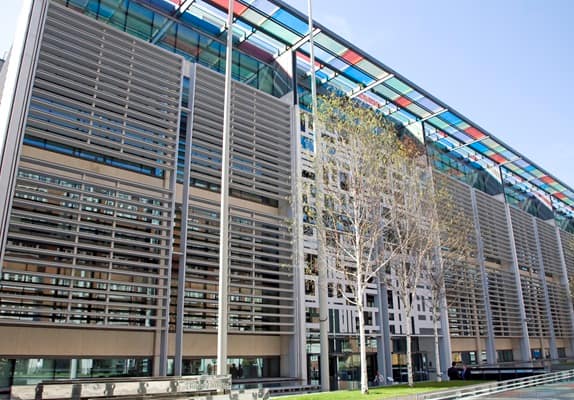
The discovery of a hidden camera inside a Whitehall building housing two major Government departments has triggered fresh questions about security at the heart of the British state, amid mounting controversy over Labour’s approval of China’s proposed mega-embassy in London.
The device, described by officials as a “secret spy camera”, was discovered within a suite of offices occupied by civil servants from both the Home Office and the Ministry of Housing, Communities and Local Government (MHCLG). Security services were subsequently informed, according to reports.
While there is currently no evidence linking the camera to any foreign state, nor any suggestion that Chinese or Russian actors were responsible, the timing of the discovery could hardly be more politically sensitive.
The building in question played a role in the planning process that ultimately approved Beijing’s controversial new diplomatic complex at the former Royal Mint site in east London – a project that has sparked months of fierce debate over national security risks and Britain’s increasingly complex relationship with China.
What should perhaps concern ministers most is not necessarily who placed the device, but that nobody appears to know.
Questions remain unanswered about how long the camera was present, what it recorded and whether any sensitive conversations were captured. The fact that such a device could apparently be installed within a Government office complex without immediate detection is likely to alarm both security officials and MPs alike.
For critics of Labour’s China policy, the episode reinforces wider concerns that Whitehall has failed to take emerging security threats seriously enough.
The Chinese mega-embassy proposal has become one of the most divisive foreign policy decisions of Sir Keir Starmer’s premiership.
The development, set to become China’s largest diplomatic mission in Europe, was approved earlier this year despite warnings from politicians across the political spectrum, security experts and campaign groups.
Opponents have repeatedly pointed to the site’s proximity to critical communications infrastructure, including fibre-optic cables carrying vast quantities of financial and commercial data through the City of London.
Communities Secretary Steve Reed dismissed such concerns as “scare-mongering” when granting approval for the project, arguing that national security agencies had raised no formal objections during the planning process.
Yet the discovery of a hidden surveillance device within a Government building connected to that very decision is unlikely to reassure sceptics.
Alex Burghart, the Shadow Chancellor of the Duchy of Lancaster, has demanded urgent answers.
His intervention reflects growing frustration among Conservatives who argue that Labour has displayed a worrying degree of complacency towards security vulnerabilities.
The issue is particularly sensitive because Britain has spent recent years repeatedly warning about hostile state activity.
Successive intelligence reports have highlighted concerns over foreign espionage, cyber attacks and influence operations directed at British institutions.
Only last week, the Five Eyes intelligence alliance warned that Chinese operatives were allegedly using fake online job advertisements to target serving and former Government officials in an attempt to obtain sensitive information.
Against that backdrop, the discovery of an unexplained recording device inside a Government office complex inevitably raises uncomfortable questions.
Civil servants reportedly reacted with shock when the device was found, with some fearing they may have been monitored for weeks or months without their knowledge.
Even if investigators ultimately conclude the camera was unrelated to espionage, the incident exposes potential weaknesses in Whitehall’s physical security arrangements.
The episode also threatens to reignite broader concerns about Britain’s preparedness for an era of increasingly sophisticated intelligence operations.
Modern espionage rarely resembles the Cold War stereotypes of trench coats and dead-letter drops. Instead, it often involves digital surveillance, data collection and the exploitation of seemingly mundane vulnerabilities.
A hidden camera placed in a communal office area may appear minor compared with cyber intrusions or state-sponsored hacking campaigns. Yet intelligence professionals have long warned that adversaries frequently exploit the weakest point in any system.
For ministers, the political problem is straightforward.
At a time when Labour is defending a controversial China policy and insisting that national security concerns are being taken seriously, the discovery of a covert recording device inside a Government building creates precisely the sort of optics Downing Street would rather avoid.
The public may never learn who placed the camera or what its purpose was.
But until those questions are answered, ministers will struggle to convince critics that Britain’s security apparatus is fully in control of what is happening inside its own walls.


Leave a Comment