
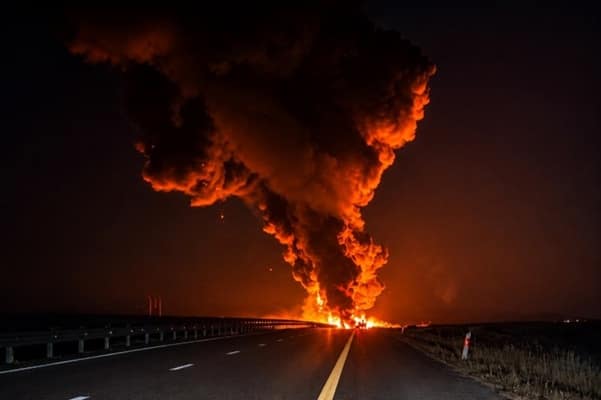
Vladimir Putin’s prized Crimean stronghold is showing fresh signs of strain after reports emerged of food shortages, rationing and supply disruptions across the occupied peninsula following a sustained Ukrainian campaign against Russian logistics networks.
For more than a decade, Moscow has portrayed Crimea as the jewel in the crown of its territorial ambitions, presenting the peninsula as both a symbol of Russian resurgence and an untouchable military bastion projecting power across the Black Sea.
Yet evidence is mounting that Ukraine’s increasingly sophisticated drone and missile campaign is beginning to expose vulnerabilities that many in the Kremlin believed had long been secured, the Kyiv Independent reported.
According to Ukraine’s National Resistance Center, residents across occupied Crimea are experiencing growing difficulties obtaining essential goods, with supplies of staple food products reportedly falling sharply in recent weeks.
The agency said shortages of sugar, flour, grains, salt and pasta have become increasingly common as Ukrainian strikes disrupt key transport routes linking the peninsula to mainland Russia.
While wartime shortages are not uncommon in occupied territories, the reports are significant because they suggest Ukraine’s strategy of targeting logistics infrastructure is beginning to have consequences far beyond the battlefield.
For months, Ukrainian commanders have increasingly prioritised attacks on what military planners refer to as the “land bridge” — the network of roads, railways, fuel depots and supply hubs connecting Crimea to Russian-occupied territory in southern Ukraine.
Rather than focusing solely on front-line positions, Kyiv has sought to weaken the foundations that sustain Russian military operations.
⛽ Crimea Faces Fuel Shortages as Food Rationing Measures Begin
Reports from opposition media and Russian public channels indicate that parts of occupied Crimea are experiencing growing supply disruptions, with some retailers in Sevastopol limiting purchases of certain products… pic.twitter.com/m3RVUZ8nZZ
— 🇺🇦 Ukraine Frontline_Daily (@ukraine_frontup) June 6, 2026
The logic is straightforward.
Armies can only fight if they can be supplied.
And nowhere is that more important than Crimea.
The peninsula has become one of Russia’s most critical military hubs since the full-scale invasion began in 2022.
It hosts airbases, naval facilities, ammunition depots and command centres that support operations across southern Ukraine and the Black Sea.
Maintaining a steady flow of fuel, food and military equipment into Crimea is therefore essential for Moscow’s wider war effort.
The latest reports suggest that task is becoming increasingly difficult.
Crimean Wind, a local monitoring channel, reported that the PUD retail chain has imposed restrictions on purchases of key household products, including flour, pasta, butter and bottled water.
If you’re choosing to vacation in occupied Crimea, then you’re making a very poor decision.
Russian tourists arriving by car are already reporting severe difficulties leaving the peninsula as fuel shortages and restrictions continue to bite.
At the same time, Ukraine is… pic.twitter.com/EC66n8nTAL
— Shaun Pinner (@ShaunPinnerUA) June 8, 2026
Separate footage shared by Petro Andriushchenko, head of Ukraine’s Center for the Study of Occupation, appeared to show stores limiting customers to three bottles of vegetable oil and three packets of pasta each.
The scenes have drawn comparisons with the fuel rationing measures introduced by Russian-installed authorities only days earlier.
At the end of May, occupation officials moved to limit fuel sales after Ukrainian strikes reportedly disrupted deliveries into the peninsula. What began as a fuel problem now appears to be spreading into wider supply chains. The shortages come at a particularly awkward moment for the Kremlin.
Russia continues to insist that Crimea is permanently integrated into the Russian Federation and beyond Ukraine’s reach. Yet the repeated attacks on military infrastructure, transport links and supply corridors tell a different story. The Kerch Bridge remains vulnerable. Rail networks have repeatedly been targeted. Fuel depots have been struck. Military airfields have suffered repeated attacks.
And now reports suggest ordinary residents are beginning to feel the effects as well. Military analysts have long argued that logistics often determine the outcome of wars more than battlefield heroics. History is filled with examples of armies that possessed superior numbers and firepower but were ultimately undermined by overstretched supply networks. Ukraine’s campaign appears designed to exploit precisely that vulnerability.
Insane video of Ukrainian drones targeting and severely damaging the crucial Chongar Bridge connecting Crimea with the southern frontline.
There are basically 3 road tha lead to Crimea, one destroyed, second under drone control, 3rd is Crimean bridge where lines are up to 6h one… https://t.co/cUhZ3pnaNS pic.twitter.com/1kR4c6NYc3
— Ukraine News 🇺🇦 (@Ukrainene) June 7, 2026
Rather than attempting costly frontal assaults against heavily fortified positions, Kyiv has increasingly sought to make Russian occupation economically and logistically unsustainable. The strategy also carries a psychological dimension. For years, the Kremlin has marketed Crimea as secure, prosperous and irrevocably Russian. Shortages on supermarket shelves risk undermining that narrative. Residents may tolerate military activity occurring in the distance.
They are less likely to ignore restrictions on food, fuel and household essentials. The pressure is being compounded by demographic changes. Ukrainian officials claim that Russia has relocated large numbers of military personnel, construction workers and migrants to Crimea since the start of the war. While intended to strengthen Moscow’s hold on the peninsula, the influx has simultaneously increased demand for goods and services.
As supply routes come under growing strain, those additional pressures become harder to manage. The development also coincides with a broader shift in the war. Across much of 2025 and into 2026, Ukraine has intensified long-range strikes against Russian military infrastructure far behind the front lines. Drone attacks have reached deep into Russian territory, targeting airfields, ammunition depots, oil facilities and transport hubs.
Crimea has increasingly found itself at the centre of that campaign. For Kyiv, the objective extends beyond symbolic attacks. The goal is to steadily degrade Russia’s ability to sustain its occupation and conduct military operations. The reports of shortages do not suggest Crimea is facing an immediate humanitarian crisis. But they do point to a deeper trend.
Every fuel shortage, every disrupted shipment and every rationed supermarket shelf represents another sign that Ukraine’s strategy is imposing costs on Moscow far beyond the battlefield. More than two years after Putin declared Crimea untouchable, the peninsula appears increasingly exposed. And as Ukrainian pressure on Russian logistics intensifies, the Kremlin may discover that holding Crimea is becoming far more difficult than seizing it.


Leave a Comment