
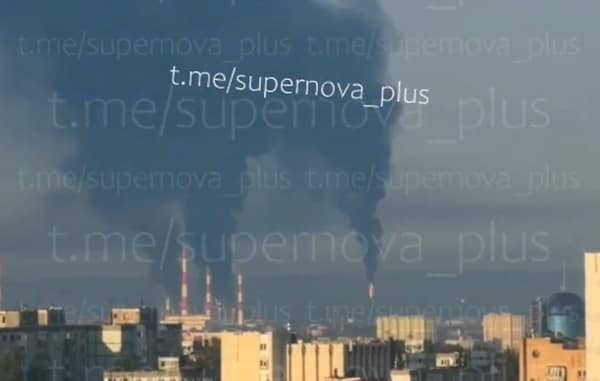
Ukraine has carried out one of its most significant long-range strike packages of the war, launching domestically produced FP-5 “Flamingo” cruise missiles and drones against military-industrial and energy infrastructure deep inside Russia.
Among the reported targets was the VNIIR-Progress facility in Cheboksary, more than 900 kilometres from the front line.
The plant produces navigation and guidance components for Russian drones, missiles, and electronic warfare systems.
officials also reported strikes against energy infrastructure in the Samara region, including facilities linked to Russia’s oil refining network. Russian authorities acknowledged attacks in several regions and temporary disruptions to industrial operations.
☀️ Morning greetings from the Ukrainian military, a Flamingo 🦩 in the sky over Chuvashia.
The Chuvash Republic lies in central Russia on the Volga River, roughly 1,000–1,200 km from the Ukrainian border pic.twitter.com/dA4m0zJgyL
— Shaun Pinner (@ShaunPinnerUA) June 10, 2026
President Volodymyr Zelensky confirmed the use of Flamingo cruise missiles, describing the attacks as part of Ukraine’s ongoing long-range campaign against facilities supporting Moscow’s war effort.
“Our long-range sanctions continue to operate quite fairly in response to Russian strikes,” Zelensky said following earlier Flamingo operations, adding that Russia must eventually “feel” the consequences of the war it continues to wage against Ukraine.
The strikes form part of a broader Ukrainian strategy that has accelerated throughout 2026. Rather than focusing exclusively on frontline engagements, Kyiv has increasingly sought to raise the cost of the war for the Kremlin by targeting the infrastructure that enables it.
Oil refineries, fuel depots, military production facilities, rail networks, ammunition storage sites and logistics hubs have all come under growing pressure.
This week’s attacks are particularly significant because they fit into a much larger pattern.
Russia has spent more than four years attempting to consolidate what are arguably Vladimir Putin’s only meaningful territorial gains since launching the full-scale invasion in February 2022. While Moscow failed to seize Kyiv, failed to topple the Ukrainian government and failed to break Ukrainian resistance, it did establish one strategic prize that became central to its entire war effort: the southern land corridor linking Russia to occupied Crimea.
Today, that corridor is under increasing pressure.
The southern route stretches through occupied Mariupol, Berdyansk and Melitopol before connecting to Crimea. Since repeated attacks on the Kerch Bridge, it has become increasingly important for transporting fuel, ammunition, personnel and military equipment between Russia and occupied territories.
Recent reports from Ukrainian partisan networks have suggested Russian troops may be withdrawing from some positions on the Kinburn Peninsula following sustained Ukrainian pressure. Such claims should always be treated cautiously until independently verified, but they highlight a broader challenge facing Moscow.
The issue is no longer simply holding territory.
It is sustaining it.
The more pressure Ukraine places on the southern corridor, the greater Russia’s dependence on the Kerch Bridge becomes. That dependence creates a strategic dilemma for the Kremlin. If one logistics artery becomes increasingly vulnerable, the importance and exposure of the other grows accordingly.
Ukraine appears to understand this well.
Long-range drones, missile strikes, partisan activity, attacks on locomotives, fuel infrastructure and military-industrial facilities increasingly form part of the same campaign. Recent attacks against railway assets in Bryansk, fuel infrastructure in Crimea and energy facilities inside Russia all point toward an effort to make sustaining the war progressively more expensive and more difficult.
Military history repeatedly demonstrates that armies rarely collapse because they lose a single battle. More often they begin to fail when logistics break down and confidence erodes.
The old military adage that “amateurs talk tactics, professionals talk logistics” has rarely felt more relevant.
For the Kremlin, the challenge is growing.
Every air defence system deployed to protect Crimea is one unavailable elsewhere. Every refinery forced offline affects fuel production and distribution. Every railway disruption creates delays that ripple across an already stretched military network.
The military consequences are significant.
The political consequences may prove even greater.
For years, Russian state media has presented Crimea as a settled issue and one of Putin’s defining achievements. An entire narrative has been built around the permanence of Russian control. Yet if the routes connecting Crimea to mainland Russia become increasingly unreliable, the image of stability Moscow has spent years cultivating begins to crack.
That creates questions the Kremlin desperately wants to avoid.
After more than four years of war, well over a million casualties, mounting economic strain and no decisive victory, Russian soldiers and civilians alike may increasingly begin asking what those sacrifices have achieved.
The most dangerous question for the Kremlin is not coming from Kyiv.
It is the one Russian soldiers may eventually ask themselves:
“Why are we still here?”
There is also an irony that Moscow can scarcely ignore.
The war that effectively began with the seizure of Crimea in 2014 may one day be decided there as well. What Putin once presented as his greatest geopolitical achievement could yet become one of his greatest strategic vulnerabilities.
For now, Ukraine’s Flamingo missiles, drones and long-range strike campaign continue to push that pressure deeper into Russia itself.
Having spent the last week in Kyiv, the contrast has been noticeable. Despite the growing intensity of Ukrainian strikes inside Russia, the capital has experienced a relatively quiet period compared with many of the mass attack packages seen in recent months.
History suggests that may not last.
For Ukraine, and for those of us living here, we now wait to see what is almost certainly an inevitable Russian response.


Leave a Comment