
For generations, Britain’s defence strategy has rested upon a simple assumption.
When the moment of crisis arrives, America will be there.
Its aircraft carriers will sail. Its fighter jets will deploy. Its surveillance aircraft will watch the skies and its logistical network will sustain allied operations. That assumption is now under unprecedented strain.
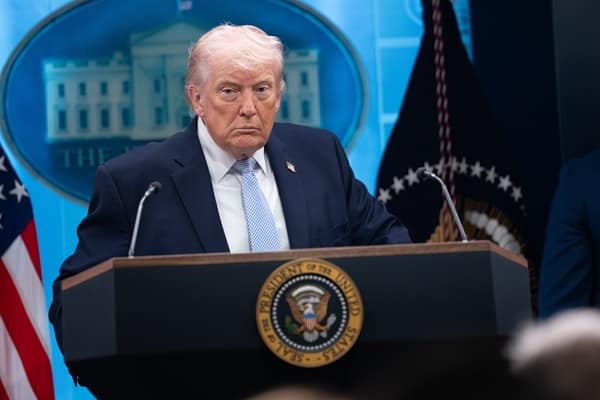
Reports that Donald Trump’s administration intends to reduce key military assets stationed in Europe should send shockwaves through defence ministries across the continent. The proposed withdrawal of fighter aircraft, aerial refuelling tankers, surveillance platforms and naval assets represents more than a routine force restructuring. It is a warning.
Washington’s message is becoming increasingly clear: Europe must take greater responsibility for its own defence.
The problem for Britain is that this message arrives at precisely the moment when confidence in the nation’s military preparedness is being openly questioned. The resignations of Defence Secretary John Healey and Armed Forces minister Al Carns have exposed a deep unease at the heart of Government. Both men left office issuing remarkably similar warnings.
Healey argued that the Government had failed to provide sufficient resources for the threats Britain now faces. Carns went further, accusing ministers of asking the Armed Forces to operate in a more dangerous world using budgets designed for a more peaceful age. Neither criticism came from political opponents.
Both came from men entrusted with overseeing Britain’s defence. That makes them difficult to dismiss. The strategic backdrop is sobering. Russia continues to expand military infrastructure along Nato’s borders. Moscow is rebuilding formations damaged in Ukraine while simultaneously increasing defence production. Across Europe, nations are accelerating rearmament programmes on a scale not witnessed since the Cold War.
The Baltic states are fortifying their borders. Poland is building one of Europe’s largest land armies. Germany has abandoned decades of military caution. Even traditionally neutral nations have fundamentally altered their security posture. Britain, by contrast, remains trapped in an argument about affordability. That debate may soon become irrelevant.
If the United States reduces its military presence in Europe, the capability gap will not simply disappear. Someone must provide the aircraft, the intelligence, the naval power and the deterrent effect that America currently supplies. Europe cannot outsource its security indefinitely.
For decades Britain has prided itself on being Nato’s leading European military power. British forces have fought alongside the United States from the Balkans to Afghanistan, from Iraq to the campaign against Islamic State. That reputation carries expectations. Yet reputation alone does not deter adversaries. Capabilities do. Military leaders have repeatedly warned that stockpiles are under pressure, recruitment remains challenging and procurement programmes continue to move too slowly for an increasingly unstable world.
The war in Ukraine has demonstrated how quickly modern conflict consumes ammunition, equipment and manpower. It has also exposed the importance of industrial capacity and sustained investment. Wars are not won by rhetoric. They are won by preparation. This is why the Defence Investment Plan matters so profoundly. The issue is no longer simply how much Britain spends. It is whether the Government has grasped the scale of the strategic shift taking place around it. The post-Cold War era is ending.
American patience with European underinvestment is wearing thin. Russia is becoming more aggressive. China is becoming more assertive. The international order that allowed Western governments to enjoy a peace dividend is rapidly disappearing. Defence can no longer be treated as a discretionary item on the Treasury’s balance sheet. It is the foundation upon which every other national ambition rests.
Without security there is no prosperity. Without deterrence there is no stability. The uncomfortable reality is that Britain may be entering an era where American support can no longer be assumed.
If that proves true, the debate about defence spending is over. The only question that remains is whether Britain chooses to rearm before events force its hand.


Leave a Comment