
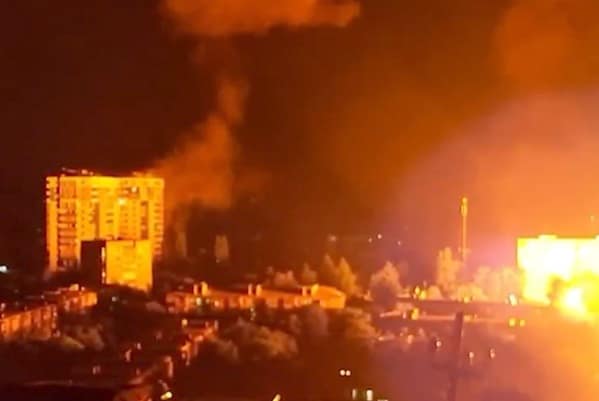
A reported Ukrainian strike on a Russian electronics factory supplying components for advanced weapons has intensified pressure on Vladimir Putin’s war machine, as drone attacks disrupted Moscow’s airports and Kyiv celebrated the restoration of vital Starlink connectivity to its front lines.
Ukraine has struck a Russian industrial facility producing electronic components potentially used in Moscow’s weapons systems, according to reports, in a fresh demonstration of Kyiv’s campaign to disrupt the supply chains sustaining Russia’s invasion.
The attack targeted the main production building of Proton-Electrotex in the Russian city of Orel, with Ukrainian officials confirming the strike and saying it would complicate the manufacture of components used in weapons fired at Ukrainian cities.
The Sun reported that British-supplied Storm Shadow missiles were used in the attack, although the Ukrainian General Staff’s statement did not independently confirm the weapon involved.
“This complicates the production of components for cruise and ballistic missiles, with which the enemy hits Ukrainian cities,” Ukraine’s General Staff said.
Read more related news:
‘Putin will return only if Ukraine yields Donbas’ as Zelensky warns of wider Russian advance
‘The bone came out of the skin’: Soldier’s horrific ordeal in Russian kill zone ends in daring drone escape
Al Carns warns ‘drones are changing the way we fight’ an fears UK is falling behind
Brits warned ‘we have a little over 1,000 days’ to prepare for war with Russia
The facility manufactures semiconductor devices, LEDs and electronic components for industrial and specialised equipment. Reports have linked its products to Russian weapons systems including the S-71 Kover cruise missile, the 9M723 Iskander-M ballistic missile and the Pantsir-S1 air defence system.
Local residents reported hearing at least four explosions, according to the Russian investigative outlet ASTRA.
The reported strike represents a potentially significant blow to a sector of Russia’s military-industrial base that supplies components for weapons used against Ukraine. However, the precise extent of the damage and its impact on Russian production were not immediately established.
The attack came amid a broader intensification of Ukrainian long-range operations against targets inside Russia, as Kyiv seeks to impose costs on the military infrastructure supporting Moscow’s war.
The pressure extended to the Russian capital on October 23, when civilian flights at all four of Moscow’s main airports were temporarily suspended amid a Ukrainian drone raid, according to local authorities.
Russia’s civil aviation authority, Rosaviatsiya, announced restrictions on arrivals and departures at Sheremetyevo, Domodedovo, Vnukovo and Zhukovsky at 2.05pm local time.
At Sheremetyevo, Moscow’s largest airport, an air alert was sounded and waiting passengers were advised to take shelter.
An evacuation was also reported at the IQ-quarter skyscraper in the Moscow City business district, which houses offices belonging to several Russian government ministries, including those responsible for digital development, economic development, and industry and trade.
Russian state news agency TASS subsequently reported, citing emergency services, that the alarm at the skyscraper had been false.
Temporary airport closures have become increasingly common as Ukrainian drones reach deeper into Russian territory during the full-scale war. The disruption illustrates how attacks far from the front line can affect civilian transport and expose the difficulties facing Russian authorities in protecting major population centres and critical infrastructure.
In September, Ukrainian President Volodymyr Zelensky warned airlines, insurers and foreign governments that Russian airspace was becoming increasingly dangerous because of drone attacks.
“Today we want to warn every airline that uses Russian airspace, every insurer, everyone who still uses key Russian airports — Russian skies are becoming completely dangerous,” he said.
“Although the Russian authorities do not report this as it should, the Russian sky will de facto be closed.”
Russian President Vladimir Putin, meanwhile, has accused Kyiv of “state terrorism”, while Ukraine has argued that its operations target Russian military capabilities and infrastructure supporting the invasion.
Kyiv also secured a significant operational reprieve on October 24, when Zelensky announced that Starlink and its military counterpart, Starshield, had returned to their previous operating speeds following restrictions that had disrupted Ukrainian operations.
The satellite systems support communications, frontline logistics and drone-related activities, making their availability an important factor in Ukraine’s battlefield effectiveness.
“The most important thing today is that Starlink and Starshield operations have been restored to the speeds we had before the restrictions,” Zelensky wrote on X. “The speeds are now where they need to be.”
He said the restoration had begun overnight, with performance sufficient by the following morning to support frontline logistics and the defence of Ukraine against jet-powered Shahed drones.
“I thank all Americans and all our partners who took this seriously and truly helped – members of Congress, senators, all the media, the State Department, and the President,” he added. “Protecting lives matters.”
The restoration followed discussions involving Zelensky, Starlink owner Elon Musk and US President Donald Trump after the restrictions prompted concerns over their effects on Ukrainian military operations.
The episode exposed the strategic importance — and potential vulnerability — of Ukraine’s reliance on communications infrastructure operated by a private company.
Taken together, the reported strike on Proton-Electrotex, the disruption to Moscow’s airports and the restoration of satellite connectivity highlight the competing pressures shaping the conflict: Ukraine is seeking to undermine Russia’s ability to manufacture and deploy weapons, while preserving the technological systems on which its own defence increasingly depends.
For Moscow, the challenge is to protect military production and infrastructure far beyond the front line. For Kyiv, the task is to sustain its ability to strike Russian targets while ensuring that disruptions to critical communications do not undermine operations at home.


Leave a Comment