
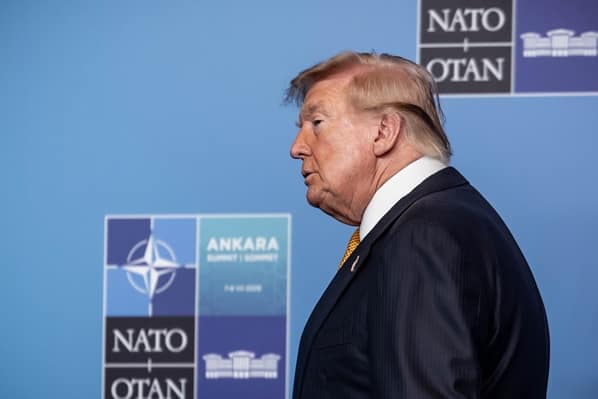
Donald Trump has indicated that the US could reconsider its position on the Falkland Islands, raising the prospect of a new strain on the UK-US “special relationship” as Washington presses Britain to increase defence spending.
Asked at the White House about his stance on the sovereignty of the South Atlantic islands, Trump told reporters: “I always review every position – that’s just one of many.”
The Falkland Islands are a British Overseas Territory, although Argentina has long disputed British sovereignty and continues to assert a claim over the archipelago. Argentina’s president is also a close ally of Trump.
The sovereignty dispute previously escalated into armed conflict in 1982, when Argentina invaded the islands, prompting Britain to launch a military operation to retake them. The 74-day war ended with an Argentine surrender.
The US currently maintains a neutral position on the question of sovereignty.
Trump’s latest comments have nevertheless raised concerns that Washington could use the Falklands dispute as leverage in negotiations with Britain’s new Labour government over defence spending and NATO burden-sharing.
A US official told the Telegraph last week that the White House could reconsider its position on the Falklands — known as the Islas Malvinas in Argentina — if Britain fails to meet Trump’s demand for minimum defence spending equivalent to 5 per cent of GDP.
Such a move would mark a significant shift in the diplomatic dynamics surrounding the islands and could put additional pressure on London as it attempts to balance higher defence commitments against competing demands on public spending.
The British government reiterated its position at the weekend, stressing its “long-standing and unwavering” commitment to maintaining the islands as a British Overseas Territory.
A spokesperson said, as per the Independent: “The UK is playing a central role in NATO and strengthening collective defence across Europe. We are NATO’s third-largest cash spender on defence and the only European NATO member to commit our nuclear deterrent to the alliance.”
The dispute has already surfaced in discussions within the US administration.
In April, a leaked internal Pentagon email appeared to suggest that Washington could withdraw its support for Britain’s position on the Falklands as a punitive measure over what it regarded as insufficient British support for the US offensive against Iran.
The latest comments suggest the issue has not been entirely removed from the White House’s wider calculations over allied defence contributions.
For London, the potential shift would be particularly sensitive. Britain regards sovereignty over the Falklands as settled following the 1982 conflict and has repeatedly rejected Argentina’s territorial claim.
For Washington, meanwhile, any formal change in its longstanding approach would carry implications beyond the South Atlantic, potentially signalling that established positions on territorial disputes could become part of negotiations over defence spending and alliance commitments.
The prospect comes as Trump continues to demand that US allies shoulder a greater proportion of the cost of collective defence. Britain is already under pressure to accelerate increases in military spending, while the government has committed to setting out a longer-term path towards higher NATO spending.
Any attempt to link the Falklands directly to that debate would therefore put the UK government in an unusually difficult position, testing both its defence commitments and one of its most important international relationships.


Leave a Comment